




|
Getting your Trinity Audio player ready...
|
Edited by: TJVNews.com
In an unprecedented legal showdown between academia and the federal government, Harvard University — the world’s wealthiest and arguably most prestigious institution of higher learning — filed a lawsuit on Monday against the Trump administration, protesting what it calls an “unlawful and politically motivated” threat to slash billions in federal funding. The allocations from the government are earmarked for research projects, including those focusing on tuberculosis, amyotrophic lateral sclerosis (ALS), and radiation poisoning.
The New York Times reported that this legal action represents the latest and most significant escalation in a deepening conflict between elite universities and President Trump’s agenda to “reclaim” higher education from ideological capture and moral decay.
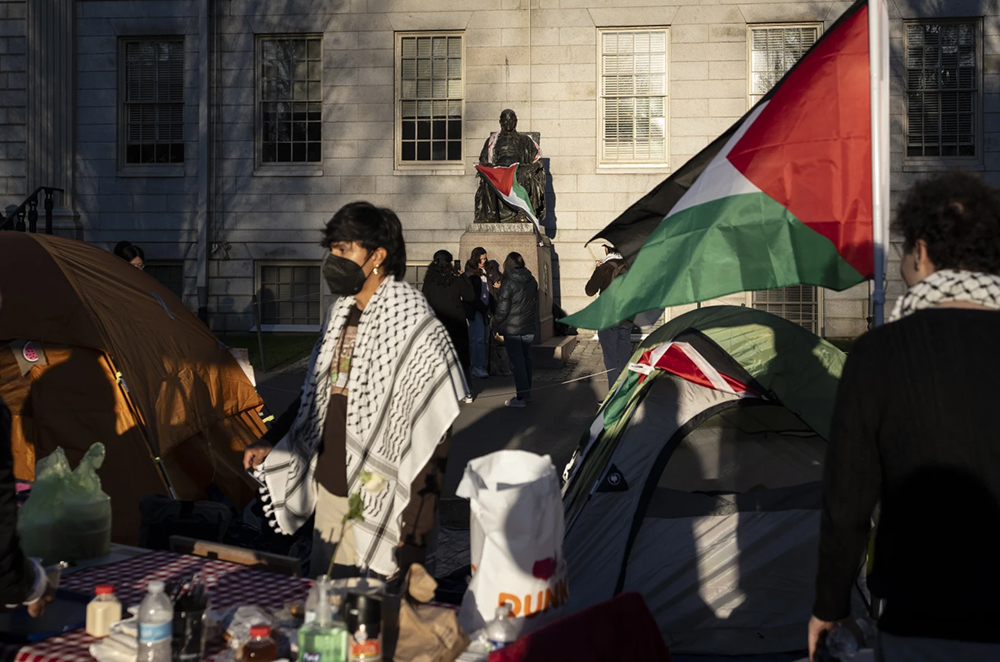
According to the information provided in The New York Times report that appeared on Monday, the administration’s campaign against elite institutions has been framed primarily as a crackdown on antisemitism. However, the scope of its demands — including new federal oversight of academic departments, ideological audits of faculty, and mandatory reporting of international students — points to a much broader effort to remake the governance and intellectual posture of the nation’s top schools.
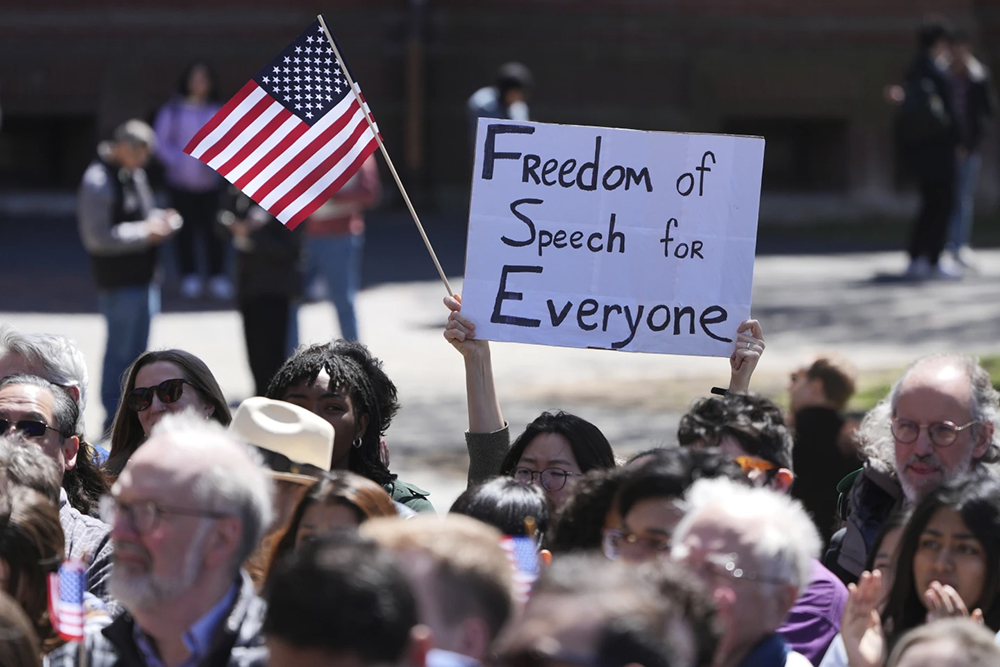
The lawsuit, filed in federal court in Massachusetts, argues that the government’s actions are not only punitive and ideologically driven, but also unconstitutional, threatening academic freedom and institutional independence. In its 67-page complaint, Harvard charges that the administration is using its accusations of campus antisemitism as a pretext for gaining unprecedented leverage over faculty hiring, curriculum design, and internal disciplinary processes.
As The New York Times report detailed, Harvard President Dr. Alan M. Garber, in a sharply worded statement, accused the administration of trying to assert “unprecedented and improper control” over the university’s internal affairs. “The consequences of the government’s actions will be severe and long lasting,” said Garber, who is himself Jewish. He acknowledged the reality of rising antisemitism but argued that the federal response has ignored lawful channels of collaboration and instead opted for coercive tactics aimed at suppressing academic dissent.
Among the most controversial demands outlined in the administration’s ultimatum to Harvard were: the creation of a federally monitored oversight body to enforce “viewpoint diversity,” federal approval of disciplinary decisions related to foreign students, and an audit of faculty members for alleged plagiarism or ideological bias. According to The New York Times, these conditions were presented with the implicit threat of withholding billions of dollars in federal research support if Harvard failed to comply.
The lawsuit specifically names several top Trump administration officials as defendants, including Health and Human Services Secretary Robert F. Kennedy Jr., Education Secretary Linda M. McMahon, acting GSA Administrator Stephen Ehikian, and Attorney General Pamela J. Bondi. All are accused of participating in what Harvard describes as a campaign of intimidation against not only its own institution, but also other universities that have recently suffered abrupt funding cuts or similar federal scrutiny.
The White House responded to the lawsuit with defiance. In a statement to The New York Times, White House spokesman Harrison Fields called the lawsuit “laughable” and insisted that the administration is standing up for working Americans. “The gravy train of federal assistance to institutions like Harvard, which enrich their grossly overpaid bureaucrats with tax dollars from struggling American families, is coming to an end,” Fields said.
Harvard’s decision to file suit marks a watershed moment in the fraught relationship between academia and federal power under the Trump presidency. The university, whose endowment exceeds $50 billion, has long been a lightning rod for conservative criticism over issues such as race-based admissions, gender theory, and perceived liberal bias in academia. Yet as The New York Times report pointed out, never before has the conflict risen to this level of legal confrontation.
Observers see the case as a potential bellwether for the future of federal funding and academic independence. If Harvard prevails, it could mark a significant rebuke to federal overreach and a reaffirmation of university autonomy. But if the Trump administration succeeds in imposing its demands, it may set a precedent for broader executive influence over the nation’s intellectual and educational landscape.
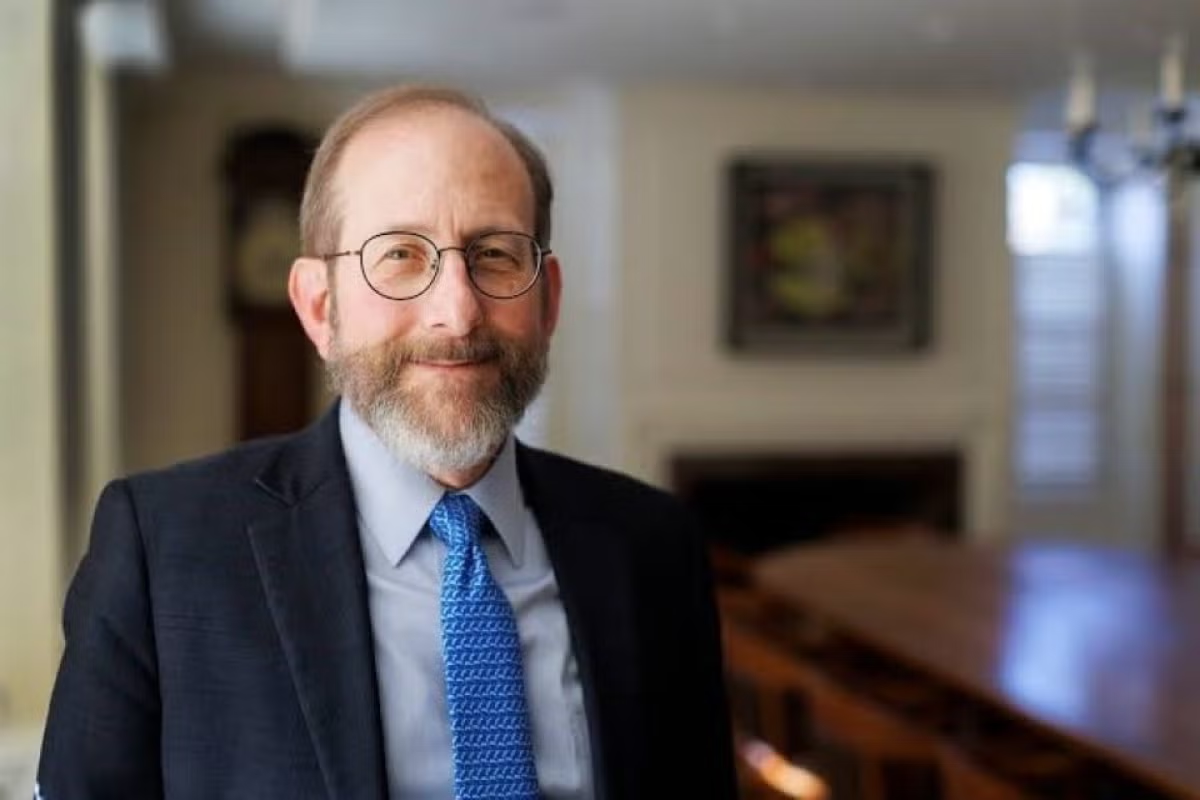
The New York Times report noted that this legal salvo is Harvard’s most direct rebuke yet to a federal campaign it believes is designed not to root out bigotry, but to reshape the ideological makeup of higher education in America.
The consequences of the funding freeze are already being felt most acutely at Harvard’s T.H. Chan School of Public Health, which relies on federal research grants for nearly half of its operational budget. The school has announced immediate and significant budget reductions, casting doubt on the continuity of vital public health initiatives.
Behind the scenes, two administration officials — speaking anonymously to The New York Times — confirmed plans to escalate pressure by freezing another $1 billion in funding, largely NIH-related. The targeting of Harvard’s public health research, legal experts argue, has little to no connection to the administration’s stated concerns about antisemitism, and appears instead to be a blunt-force attempt to bring elite institutions to heel.
The Washington Free Beacon reported that Harvard’s complaint also argues that the school was already tackling the problem of campus anti-Semitism, citing a number of “changes to clarify the scope of prohibited conduct aimed at Jewish and Israeli students.” It points to the adoption in January of the International Holocaust Remembrance Alliance’s definition of anti-Semitism, though Harvard adopted that definition only as a part of a settlement with Jewish students who had sued the school over “severe and pervasive” campus anti-Semitism. In another example, Harvard credits itself with “releasing a statement clarifying Harvard’s values” and “fostering constructive dialogue on campus.”
The lawsuit underscores this point: “The government cannot identify any rational connection between antisemitism concerns and the medical, science, technological, and other research it has frozen that aims to save American lives.” The complaint also makes a forceful First Amendment argument, quoting the landmark 1969 Supreme Court decision Tinker v. Des Moines: “The classroom is peculiarly the ‘marketplace of ideas’ that the First Amendment is designed to safeguard.”
In an official statement reported by The New York Times, White House spokesman Harrison Fields remained unapologetic, declaring that “taxpayer funds are a privilege, and Harvard fails to meet the basic conditions required to access that privilege.” This rhetoric, Harvard argues in court filings, signals a dangerous shift in the government’s understanding of public funding — one that transforms research grants into political leverage.
The university is not alone in facing the administration’s wrath. According to The New York Times, other elite schools — including Columbia, Cornell, Northwestern, and Princeton — have similarly been targeted, with threats of funding withdrawals and federal investigations looming. All were cited by the administration for allegedly inadequate responses to antisemitic incidents on campus, despite ongoing internal reviews and disciplinary processes.
As The New York Times reported, Dr. Garber remains resolute: “Their actions suggest otherwise,” he said, rejecting claims from administration insiders that the controversial list of demands had been sent by mistake. For Harvard, and possibly the rest of the nation’s elite academic community, this legal confrontation is no longer just about research funding — it’s about defining the very soul of the American university in the 21st century.
Harvard’s complaint asserted that the government’s actions violate the First Amendment and bypass due process, amounting to a calculated political attack masquerading as a crackdown on antisemitism.
Harvard University’s decision to sue the Trump administration has not only ignited a landmark legal battle but also galvanized widespread support from students, faculty, and national education leaders who view the move as a bold stand for academic freedom, civil liberties, and the constitutional boundaries of executive power.
The lawsuit has electrified Harvard’s campus, where the announcement by university president Dr. Alan M. Garber was met with something approaching jubilation. “The level of school spirit was on par with the Yale game,” said sophomore Lorenzo Ruiz of Texas, referring to the university’s storied football rivalry. “The university has really managed to tap into and inspire not only the support of students, but a massive segment of the nation that is deeply concerned by federal meddling,” he told The New York Times.
Indeed, support for Harvard’s legal action is widespread and robust, particularly among its faculty. Political science professor Ryan Enos, who spearheaded a faculty letter signed by more than 800 colleagues urging the university to stand firm, told The New York Times that Harvard’s lawsuit “should be a larger signal not just to education but civil society that what the Trump administration is doing is unlawful.”
Harvard’s legal strategy is notably aggressive, reflecting what The New York Times described as the university’s frustration with the administration’s unprecedented list of demands. These include monitoring faculty for ideological diversity, mandatory reporting of international students suspected of misconduct, and the imposition of outside federal overseers—conditions that Harvard says are unconstitutional and extralegal.
In a striking move, Harvard retained two high-profile attorneys with prior ties to the Trump administration to lead its legal team. William A. Burck, who previously advised the Trump Organization on ethics, and Robert K. Hur, a former Justice Department official under Trump and the special counsel in the investigation of President Biden’s classified documents case, will represent the university in what is shaping up to be one of the most consequential legal clashes between academia and the federal government in decades.
Ted Mitchell, president of the American Council on Education, an organization representing more than 1,700 colleges and universities, offered resounding support for Harvard’s action. “We applaud Harvard for taking this step and look forward to a clear and unambiguous statement by the court rebuking efforts to undermine scholarship and science,” he said in a statement to The New York Times.
The lawsuit is structured around dual pillars of legal argumentation. First and foremost, it asserts that the Trump administration’s efforts to control the content of what Harvard’s faculty can teach—and who may teach it—amount to a fundamental breach of First Amendment protections. “The classroom is peculiarly the ‘marketplace of ideas’ that the First Amendment is designed to safeguard,” the complaint states, citing the Supreme Court’s 1969 Tinker v. Des Moines ruling.
Second, Harvard accused the administration of trampling procedural norms by bypassing established frameworks for investigating alleged civil rights violations. The university says that instead of engaging in legitimate oversight, federal officials opted to impose immediate punitive measures without affording due process—culminating in the abrupt freeze of over $1 billion in research funding, including from the National Institutes of Health.
Harvard’s legal filing also requests that the court expedite its proceedings, reflecting the urgency of the university’s situation. “Expediting the resolution of this action,” the complaint pleads, is necessary to avert further damage to the university’s research agenda and to defend the broader principle of institutional independence from political coercion.
According to former President Barack Obama, “Harvard has set an example for other higher-ed institutions—rejecting an unlawful and ham-handed attempt to stifle academic freedom.” He was echoed by NeverTrump former jurist J. Michael Luttig, who told The New York Times: “This is of momentous, momentous significance. This should be the turning point in the president’s rampage against American institutions.”
Times opinion columnist M. Gessen endorsed Harvard’s stand, saying, “No other response should have been possible by the logic of the law—or the logic of academic freedom or the logic of democracy.”
As The New York Times report noted, the case could set a national precedent that will resonate well beyond Harvard Yard. For supporters of academic freedom, the university’s stand represents a defining moment in the ongoing struggle over the soul of American higher education. For critics of elite institutions, it marks a test of whether powerful universities will be held accountable to public standards and scrutiny.
Regardless of outcome, Harvard’s decision to push back against what it sees as a deliberate overreach by the Trump administration has transformed a bureaucratic battle over grants into a constitutional confrontation with implications that reach deep into the future of education, civil liberties, and the role of government in shaping intellectual life.