



|
Getting your Trinity Audio player ready...
|
By: Carl Schwartzbaum
The intersection of grief, hatred, and accountability collided in a Georgia neighborhood this week, when a high-tech health care entrepreneur was terminated from the company he co-founded after defending his wife during a shocking antisemitic tirade against their Jewish neighbor.
Mark Bouyzk, who helped build the AI-powered health care platform AllaiHealth, was dismissed from the firm after footage circulated online showing him defending his wife Anna’s verbal assault on David Lubin, a bereaved father whose daughter, Sergeant Rose Lubin, was killed while serving in the Israeli Border Police last November.
The incident, reported by The New York Post, has ignited outrage in the Jewish community, drawn sharp condemnation from the business world, and underscored the way simmering tensions over the Israel-Hamas war have spilled into private neighborhoods across America.
The disturbing altercation began after Lubin placed signs in remembrance of his daughter opposite his neighbors’ pro-Palestinian signage, some of which contained derogatory phrases. According to the information provided in The New York Post report, Lubin, whose daughter was stabbed to death by a Palestinian teenager in Jerusalem in November 2023, had not previously challenged the Bouyzks’ right to display political slogans on their property.
But the fragile equilibrium shattered when Anna confronted Lubin face to face, unleashing a torrent of slurs and venom.
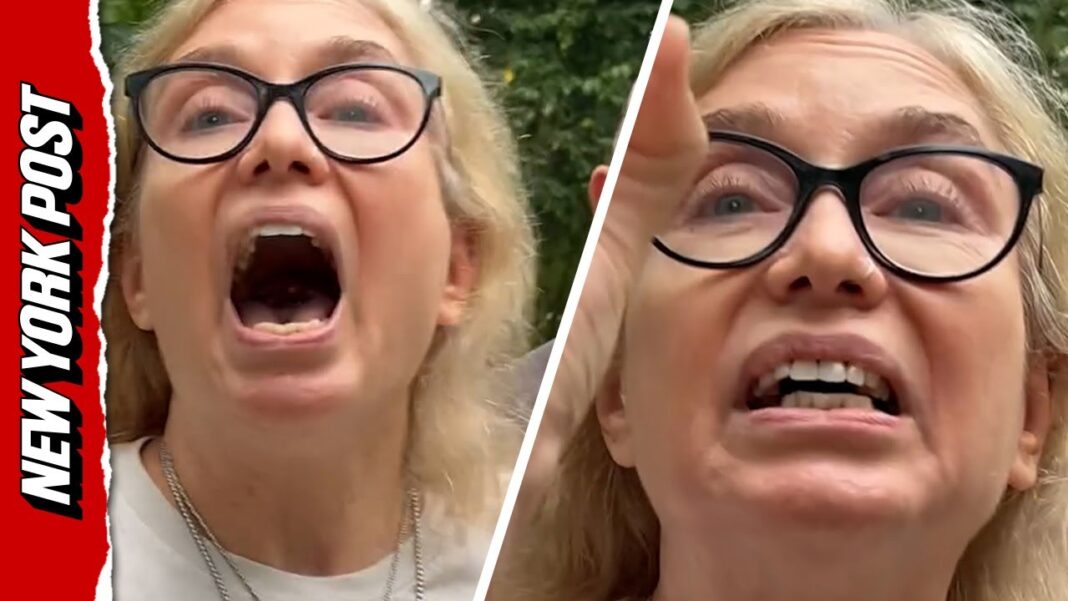
“You are calling yourself a k–e, you know what you are,” Anna shouted in footage captured on video. “You are a corrupt politician with a daughter in the IDF that went there to kill, and has killed maybe in friendly fire because the Israeli soldiers kill each other all the time, and you know very well.”
Lubin’s daughter, Rose, just 20 years old, was murdered while on patrol in Jerusalem weeks after the outbreak of the Israel-Hamas war. Despite the raw pain of Lubin’s loss, Anna declared that Rose’s killing was deserved. Her husband, Mark, standing by, doubled down: “She was fighting,” he said flatly, as though her death was justified by her uniform.
The confrontation, filmed by Lubin, quickly spread online after he uploaded it, sparking immediate outrage. The footage not only captured Anna’s use of antisemitic slurs but also showed Mark defending her tirade and dismissing the grief of a father who had lost his daughter to terrorism.
By Monday, AllaiHealth announced on LinkedIn that Mark Bouyzk had been terminated. CEO Robert Boisjoli issued a searing statement: “The behavior displayed in that footage is reprehensible, completely inconsistent with our values, and has no place in our organization or society. We hold ourselves and all those who represent AllaiHealth to the highest standards of integrity and accountability.”
As The New York Post reported on Thursday, Mark’s dismissal marked a dramatic fall for a man who had once been celebrated as an innovator in health technology. Bouyzk had previously co-founded AKESOgen, a genomics company acquired by Chicago-based Tempus Laboratories, before partnering with Boisjoli to launch AllaiHealth.
For David Lubin, the confrontation was both shocking and cruel. His daughter Rose, a U.S.-born Israeli who moved to Israel as a teenager, had joined the Border Police to protect civilians during a time of escalating violence. She was killed in November 2023 when a Palestinian teenager stabbed her at a checkpoint in Jerusalem.
Lubin told reporters, including The New York Post, that he never took issue with his neighbors’ right to post pro-Palestinian signs on their property. “They have the right to put up whatever signage they want,” he said. “I didn’t challenge them once. This was the first real confrontation.”
The grief-stricken father recounted how Anna’s hostility did not end with the filmed altercation. Later, she reportedly phoned him directly, accusing him of being responsible for his daughter’s death.
“It was beyond anything I could have imagined,” Lubin told The New York Post, describing the encounter as the moment his neighbors crossed an unforgivable line from political expression into targeted hatred.
The Bouyzks’ tirade is part of a broader surge in antisemitic incidents across the United States since the outbreak of the Israel-Hamas war on October 7, 2023. Jewish advocacy groups have reported a dramatic increase in verbal harassment, vandalism, and intimidation targeting Jewish individuals and institutions.
As The New York Post report emphasized, what makes the Georgia case particularly troubling is the intensely personal nature of the attack. Lubin was not just a Jewish neighbor; he was a grieving father who had recently buried his daughter, murdered by a Palestinian assailant in Jerusalem.
Rather than offering sympathy—or even silence—the Bouyzks weaponized his loss, suggesting that Rose’s death was deserved and taunting Lubin with crude stereotypes.
For AllaiHealth, Mark’s involvement in the tirade represented not only a public relations nightmare but also a moral dilemma. Companies in recent years have been increasingly pressed to respond decisively to executives or employees who engage in offensive or discriminatory conduct, particularly when such behavior goes viral.
By firing Bouyzk, AllaiHealth sought to distance itself from his remarks and align itself with values of inclusivity and accountability. As The New York Post report noted, the company’s swift response reflects how corporate reputations can hinge on leaders’ actions outside the boardroom.
The case also raises broader questions about the line between private conduct and professional consequences. While Bouyzk’s defenders may argue that his firing was a reaction to actions in his personal life, critics counter that his words and conduct reflect values incompatible with leadership in any health-related company built on trust, integrity, and human dignity.
The fallout has extended beyond Bouyzk’s termination. Jewish organizations and community leaders have condemned the incident as symptomatic of a darker climate for Jews in America, one in which antisemitic rhetoric is increasingly normalized under the guise of political criticism.
As The New York Post reported, Anna’s repeated invocation of slurs and her attempt to justify violence against Jews by equating Jewish identity with Israel’s military highlight how antisemitism often masquerades as political discourse. For Jewish families like the Lubins, however, the distinction is irrelevant when the rhetoric turns into targeted harassment.
What stands out most starkly is the raw cruelty of the exchange. Lubin, a man whose daughter was murdered while serving in uniform, was forced to endure taunts that not only demeaned his faith but desecrated the memory of his child.
The confrontation serves as a reminder of the human cost of rising antisemitism. Beyond the headlines and political arguments, there are individuals and families living with grief, singled out in their neighborhoods, and stripped of the basic expectation of compassion from those around them.
As The New York Post report indicated, the viral video captured not just a shouting match but a chilling portrait of how antisemitism corrodes community ties and fuels division at the most intimate level of daily life.
The saga of Mark and Anna Bouyzk is, at its core, a story of hatred confronted by accountability. A grieving father was attacked with slurs and accusations that mocked the death of his daughter. A neighbor, rather than offering sympathy, chose cruelty. And a health tech entrepreneur discovered that defending such cruelty was incompatible with his role as a leader in a company dedicated to human well-being.
As The New York Post has reported, the Bouyzk case is emblematic of the current moment in America, where private disputes become public reckonings, and where words carry consequences not only for communities but for careers.
For David Lubin, the wounds remain raw. For AllaiHealth, the decision has been made. And for a society grappling with rising antisemitism, the lesson is as clear as it is painful: hatred expressed behind closed doors will not stay there for long—and when it comes to light, it demands both accountability and condemnation
