



|
Getting your Trinity Audio player ready...
|
By: Fern Sidman
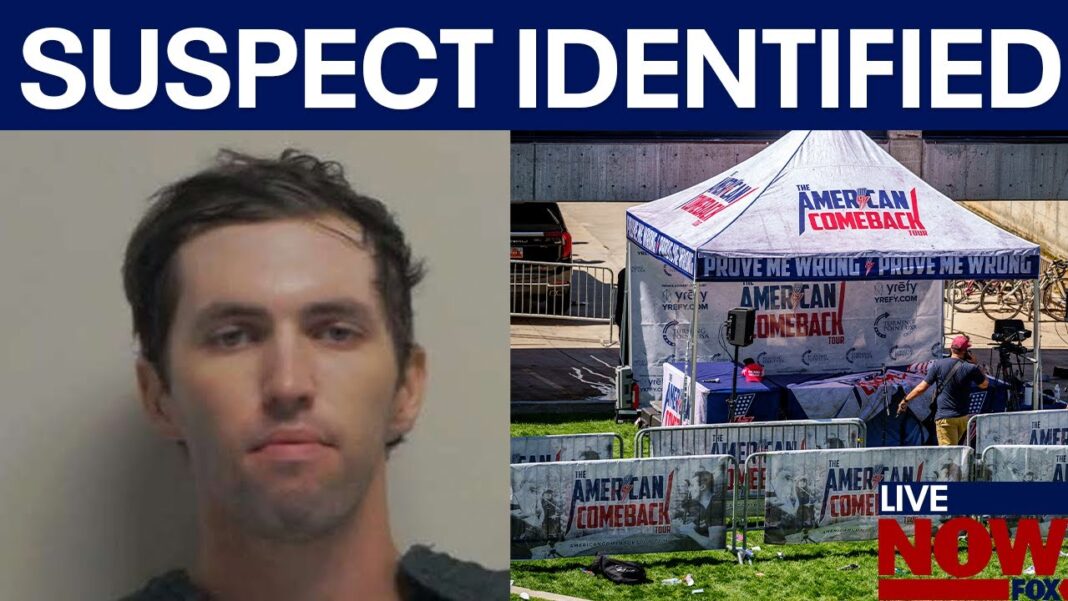
When President Donald Trump confirmed live on Fox & Friends that a suspect in Charlie Kirk’s assassination had been turned in by his own father, the revelation instantly reverberated across the nation. Within hours, The New York Post identified the accused gunman as Tyler Robinson, a 22-year-old Utah local whose anonymity vanished in the crack of a single rifle shot that claimed the life of one of America’s most visible conservative activists.
Now, as details continue to emerge, Robinson’s descent from relative obscurity to alleged assassin raises haunting questions about how a young man from suburban Utah could become the focal point of one of the most shocking political crimes in recent memory.
Robinson was, by most accounts gathered by The New York Post, a loner. Neighbors in Utah County remembered him as a thin, pale figure who kept irregular hours. He lived in a modest single-family home with his parents, rarely socializing, rarely smiling.
“He wasn’t the type to make waves,” one neighbor told The Post. “But when you’d catch his eye, it felt like he was carrying something heavy — anger, maybe.”
School records indicate Robinson attended local high schools but never advanced to higher education. Though Utah Valley University — the very campus where Kirk was slain — is only a short drive from his home, administrators confirmed he was not enrolled.
Employment records obtained by The New York Post reveal a scattered path: cashier at a grocery store, a warehouse stocker, fast-food worker. None lasted more than a few months.
Former coworkers described a young man prone to abrupt mood swings. “He would get really heated over nothing,” one ex-manager told The Post. “We had to let him go after he started ranting about conspiracies to other employees.”
The pattern was consistent: short stints, clashes with authority, then departure. It left Robinson drifting without structure or community — an isolation that investigators now believe may have pushed him deeper into online radical spaces.
According to law enforcement sources quoted by The New York Post, Robinson’s devices are now the centerpiece of the investigation. Preliminary reviews suggest he frequented fringe forums where extremist rhetoric blended with calls for political violence.
“He wasn’t just a passive reader,” one federal investigator told The Post. “He was posting — long, angry screeds about betrayal, about enemies, about cleansing the system.”
His posts, investigators said, displayed an obsessive focus on conservative figures, particularly those he viewed as “dangerous manipulators.” Among them was Charlie Kirk.
In one chilling entry, Robinson allegedly wrote about “taking out the mouthpieces who poison the youth,” language that prosecutors may ultimately argue foreshadowed the assassination.
Wednesday, September 10, began like any other on the Utah Valley University campus. Students streamed into the Losee Center plaza, where Kirk, 31, was hosting one of his trademark open-mic debates. By noon, thousands had gathered.
According to law enforcement accounts shared with The New York Post, Robinson scaled a low-rise rooftop east of the library. Wearing jeans, a black shirt, and a tactical vest, he carried a long rifle wrapped in cloth to conceal it.
At approximately 12:10 p.m., as Kirk fielded a pointed question about mass shootings by transgender individuals, a single crack split the air. Video obtained by The Post shows Kirk jerk backward, his hand at his neck, as panic rippled through the crowd.
The gunman fled. Chaos consumed the scene. Kirk was rushed to a hospital but pronounced dead within the hour.
What happened next stunned the nation. According to President Trump’s interview and corroborated by The New York Post, it was Robinson’s own father who turned him in — relaying suspicions through a trusted minister connected to law enforcement.
“This was a father’s worst nightmare,” one local official told The Post. “But he knew the truth had to come out.”
Trump praised the father’s courage on national television, even as he demanded the death penalty for Robinson.
Prosecutors have not yet outlined a formal motive, but investigators speaking to The New York Post say Robinson’s notebooks and online posts suggest a volatile fusion of personal frustration and political animus.
“It wasn’t one ideology,” one source explained. “It was a stew of resentments — against conservatives, against liberals, against institutions. He seemed to want chaos, and Kirk represented a symbol.”
The attack, therefore, may not have been about Kirk personally but about what he represented: a charismatic conservative voice commanding youth audiences across the nation.
The revelation that Robinson was not previously on federal watchlists has prompted scrutiny. The New York Post reports that FBI Director Kash Patel initially announced a different “person of interest” had been detained and released, a misstep that confused the investigation’s early hours.
The bureau later released photos of a suspect in sunglasses and a patriotic t-shirt, offering a $100,000 reward for tips. By then, Robinson’s father had already stepped forward.
Robinson’s arrest has ignited a furious national debate over political violence, extremism, and the role of online radicalization.
“This wasn’t just a crime against one man,” Utah Gov. Spencer Cox said, according to The New York Post. “It was an attempt to silence political expression through terror.”
President Trump, speaking hours after Robinson’s apprehension, declared Kirk “a martyr for truth and freedom.”
Yet Robinson’s story also underscores broader societal fractures: a disaffected young man, alienated from institutions, drawn into ideological fury, who allegedly chose violence as expression.
Robinson now faces capital charges. Prosecutors in Utah have already hinted they will pursue the death penalty.
For Kirk’s supporters, justice cannot come soon enough. For Robinson’s family — particularly his father — the weight of betrayal and duty will linger forever.
As The New York Post framed it in its Friday coverage, the case is not just about a gunman and a victim. It is about a country teetering at the edge of political rage, where the distance between online rhetoric and real-world bloodshed grows perilously thin.
In the end, Tyler Robinson may be remembered less for who he was than for what his actions represent. A quiet suburban 22-year-old who slipped into darkness, emerging in a single flash to change the course of a movement and to wound a nation.
As investigators piece together his path, The New York Post notes that the lessons are stark: extremism festers in silence, radicalization thrives online, and sometimes the most dangerous figure is the one you never noticed.
