



|
Getting your Trinity Audio player ready...
|
|
|
||||
Fire in the Heart of Dixie: The Arson at Mississippi’s Lone Synagogue and the Unsettling New Geography of American Antisemitism
By: Fern Sidman
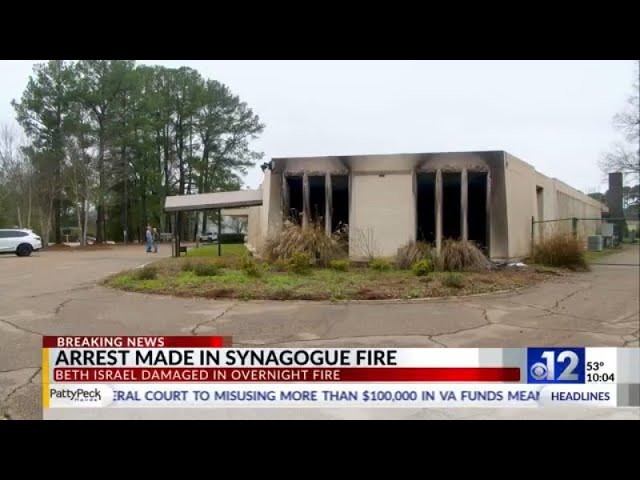
In the pre-dawn darkness of Saturday morning, as most of Jackson, Mississippi slept, flames tore through Beth Israel Congregation — the state’s largest synagogue and the only one in its capital city. By the time firefighters subdued the blaze, two Torah scrolls lay in ashes, five more were badly damaged, and the sanctuary that had anchored Jewish life in central Mississippi for more than a century was left scarred and silent.
According to a report on Sunday at The Jewish Insider, a suspect is now in custody after local law enforcement concluded that the fire was deliberately set shortly after 3 a.m. Jackson Mayor John Horhn confirmed the arrest but declined to disclose the suspect’s name or motive, saying the investigation remains ongoing. While the FBI has not yet formally classified the attack as a hate crime, Jewish leaders nationwide are already bracing for what many fear is another data point in a grim national pattern.
“This is not just an attack on a building,” one senior Jewish communal figure told The Jewish Insider. “It is an attack on memory, on continuity, and on the fragile sense of security Jews are struggling to maintain in America.”
Beth Israel Congregation is no ordinary house of worship. Nestled in Jackson — a city synonymous with the Civil Rights Movement — the synagogue has long stood at the intersection of Jewish faith and moral activism. Its building also houses the Institute of Southern Jewish Life, an organization dedicated to sustaining Jewish culture across a region where Jews make up barely 0.1% of the population.
The synagogue’s walls are steeped in history. In 1967, at the height of racial tensions in the South, the Ku Klux Klan bombed Beth Israel because its rabbi had dared to support civil rights activists, providing chaplaincy services to those jailed for defying segregated bussing laws. That attack nearly leveled the building — yet the congregation rebuilt, a defiant testament to resilience.
Now, more than half a century later that history has repeated itself in devastating fashion.
Miraculously, no congregants were injured in Saturday’s fire. But the physical and spiritual toll is immense. Two Torah scrolls were destroyed outright, and five others were damaged. Among the survivors was a Torah that had itself escaped annihilation during the Holocaust — preserved inside a glass case that withstood the inferno.
The synagogue’s library and administrative offices were reduced to charred remnants. With the building unsafe, services have been canceled indefinitely.
Zach Shemper, the congregation’s president, told The Jewish Insider that the outpouring of support from the broader Jackson community has been swift and heartfelt. “We have already had outreach from other houses of worship in the area,” he said in a statement, “and greatly appreciate their support in this very difficult time.”
Mississippi is home to roughly 3,000 Jews scattered across a dozen synagogues, most of them small and isolated. For many, Beth Israel is more than a spiritual center; it is a lifeline.
While investigators remain cautious about assigning motive, the context is inescapable. As The Jewish Insider has reported, antisemitic hate crimes in the United States reached a record high in 2024 — the highest levels since the FBI began collecting data in 1991.
Against that backdrop, the arson in Jackson feels less like an aberration and more like the latest chapter in a nationwide crisis.
Mayor Horhn, who was 12 years old when the synagogue was bombed in 1967, spoke with emotion. “Acts of antisemitism, racism and religious hatred are attacks on Jackson as a whole,” he said, according to The Jewish Insider report. “Targeting people because of their faith, race, ethnicity or sexual orientation is morally wrong, un-American, and incompatible with the values of this city.”
Condemnation poured in from across the political spectrum. Senator Roger Wicker of Mississippi declared, “Our hearts are with the members of Beth Israel Congregation. We stand together with them as do all the caring people of Mississippi. We denounce violence and find attacks on places of worship especially despicable.”
But Jewish leaders say such statements, while welcome, no longer feel sufficient.
Sheila Katz, chief Jewish life officer at Jewish Federations of North America, captured the bitter resignation many feel. “This is what it means to be Jewish in America right now,” she wrote on social media. “Antisemitic violence and attacks on synagogues are so common that they barely register beyond local news.”
Yet Katz also emphasized the other side of the Jewish story: solidarity. “The Jewish community in Mississippi will come together,” she wrote. “They will rebuild. They will continue to celebrate Jewish holidays and live Jewish life with joy.”
Ted Deutch, CEO of the American Jewish Committee, echoed that call. “Waking to the news of an arson attack on a Mississippi synagogue feels all too familiar,” he told The Jewish Insider. “Now will you touch base with your Jewish friends, neighbors and co-workers? Tell them you stand with the Jewish community. It will mean more than you know.”
Representative Ritchie Torres of New York, one of Congress’s most outspoken advocates against antisemitism, framed the attack in stark terms. “Domestic terrorism against Jews never happens in a vacuum,” he said. “Instead of extinguishing the fires of antisemitism, American politics is often guilty of fanning the flames.”
Deborah Lipstadt, the former State Department special envoy on antisemitism, went further still, calling the Jackson arson “another step in the globalization of the intifada.”
That phrase — globalization of the intifada — has become shorthand for the way Middle Eastern hatreds are metastasizing onto American soil. As The Jewish Insider has documented, synagogues, Jewish schools, and community centers across the country have become targets not merely of vandalism but of ideological rage imported through social media, protests, and political discourse.
In Jackson, the mood is somber but defiant. Congregants gathered outside the smoldering building Saturday afternoon, some clutching prayer books salvaged from the debris, others wiping soot from memorial plaques that had survived the blaze.
One elderly member told The Jewish Insider that the fire felt like a message: “They’re telling us we don’t belong here.” She paused before adding, “But we’ve been told that before — and we’re still here.”
Security around Jewish institutions statewide has been quietly tightened, according to local officials. The FBI is assisting with the investigation, and while the suspect’s motive remains undisclosed, Jewish leaders are urging vigilance.
The symbolism of the destroyed Torah scrolls has reverberated far beyond Mississippi. In Jewish tradition, a Torah is not merely a book; it is a living vessel of covenant, painstakingly handwritten over the course of a year or more. To see one reduced to ash is, for many, akin to witnessing the erasure of a soul.
That one Torah — a survivor of the Holocaust — endured the flames only deepens the emotional resonance. “It’s as if history itself refused to burn,” one rabbi remarked to The Jewish Insider.
The congregation now faces the daunting task of rebuilding — not just bricks and mortar, but a sense of sanctuary. Insurance will cover some costs, and national Jewish organizations have pledged assistance, yet the deeper wound is psychological.
As The Jewish Insider report observed, attacks such as the one in Jackson erode something fragile: the assumption that in America, unlike in so many chapters of Jewish history, the synagogue is a safe place.
That assumption is no longer tenable.
Yet amid the ashes, something else is stirring. Interfaith leaders across Jackson have offered their pulpits for Jewish services. Donations are arriving from strangers across the country. The Institute of Southern Jewish Life has vowed to continue its work uninterrupted.
The story of Beth Israel Congregation is, in many ways, the story of American Jewry itself: battered but unbroken, scarred by hatred yet sustained by an unyielding commitment to life.
As one congregant told The Jewish Insider, standing in the shadow of blackened walls, “They tried to silence us in 1967. They failed. They tried again this weekend. They will fail again.”