



|
Getting your Trinity Audio player ready...
|
By: Jerome Brookshire
A growing wave of financial fraud targeting older Americans has reached what cybersecurity professionals are calling “devastating” proportions. According to the FBI’s Los Angeles field office, the “Phantom Hacker Scam” has stripped U.S. citizens—primarily seniors—of more than $1 billion since at least 2024. In a detailed report carried by Fox News Digital, experts describe the scheme as a multi-phased deception designed to exploit the trust, vulnerabilities, and sometimes the very interests of retirees, often leaving victims penniless with little chance of restitution.
The FBI issued a reminder about the scam on July 15, warning that it has become a leading financial crime threatening older Americans, many of whom are losing their entire retirement savings within days.
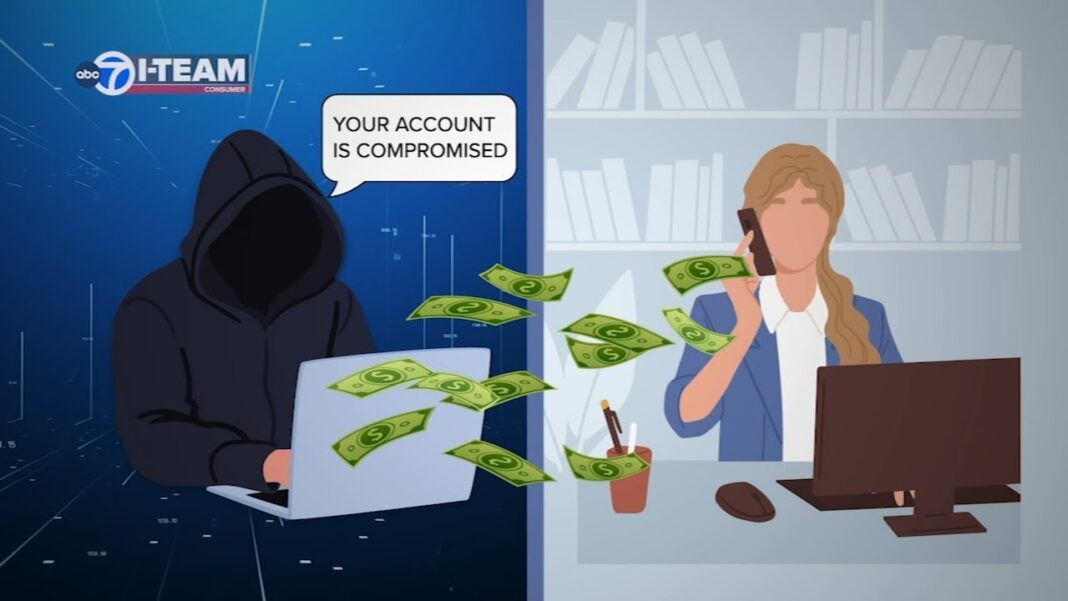
The Phantom Hacker Scam unfolds in three stages, each carefully choreographed to build a sense of credibility and urgency in the victim’s mind.
Phase One: The Tech Support Impostor
As explained by the FBI and reiterated in the Fox News Digital report, scammers first pose as representatives from a legitimate technology company, reaching out through unsolicited emails, phone calls, or text messages. Victims are persuaded to download remote-access software, giving the scammer full control of their device. Once inside, the criminal directs the victim to open their financial accounts “to check for unauthorized charges,” which in reality provides the scammer with a clear roadmap of the victim’s wealth.
Phase Two: The Financial Institution Impostor
At this point, the scam escalates. Victims receive a phone call from someone claiming to represent their bank’s “fraud department.” This impersonator tells them their funds have been “accessed by a foreign hacker” and must be relocated to a so-called “safe account.” According to Fox News Digital, victims are then instructed to move their money via wire transfers, cash deposits, or cryptocurrency transactions, often stretched across days or even months to avoid suspicion.
Phase Three: The Government Impostor
Finally, in the coup de grâce, victims may be contacted by someone masquerading as a U.S. government official. This figure claims to be protecting the individual’s funds and instructs them to transfer assets into an “alias” account for safekeeping. By this stage, many victims are so psychologically entangled in the fraud that they comply without hesitation, unaware they are handing over the last of their savings.
The Devastating Toll on Seniors
Pete Nicoletti, chief information security officer at Check Point, told Fox News Digital that the scam has grown “devastating” in scale and sophistication, with retirees bearing the brunt. Seniors are not only targeted because of their accumulated wealth but also because of their social vulnerability and tendency to trust authority figures.
Nicoletti emphasized the emotional as well as financial destruction: “It’s devastating,” he told Fox News Digital, noting that victims almost never recover their stolen money. Even when fraud is reported to authorities on the same day, he estimated that successful recovery occurs in only “single digit percentages”—roughly 10 to 15 percent. Once the money is funneled through layered accounts or converted into cryptocurrency, it is effectively gone.
Artificial Intelligence and Targeted Deception
One of the most disturbing dimensions of the Phantom Hacker Scam, experts say, is the criminals’ use of artificial intelligence to profile victims. Nicoletti explained to Fox News Digital that scammers are combing through social media posts to tailor their approaches with alarming precision.
He cited the example of seniors who openly post about niche hobbies, such as car collecting. A scammer might then send an email claiming that a rare Corvette the victim “ordered” months ago has become available at a special price, exploiting both the victim’s passion and possible memory lapses. “The senior goes, ‘Well, I’m a Corvette collector. Maybe I was forgetful and didn’t know that I ordered that Corvette,’” Nicoletti noted. This personalization creates a powerful psychological trap, making the fraudulent scheme all the more convincing.
A Perfect Storm of Vulnerability
The scam’s effectiveness lies in the intersection of trust and fear. Seniors, often less technologically savvy, are especially susceptible to authoritative voices claiming to represent banks or government agencies. Coupled with the anxiety of potentially losing one’s life savings to “foreign hackers,” victims comply quickly to avoid imagined greater losses.
As the report at Fox News Digital pointed out, these schemes are meticulously engineered to manipulate human behavior rather than just exploit technological gaps. By cycling through three distinct impostor roles—technical support, financial institution, and government—criminals reinforce the illusion of legitimacy at every step.
The FBI’s Warning
The FBI has warned the public repeatedly about the Phantom Hacker Scam. Its July 15 reminder on X (formerly Twitter) underscored that the scam is “most lucrative when targeting senior citizens.” The agency urged family members to educate elderly relatives about the red flags, such as:
Unsolicited phone calls, texts, or emails claiming to be from tech support.
Requests to install remote-access programs.
Instructions to move money to unfamiliar accounts for “safekeeping.”
Claims of being contacted by government officials about personal financial accounts.
The FBI recommends immediate reporting to its Internet Crime Complaint Center (IC3) for any suspected fraud.
The Family’s Role: Prevention as Protection
Nicoletti stressed to Fox News Digital that prevention remains the most effective defense. Families must have frank, consistent discussions with their elderly relatives, even framing it as a dinner-table conversation. “The family should have dinner-time discussions about this,” he advised, noting that awareness alone can inoculate seniors against manipulation.
Educational outreach by community organizations and financial institutions is also key. Nicoletti urged relatives to warn seniors against posting excessive personal details on platforms like Facebook, which scammers now scour using advanced AI. Limiting the exposure of private information online is as critical as strengthening digital security.
Why Recovery Is So Rare
The difficulty of recovering stolen funds lies in the speed and sophistication of modern financial fraud networks. Once money is transferred, scammers typically employ “money mules” and cryptocurrency exchanges to obscure its origin. As Fox News Digital emphasized, the longer the delay in reporting, the slimmer the chances of recovery.
This grim reality illustrates the need for preemptive caution rather than reactive hope. Once a victim complies with the scam’s third stage, even law enforcement agencies are effectively powerless to retrieve the funds.
A Growing National Crisis
The Phantom Hacker Scam is not an isolated trend but part of a larger wave of cyber-enabled frauds preying on seniors. According to FBI data, losses from elder fraud surged past $3 billion in 2023 across all schemes, with the Phantom Hacker emerging as the single most damaging variant.
Fox News Digital reported that the scam has now spread across all fifty states, often striking the same victims multiple times in “recovery scams,” where criminals posing as investigators offer to retrieve stolen funds—for another fee.
The rise of the Phantom Hacker Scam represents a profound threat not just to seniors’ financial security but to their dignity and independence. With more than $1 billion siphoned away since 2024, the scheme is devastating American families and eroding trust in digital communication.
As experts told Fox News Digital, the only viable defense is vigilance: family conversations, reduced online exposure, and swift reporting of suspicious activity. But for victims already ensnared, the reality is harsh—most will never see their savings again.
In the end, the Phantom Hacker Scam illustrates the brutal efficiency of modern cybercrime, where technology and psychology intersect to exploit human trust. For seniors in particular, awareness is no longer optional; it is essential to survival in the digital age.
