



|
Getting your Trinity Audio player ready...
|
By: Fern Sidman
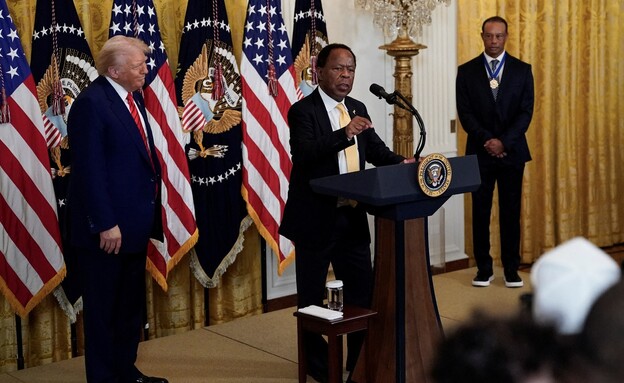
At a moment when the vocabulary of civil rights is once again being tested by the resurgence of old hatreds in new guises, the words spoken this week in Washington carried a resonance that extended far beyond the confines of a government hearing room. Leo Terrell, the chair of the Department of Justice’s Task Force to Combat Antisemitism, addressed the Religious Liberty Commission with a message that was as declarative as it was expansive: the fight against antisemitism, he argued, is not merely a Jewish concern, nor even an American one alone, but a civilizational imperative. VIN News, which closely followed the proceedings, reported on Monday that Terrell’s testimony sought to frame the struggle against Jew-hatred as a defining moral challenge of the current political era, one that cuts across race, faith, and ideology.
The context of Terrell’s remarks is a fraught one. In recent years, Jewish communities across the United States have faced a chilling escalation in harassment, vandalism, and violence, often concentrated in educational spaces that were once imagined as sanctuaries of liberal pluralism. The formation of the Task Force to Combat Antisemitism earlier this year, under an executive order issued by President Donald Trump, was framed by the administration as a decisive institutional response to what it described as an intolerable corrosion of American civic life.
The VIN News report underscored that the initiative, drawing on multiple federal agencies, reflects an attempt to move beyond rhetorical condemnation toward coordinated enforcement, particularly in schools and on college campuses where incidents of intimidation and exclusion have become disturbingly commonplace.
Terrell, who also serves as senior counsel to the assistant attorney general for civil rights, spoke with the cadence of a civil rights veteran steeped in the moral language of the American struggle for equality. In recalling the historical role of Jewish activists in the Black freedom movement, he situated contemporary antisemitism within a longer narrative of shared struggle and reciprocal obligation. VIN News reported that Terrell invoked this lineage not as a sentimental gesture but as a reminder of an ethical debt, one that obliges the broader society to defend Jewish communities with the same fervor once marshaled in defense of Black Americans during the most perilous chapters of the twentieth century.
What distinguished Terrell’s testimony, however, was not merely its historical sensibility but its insistence on universality. Identifying himself as a Black Baptist, he rejected any parochial framing of antisemitism as the exclusive burden of Jews. Hatred directed at one minority, he suggested, metastasizes into a broader assault on the moral foundations of democratic life. The report at VIN News captured the gravity of this assertion, noting that Terrell described antisemitism as an “American issue” and, more starkly, as a challenge to Western civilization itself. The rhetorical move was deliberate: by elevating antisemitism from a sectional grievance to a civilizational threat, Terrell sought to galvanize constituencies that might otherwise view the issue as remote from their own lived experience.
The administration’s emphasis on educational institutions as focal points of intervention reflects a recognition that campuses have become crucibles of ideological contestation. The VIN News report documented how incidents of antisemitic harassment have increasingly been entangled with polarized debates over Israel and the Middle East, producing environments in which Jewish students report feeling marginalized or unsafe. The task force’s mandate to prioritize these settings suggests an attempt to confront what officials view as a normalization of hostility under the guise of political activism. Terrell’s testimony, according to VIN News, framed this phenomenon as a failure of institutional guardianship, one that demands not only law enforcement but moral leadership.
Yet the creation of a federal task force also raises complex questions about the boundaries between protection and overreach. Civil liberties advocates have long cautioned that government interventions in educational discourse risk conflating hateful conduct with controversial speech. VIN News has noted that Terrell, in his remarks, appeared sensitive to these concerns, emphasizing that the task force’s mission is rooted in combating harassment and intimidation rather than policing political dissent. The distinction is a subtle but crucial one, and its practical application will likely define the credibility of the initiative in the eyes of skeptics.
Terrell’s invocation of Western civilization as a shared inheritance under threat may strike some as rhetorically grandiose, yet it resonates with a deeper anxiety about the erosion of pluralistic norms. The resurgence of antisemitic tropes, often recycled through digital platforms with alarming velocity, reflects a broader crisis of information and authority. The VIN News report highlighted how conspiracy theories and dehumanizing narratives, once confined to fringe subcultures, now circulate with unprecedented reach. In this environment, the task force’s work is as much about symbolic reassurance as it is about concrete enforcement: a signal that the state acknowledges the vulnerability of Jewish communities and affirms their place within the national fabric.
The cross-communal framing of Terrell’s remarks carries an additional, perhaps understated, significance. By positioning himself—a Black Baptist leader within the civil rights apparatus of the federal government—as a defender of Jewish safety, Terrell sought to model a form of solidarity that transcends the transactional politics of grievance. VIN News interpreted this gesture as an attempt to reclaim the moral grammar of coalition-building that once defined the American civil rights movement. In an era marked by fragmentary identity politics, such an appeal to shared ethical responsibility is both ambitious and precarious.
Whether the Task Force to Combat Antisemitism will translate lofty rhetoric into durable change remains an open question. The structural forces driving contemporary antisemitism—geopolitical polarization, social media radicalization, and the erosion of civic trust—are formidable. Yet Terrell’s testimony, as reported by VIN News, articulated a vision of moral clarity that cuts against the cynicism of the age. It insists that antisemitism is not a peripheral affliction but a diagnostic symptom of democratic decay. To confront it, in this framing, is not merely to protect a vulnerable minority but to defend the very premise of pluralistic society.
In the end, the hearing offered more than policy declarations; it provided a moral tableau. Terrell’s voice, shaped by the cadences of Black church tradition and civil rights advocacy, carried a reminder that the struggle against hatred has always demanded allies willing to speak beyond the boundaries of their own identity. VIN News captured the moment as emblematic of a broader reckoning: a recognition that the defense of one community’s dignity is inseparable from the preservation of a nation’s conscience.
