



|
Getting your Trinity Audio player ready...
|
By: Russ Spencer
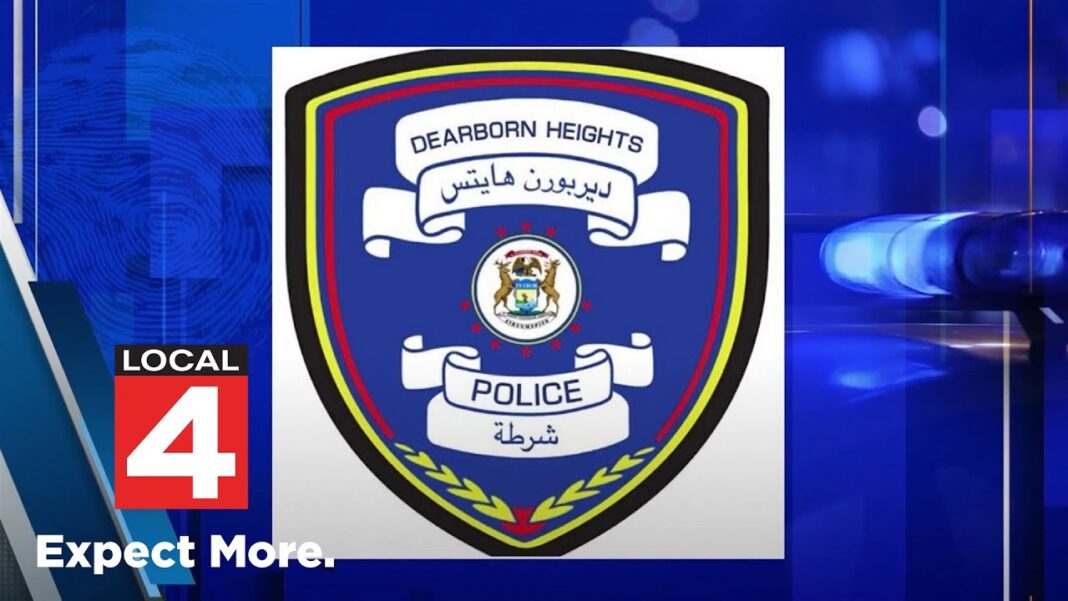
The Dearborn Heights Police Department has unveiled a new uniform patch that features both English and Arabic — a move touted by officials as a nod to diversity but criticized by many as a step away from the principle that law enforcement should serve all citizens equally, without highlighting one community over others.
The design, the first of its kind in the United States, displays the Michigan state seal in the center with the words “Dearborn Heights Police” written in English and Arabic. Created by Officer Ermily Murdoc, the optional patch is intended, according to police, to “reflect and honor the diversity of our community.”
While the patch has been promoted as inclusive, critics contend that it risks creating division by elevating one minority group above the rest. Law enforcement uniforms are historically designed to be neutral — bearing only official seals, city names, or universally recognized insignias — precisely because police are meant to represent the totality of a community, not specific ethnic or linguistic groups.
The choice of Arabic is not coincidental. Dearborn Heights is home to a significant Middle Eastern and North African population, making up 39 percent of residents as of 2023. Neighboring Dearborn, with roughly 55 percent of its population from MENA backgrounds, is often described as the nation’s Arab American capital. Yet, Dearborn Heights also contains large African American, Hispanic, and European-descended populations, none of whom see their identities reflected on the patch.
For opponents of the move, the question is simple: if Arabic is recognized on the uniform, why not Spanish, which is spoken widely in Michigan? Why not symbols honoring African American heritage, Polish heritage, or any number of communities that call Dearborn Heights home?
Police uniforms and insignias carry weight as symbols of authority, impartiality, and unity under the law. By adopting a patch that foregrounds one community’s identity, critics argue, the department undermines the very neutrality that uniforms are supposed to project.
Law enforcement has long insisted that its officers represent the collective — not individual neighborhoods, ethnic groups, or languages. In this context, the addition of Arabic to the patch sets a precedent that may pressure other departments to adopt similar symbols, each catering to a particular group, potentially fragmenting rather than unifying civic identity.
When the Dearborn Heights Police Department announced the new design on Facebook, officials quietly disabled public comments. The decision was telling. It suggests leaders anticipated controversy but preferred to present the patch as a fait accompli rather than invite open dialogue.
By shutting down conversation, the department effectively silenced voices of residents who may view the patch as inappropriate or exclusionary. In a democracy where law enforcement must be accountable to all, the refusal to engage public opinion raises its own set of questions.
Few dispute the reality of Dearborn Heights’ diversity. The city has been profoundly shaped by waves of immigration, particularly from the Middle East and North Africa. Arabic is commonly spoken in homes, businesses, and institutions. Yet civic symbols are not designed to highlight specific heritages; they are meant to unify under a shared identity.
A police patch that favors one group may unintentionally alienate others, especially in a city where nearly two-thirds of the population is not of MENA background. Critics warn that what begins as a symbolic gesture of inclusion can easily be perceived as favoritism, eroding trust among those left out.
The Dearborn Heights patch is the first of its kind in the nation, but the precedent it sets could reverberate far beyond Michigan. Should other departments in immigrant-rich areas follow suit, the once-universal look of police insignias could splinter into a patchwork of cultural symbols — each speaking to one group, but not necessarily to the whole.
Such a trend could undermine the common authority of law enforcement uniforms, replacing the neutrality of shared symbols with a system where departments appear to cater selectively to demographics. For many, this raises troubling questions about whether civic institutions are drifting away from their responsibility to serve the collective good.
The Dearborn Heights Police Department’s Arabic patch may have been designed to celebrate diversity, but its symbolism risks undercutting the very principles of impartiality and unity that law enforcement must uphold. Police officers are sworn to serve and protect all people — regardless of language, heritage, or background.
By elevating one group’s identity onto the uniform, however well-intentioned, the department has sparked concerns that its symbol now represents some more than others. For a badge meant to embody equal justice under the law, that may be a step in the wrong direction.
