



|
Getting your Trinity Audio player ready...
|
By: Abe Wertenheim- Jewish Voice News
The rising tide of antisemitic hostility that has engulfed university campuses and major American cities since October 7 reached one of Los Angeles’ most historic Jewish institutions last Wednesday, when a community event at Wilshire Boulevard Temple was violently disrupted by masked protesters who hurled slurs, shattered property, and terrified guests attempting to foster understanding across cultures.
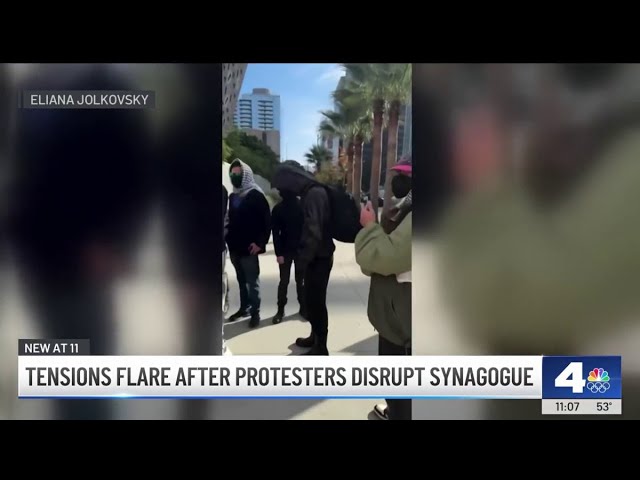
According to a report that appeared on Wednesday in The Jewish Journal of LA, the incident began shortly after 9:30 a.m., when UCLA medical student and Jewish activist Eliana Jolkovsky arrived at the 162-year-old synagogue, located in Koreatown, for a program designed to strengthen ties between the Jewish and Korean communities. Instead, she was greeted by a scene of hostility: a group of roughly 15 demonstrators, their faces obscured by keffiyehs, shouting “Baby killers,” “Zionist pigs,” and “Occupation no more,” directly at worshippers and community members entering the building.
Jolkovsky, who has used her social-media platform of 30,000 followers to highlight antisemitism at UCLA and across Los Angeles, told The Jewish Journal of LA that she approached one masked woman to understand why protesters had chosen a synagogue—rather than a government office or public square—as their target. The woman responded coldly: “We are protesting in front of a site that holds genocide supporters, and they are trying to bring it to K-Town.”
For Jolkovsky and others inside the sanctuary, the chants carried an unmistakable intention: to intimidate, to disrupt, and to send a message that even synagogues—houses of worship with daycare centers, elderly congregants, and interfaith partners—were not off limits.
As The Jewish Journal of LA reported, Wednesday’s program was intended to be the opposite of what unfolded. Organized in partnership with Korean community leaders, the event sought to introduce Korean residents of the neighborhood to the safety protocols used by Jewish institutions amid rising hate crimes. It was a forum for education and solidarity, with Koreans and Jews sitting together to share experiences of targeted violence and cultural misunderstanding.
“We couldn’t hear the speakers because they were chanting so loudly outside,” Jolkovsky told the Journal. The Korean participants, she said, were even more shaken than the Jewish attendees. “They said to us, ‘So this is what you experience?’”
The lecture had barely reached its midpoint when the atmosphere abruptly curdled. As The Jewish Journal of LA report recounted, two women seated among attendees suddenly stood and began screaming anti-Israel slogans—disparaging the audience, claiming Israel was committing genocide, and ignoring repeated pleas that the synagogue was a house of worship containing children and elders.
Security moved quickly to escort them out. But the disruption had just begun.
Moments later, a man who had slipped into the synagogue under the guise of attending the lecture seized a glass vase and smashed it violently on the floor, sending shards flying. The act—vandalism inside a sacred space—sent a jolt of panic through the room.
Jolkovsky, who had been standing only a few feet away, described a scene of chaos to The Jewish Journal of LA: “There were pieces of glass everywhere… he yelled ‘Genocidal terrorist, s**k my d—k,’ and other profanities.”
The man was quickly restrained and removed from the building. A second woman then rose to shout about “dead babies in Palestine,” unfazed by the presence of children. Through the glass wall of the sanctuary, attendees saw a man participating in the outdoor demonstration—his baby strapped to his chest—screaming at worshippers while his terrified toddler cried. “It was really cowardly to hide behind his baby,” Jolkovsky observed.
According to expert analysis cited by The Jewish Journal of LA, the protesters appear to have been mobilized by specific groups with a history of pro–North Korea and anti-Israel activism in Koreatown, including Nodutdol and Koreatown 4 Palestine. Both groups advertise on social media their campaigns against Israel and routinely defend authoritarian regimes in Pyongyang and Tehran, raising questions about the ideological underpinnings of the demonstration.
This coordination undercuts the narrative of spontaneous outrage and instead suggests a deliberate attempt to bring political agitation—under the guise of “solidarity”—into a synagogue during a community event.
Arrest and prosecute these absolute scum bags. Enough with the antisemitic assaults. They needs to be consequences NOW!!!! @MayorOfLA @NathanHochmanDA https://t.co/ZTtrN9P4at
— Justin Gordon (@Justin_G0rd0n) December 4, 2025
Los Angeles Mayor Karen Bass swiftly and unequivocally condemned the disruption after receiving reports of vandalism and intimidation inside the temple. Her statement, widely quoted by The Jewish Journal of LA, called the attack “abhorrent” and affirmed that it had “no place in Los Angeles.”
Bass, who personally phoned Rabbi Joel Nickerson in the aftermath, emphasized that the city “fully condemns these attacks” and announced the deployment of additional LAPD officers to protect synagogues and other houses of worship across Los Angeles.
The Los Angeles Police Department confirmed that officers arrested two individuals: one on charges of battery and another for vandalism. Investigations remain ongoing.
The Jewish Federation of Greater Los Angeles, which has tracked the city’s sharp rise in antisemitic hate crimes since October 7, issued a forceful statement obtained by The Jewish Journal of LA. The Federation highlighted that the event was specifically designed to bridge communities—yet was cynically targeted by activists intent on disruption and intimidation.
“We are outraged and condemn this antisemitic behavior in the strongest of terms,” the statement read. “There is no place in our community—or anywhere—for antisemitism and hate disguised as dissent.”
Absolutely appalling footage from the Hamas of Los Angeles attacks on the Wilshire Boulevard Temple.
The pro Palestine movement has declared war on Jewish Synagogues, museums, schools and institutions.
They have declared war on the Jewish people around the world.
Would you… pic.twitter.com/wv8ng6WCBt
— Rabbi Poupko (@RabbiPoupko) December 4, 2025
The Federation’s Community Security Initiative, which had representatives on-site during the attack, is assisting law enforcement with ongoing inquiries.
Founded in 1862, Wilshire Boulevard Temple is the oldest Jewish congregation in Los Angeles and one of the most architecturally significant synagogues on the West Coast. Its landmark sanctuary has long served as a meeting place for interfaith dialogue, civic engagement, and cultural exchange.
That the violence unfolded inside a sacred building—amid an event designed to promote harmony—intensified its emotional impact. The shattered glass was not just property damage; it was symbolic desecration.
Rabbi Joel Nickerson, in a statement quoted by The Jewish Journal of LA, said: “Today we saw a disturbing outbreak of hate… These individuals targeted the Jewish community and chose to disrupt a community event… focused on advancing public safety in Koreatown.”
He also underscored gratitude for the rapid response from elected officials and law enforcement and pledged cooperation to ensure accountability.
Jewish security organization Magen Am, which works closely with synagogues, schools, and community centers across LA, issued its own statement through The Jewish Journal of LA. CEO Rabbi Yossi Elifort said the incident underscores the urgent need for community-based security solutions: “Events like this highlight why Magen Am believes in empowering our community to secure itself… Our community deserves to live and practice in peace.”
Wilshire Blvd Temple is where I worship, where my wife serves on the board, where my son goes to school. Today’s protest crossed the line into antisemitism, intimidation, and harassment. The city and the state need to stand against hate. Period.https://t.co/KJoOzUwBBF
— Brian Goldsmith (@GoldsmithB) December 4, 2025
Magen Am’s approach—training Jewish volunteers in situational awareness and professional-grade defense—has gained traction as antisemitic incidents nationwide continue to spike, particularly around houses of worship.
Perhaps the most painful aspect of the attack, as Jolkovsky shared with The Jewish Journal of LA, was its impact on the Korean partners who had come seeking connection and mutual understanding. Many expressed shock at the hostility and expressed empathy for Jewish Angelenos who face such vitriol regularly.
“The Koreans said to us, ‘So this is what you experience?’” Jolkovsky recalled. Their distress illustrated that antisemitic targeting extends beyond the Jewish community—it disrupts coalition-building, intimidates potential allies, and poisons the civic environment.
The Wilshire Boulevard Temple incident is not isolated. Across the United States, synagogues have faced escalating harassment in the form of protesters shutting down Shabbat services, masked agitators entering synagogues disguised as attendees, and vandalism adorned with slogans echoing Hamas propaganda.
As The Jewish Journal of LA has documented, Los Angeles in particular has seen a surge in antisemitic incidents in recent months—from campus occupations to assaults to synagogue blockades in Pico-Robertson.
A mob stormed Wilshire Boulevard Temple in LA — shouting, cursing, vandalizing, smashing objects with Israeli flags on them. Two were arrested for battery and vandalism.
Rabbi Nickerson is right: this wasn’t “protest.” It was an attack targeting Jews on synagogue property.… pic.twitter.com/80SaOUmIfF— Trisha Posner (@trishaposner) December 4, 2025
The attack at Wilshire Boulevard Temple represents a chilling escalation: the deliberate infiltration of a house of worship with intent to destabilize and damage.
For Los Angeles, the incident forces a reckoning: how to balance First Amendment rights with the imperative to protect vulnerable communities, especially when political activism crosses into harassment, vandalism, and targeted intimidation inside religious space.
Mayor Bass’s deployment of additional LAPD patrols indicates a recognition that the status quo—where synagogues must brace for demonstrations, invasions, and digital harassment—is untenable.
But for congregants such as Jolkovsky and the Korean participants who witnessed the violence, the question is not only about security. It is about the future of civic trust, about whether hostility will be allowed to displace dialogue, about whether community-building efforts will be drowned out by the shouts of those who seek not conversation but confrontation.
In the end, the image that lingers is the broken glass scattered across the synagogue floor—a symbol far too evocative for Jews to ignore.
What was meant to be a morning of shared learning between Jews and Koreans became another reminder that antisemitism remains deeply embedded in political discourse, often masquerading as activism but revealing itself starkly through rage, vandalism, and the targeting of sacred spaces.
My husband grew up going to the Wilshire Blvd. Temple’s summer camp. I’m so fucking tired. https://t.co/SemvZIy4AB
— Meg Keene 🇮🇱🇺🇸 (@MegKeene) December 4, 2025
As Los Angeles debates how to respond, the message from Wilshire Boulevard Temple is clear: Jewish institutions, and the multicultural relationships they nurture, are under siege. And unless the city acts decisively, the shards of that shattered vase may foreshadow deeper fractures yet to come.
Calling these mob people “protesters” gives them a purported legitimacy they do NOT deserve. They should be called disrupters, trespassers, vandals or provocateurs, in some cases paid ones. Our media language needs to be revised.