



|
Getting your Trinity Audio player ready...
|
Baltimore’s Holocaust Survivors – The Vanishing Witnesses of History Speak Out on International Holocaust Remembrance Day
By: Fern Sidman
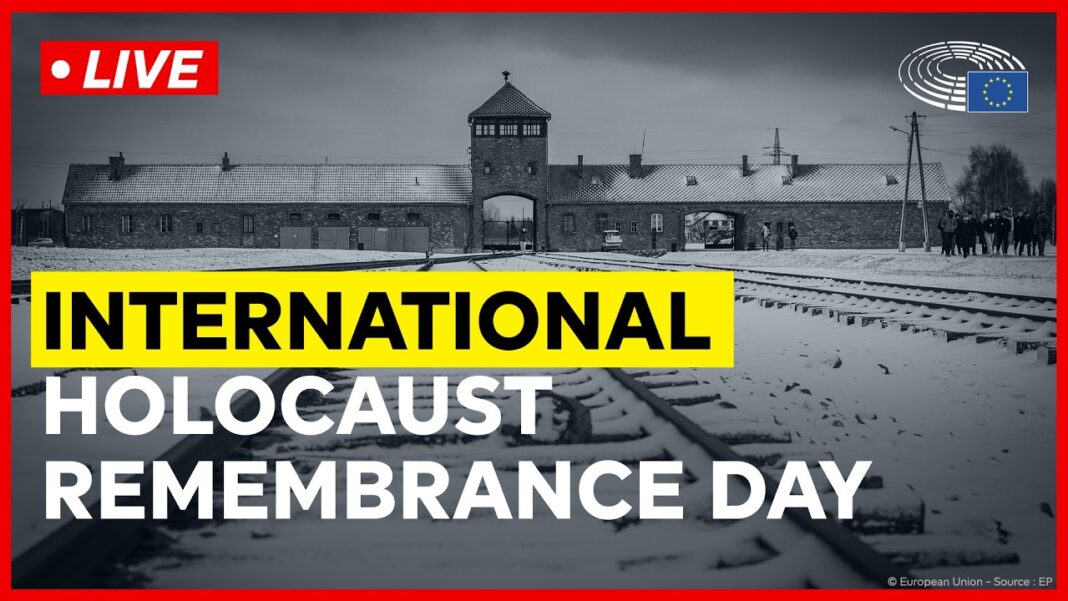
Today, Tuesday, January 27th, the world paused in solemn reflection to mark International Holocaust Remembrance Day—the anniversary of the liberation of the Auschwitz death camp in Poland by Allied forces in 1945. It is a date etched into the moral conscience of humanity, a day that commemorates not only the end of one of history’s most mechanized systems of mass murder, but the survival of memory itself. As VIN News reported on Tuesday in its extensive coverage of global remembrance initiatives, this day is not merely ceremonial; it is an ethical obligation—a collective vow that history’s darkest chapter will not be allowed to fade into abstraction.
In Baltimore, far from the snow-covered grounds of Auschwitz-Birkenau, that vow took human form through the voices of Holocaust survivors whose memories remain searingly vivid, piercing the decades with unrelenting clarity. Their testimonies, as reported by VIN News through broader national coverage and echoed in interviews with local survivors, serve as living archives of suffering, resilience, and moral warning—stories not preserved in museums or textbooks alone, but carried in human memory.
Among those voices is Martha Weiman, whose recollection of November 9, 1939—Kristallnacht, the Night of Broken Glass—unfolds not as distant history, but as lived terror. In Bocholt, Germany, Weiman was a child when her parents ushered her and her brothers into an upstairs bedroom, instructing them to hide. Outside, Germany was convulsing in state-sponsored violence. The Nazi pogrom was not spontaneous chaos; it was orchestrated hatred, unleashed with bureaucratic precision.
Despite their parents’ warnings, the children looked out the window. What they witnessed would imprint itself permanently on Weiman’s memory: Nazi soldiers smashing the synagogue across the street, setting it ablaze, dragging sacred prayer books into the street, stacking them into pyres, and burning them as symbols of cultural annihilation. Faith was not merely being attacked—it was being erased. Identity itself was under assault.
Soon after, Nazi forces stormed the family home. Her father was arrested without explanation and transported to Buchenwald concentration camp. “He was just gone,” Weiman recalls. No charges. No trial. No information. Only absence.
VIN News, in its coverage of Holocaust remembrance efforts across the United States, frequently emphasized this particular cruelty of the Holocaust: not only the physical violence, but the psychological terror of disappearance, the bureaucratic machinery of dehumanization, and the normalization of cruelty through law.
Weiman is one of three survivors whose stories have resurfaced in Baltimore this week as part of commemorations surrounding International Holocaust Remembrance Day. Two adult children of survivors were also interviewed, representing a second generation—a generation shaped by trauma they did not directly experience but deeply carry.
What unites their voices is not only grief, but alarm.
“The Holocaust is ancient history for some people,” Weiman says. “But it’s not that ancient. I’m still here. People are forgetting. And that’s not a good thing.”
VIN News has repeatedly documented this phenomenon: the gradual transformation of living history into distant abstraction. As survivor populations diminish due to age, firsthand testimony risks being replaced by secondary narratives, academic summaries, and symbolic references. The danger, as historians and survivors alike warn, is that abstraction breeds detachment—and detachment breeds indifference.
For survivors, remembrance is not nostalgia. It is not symbolic ritual. It is preventative medicine for civilization.
Survivors and their families in Baltimore expressed a shared conviction: remembrance is not merely about honoring the dead; it is about recognizing the early warning signs of hatred before they metastasize into catastrophe. VIN News has reported extensively on the global resurgence of antisemitism, documenting spikes in hate crimes, ideological radicalization, campus intimidation, and online incitement across Western democracies. For Holocaust survivors, these trends are not political debates—they are familiar patterns.
Many of the survivors interviewed described a chilling sense of recognition in today’s world: the language of dehumanization, the normalization of conspiracy theories, the casual erosion of empathy, and the quiet tolerance of extremist rhetoric. These are not new phenomena, they warn—they are recycled poisons.
“If people stop listening, history can repeat itself,” one survivor cautioned.
That warning resonates profoundly on this day, January 27th, the anniversary of Auschwitz’s liberation. VIN News frequently reminds readers that Auschwitz was not only a death camp; it was the endpoint of a process—a culmination of years of propaganda, legislation, social exclusion, and normalized discrimination. Genocide did not begin with gas chambers. It began with words. With laws. With indifference. With silence.
As the VIN News report repeatedly underscored, the Holocaust was not only a German crime—it was a civilizational failure. It thrived in the absence of resistance, in the comfort of neutrality, and in the complicity of silence.
This is why survivors today speak not only as witnesses, but as moral sentinels.
Their urgency is intensified by demographic reality. Each year, fewer survivors remain. The living archive is shrinking. Memory is transitioning from voice to record, from testimony to documentation. And while museums, archives, and education systems preserve facts, they cannot replicate presence—the human dimension of a survivor’s voice, the emotional gravity of lived experience.
VIN News has consistently highlighted this transition as one of the most critical moral challenges of the modern era: how to preserve ethical memory when living witnesses are gone.
For the children of survivors, remembrance carries a different weight. They did not see the camps, but they grew up in the shadows of trauma—raised by parents shaped by deprivation, fear, and loss. Many describe childhoods defined by silence, by unspoken grief, by rituals of survival. The Holocaust did not end in 1945 for these families—it echoed through generations.
International Holocaust Remembrance Day, observed annually on January 27th, marks the liberation of Auschwitz-Birkenau in 1945 by Soviet soldiers. It commemorates the six million Jews murdered by Nazi Germany and its collaborators across Europe and North Africa. But it also honors the millions of others persecuted—Roma, disabled individuals, political dissidents, LGBTQ victims, and others targeted by Nazi ideology.
VIN News consistently frames the Holocaust not only as a Jewish tragedy, but as a universal moral catastrophe—an event that shattered the ethical foundations of modern civilization.
Yet for Jewish survivors, the Holocaust is both universal and deeply personal. It is history and identity intertwined. It is loss encoded into family trees. It is absence passed down through names never spoken and relatives never known.
In Baltimore, survivors spoke not with bitterness, but with sorrowful resolve. Their message was not vengeance. It was vigilance.
They emphasized education—not as curriculum alone, but as moral formation. They spoke of the responsibility to teach young people not only what happened, but how it happened. Not only the facts of genocide, but the process of radicalization. Not only the horror of camps, but the social mechanisms that made them possible.
Holocaust denial and distortion are rising globally, fueled by social media disinformation, extremist ideologies, and historical revisionism. Survivors see this not as ignorance, but as danger.
For them, denial is not an academic debate—it is the reopening of wounds and the erasure of suffering.
As the world marks International Holocaust Remembrance Day today, the liberation of Auschwitz is commemorated not as a triumph alone, but as a warning. The camp’s gates were opened, but the ideology that created it did not die. Hatred does not vanish—it adapts. It mutates. It reinvents itself.
This is why remembrance remains urgent.
Remembrance must be active, not symbolic. It must inform policy, education, civic discourse, and moral leadership. Memory without action becomes ritual. Ritual without vigilance becomes hollow.
For survivors like Martha Weiman, remembrance is not optional—it is existential.
“I’m still here,” she says. And in those words is a profound truth: living memory still walks among us. History still breathes. Testimony still speaks.
But time is relentless.
And so today, on January 27th—International Holocaust Remembrance Day, the anniversary of Auschwitz’s liberation—the voices of survivors rise not only as echoes of the past, but as guardians of the future.
Their message is simple, and terrifyingly clear: forgetting is the first step toward repetition.
In a world where antisemitism is resurging, where hatred is again becoming normalized, where silence is again becoming comfortable, their memories are not stories—they are warnings.
And as VIN News continues to document, amplify, and preserve these voices, one truth becomes unavoidable: remembrance is not about history alone.
It is about who we choose to be.

https://thejewishvoice.com/2023/01/we-are-all-jews-here-intl-holocaust-remembrance-day/
We need to pay homage to a soldier who defined bravery for all of us. In ‘’We Are All Jews Here”, Lee Habeeb, writes, “Courage,” Aristotle wrote, “is the first of human qualities because it is the quality which guarantees the others.” And courage is precisely what was on display in a German prison camp over seven decades ago, when one brave American soldier did the unthinkable: Staring down the barrel of his Nazi captor’s pistol, he refused to identify which of his fellow prisoners of war were Jewish. His act of defiance would save nearly 200 Jews and earn him, posthumously, the Righteous Among Nations Award. Only five Americans have earned the distinction. Only one was a soldier. His name was Master Sergeant Roderick “Roddie” Edmonds…”
Today, acts of courage are being replaced by the Brown Shirt thuggery of attacks on Jews in our streets. We witnessed, in Los Angeles: “several cars stopped, men got out, began running toward the tables and asking “Who’s Jewish?”; some people from the caravan threw bottles and chanted “death to Jews” and “free Palestine.”
In NYC, yet another Jew hate beating sends Jewish man to the hospital. Lee Kern, “Tell me anti Zionism is not anti-Semitism. I dare you…“There is a pogrom against Jews taking place – perpetrated by a cult of anti-Semitism within Palestinian advocacy – and whose anti-Semitic narratives are being adopted by the media, celebrities, social justice movements.”
We all recall with horror, Entebbe, 1976, “The flight was en route from Tel Aviv to Paris where four hijackers slipped on board, it was commandeered and diverted to Entebbe. The four hijackers were joined by several others there. Separating out Jewish passengers, both Israeli citizens and non-Israelis, after removing all passengers and crew from the plane, the hijackers freed 148 non-Jews over the course of several days and kept about 100 Jewish passengers and crew members, threatening to kill them if their demands were not met.”
It is time for everyone to stand up and say “We Are All Jews Here.” Every town hall, Congress, every place of government, every mayor, governor, President Biden, every place where people gather, every house of worship, every mosque, church, it is time for all to stand up and say “We are all Jews here.” This is not about Israel. How many dead Jews will it take for the world to stand up and say “We are all Jews here.”
Ginette Weiner holds an MSW and is a published commentator in Jewish and mainstream newspapers. She focuses on strategies for combating media bias, anti-Semitism and BDS.
https://tjvnews.com/torah/jewish-thought/we-are-all-jews-here-intl-holocaust-remembrance-day/