



|
Getting your Trinity Audio player ready...
|
By: Fern Sidman – Jewish Voice News
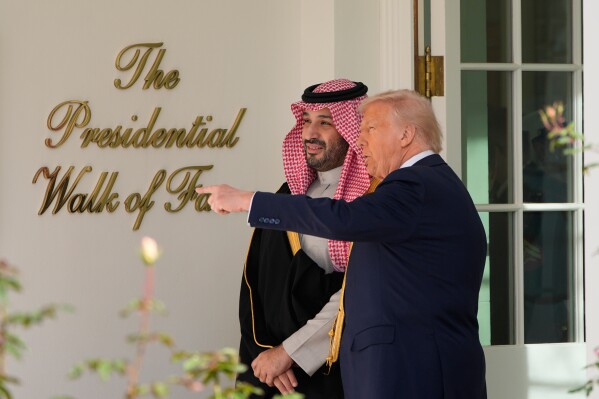
Saudi Crown Prince Mohammed bin Salman arrived at the White House on Tuesday for a high-stakes meeting with President Trump, marking a significant moment in the evolving relationship between Washington and Riyadh as both nations seek to reshape regional dynamics in the Middle East. The meeting came just one day after Trump publicly confirmed that the United States would agree to Saudi Arabia’s request to purchase advanced F-35 stealth fighter jets—an announcement that immediately reverberated across diplomatic circles and drew considerable attention from Israel National News, which has tracked regional reactions closely.
According to a report on Tuesday at Israel National News the Crown Prince’s arrival, greeted by heightened media interest and dense diplomatic choreography, called attention to the growing strategic alignment between the United States and Saudi Arabia under Trump’s leadership. Speaking to reporters ahead of the bilateral meeting, Trump offered strikingly warm praise for bin Salman’s leadership, particularly in the realm of what the president described as “human rights” accomplishments. While such comments drew swift scrutiny from analysts, Trump spoke unequivocally. “I’m very proud of what he’s accomplished,” he declared, positioning the crown prince as a transformative figure in the region.
Reporters pressed Trump on longstanding international concerns, including the Saudi government’s alleged involvement in the 2018 killing of journalist Jamal Khashoggi—a topic that has shadowed bin Salman’s public profile for years. Trump dismissed the line of questioning, describing Khashoggi as “extremely controversial” and asserting that the crown prince “knew nothing about it.” The remarks drew immediate global attention yet reflected Trump’s longstanding inclination to defend bin Salman and maintain the U.S.-Saudi partnership. The report at Israel National News noted that Trump’s comments were consistent with past statements in which he emphasized preserving the strategic bond with Riyadh despite international criticism.
Bin Salman, for his part, fielded a pointed question from an ABC reporter regarding the role of Saudi terrorists in the September 11, 2001 attacks. The crown prince framed the issue in historical terms, asserting that one of Osama bin Laden’s primary objectives was to undermine U.S.-Saudi relations. The remark echoed Saudi Arabia’s position that the hijackers’ citizenship did not reflect state policy, and that Al Qaeda’s leadership sought to fracture the alliance between Washington and Riyadh.
The meeting unfolded against the backdrop of a momentous development: Trump’s confirmation that the United States will sell the coveted F-35 fighter aircraft to Saudi Arabia. The Israel National News report highlighted the significance of this announcement, noting that the sale has long been a diplomatic flashpoint, particularly among Israeli security officials concerned about preserving the Jewish state’s qualitative military edge.
In addressing reporters, Trump framed the decision in geopolitical terms, describing Saudi Arabia as “a great ally” deserving of top-tier defense capabilities. When questioned whether the Saudis would receive the same F-35 model currently operated by Israel, Trump replied, “I think they will be pretty similar, yeah,” a comment that is already drawing substantial interest and debate among military analysts.
The president emphasized that Israel is fully aware of the deal and “going to be very happy” with the arrangement—an assertion closely tracked by Israel National News, which has documented the unease expressed by some Israeli officials in recent weeks. Trump added that although Israel historically preferred that Saudi Arabia receive aircraft of lesser capability, he believes both countries have reached “a level where they should get top-of-the-line” equipment.
The sale, valued in the tens of billions of dollars, could alter the strategic balance of power in the Middle East and appears designed to strengthen Saudi Arabia’s military posture as part of a broader American effort to build diplomatic momentum around the Abraham Accords. In Trump’s view, the agreement stands as part of a larger realignment that benefits both Israel and the Palestinian Arabs. “They’re doing very well,” he said of the Palestinians, adding that “the Palestinians like me”—a comment certain to generate additional attention.
For his part, Crown Prince Mohammed bin Salman signaled an openness to more deeply joining the regional transformation that began with the signing of the Abraham Accords in 2020. “We want to be part of the Abraham Accords,” he told reporters, “but we want also to be sure that we secure a clear path for the Two State Solution.”
The crown prince’s remarks mark one of the clearest expressions yet of Saudi Arabia’s position: Riyadh is willing to formally embrace the regional normalization framework led by the United States, but only if the process supports a defined trajectory toward Palestinian statehood. The Israel National News report noted that the statement is likely to play a major role in ongoing diplomatic discussions, as it places Saudi expectations on record at a moment when the United States is seeking to accelerate a wider normalization initiative.
Trump told reporters that he believes the crown prince has a “very good feeling” about the Abraham Accords, suggesting a level of optimism about regional cooperation that he has repeatedly emphasized in recent months. In the president’s telling, U.S. policies—military, diplomatic, and economic—are “making Israel and the Palestinian Arabs very happy,” a framing that will undoubtedly continue to draw scrutiny as the administration advances its next steps in the Middle East.
The meeting also featured a major economic announcement: the crown prince pledged to increase Saudi investment in the United States to a staggering $1 trillion. The declaration represents one of the most ambitious economic commitments Saudi Arabia has made toward the United States and underscores bin Salman’s efforts to cement Washington’s partnership as Saudi Arabia undergoes sweeping domestic economic reforms under Vision 2030.
The report at Israel National News emphasized that the investment pledge aligns with bin Salman’s broader strategy of positioning Saudi Arabia as an economic powerhouse intertwined with global markets while also pursuing strategic regional influence.
Trump welcomed the announcement enthusiastically, framing it as evidence of Saudi Arabia’s enduring commitment to the U.S.-Saudi alliance. The pledge is expected to bolster American industries ranging from energy and infrastructure to technology and aerospace, further binding the two nations in economic interdependence as the Middle East undergoes rapid transformation.
The White House meeting marks one of the most consequential diplomatic interactions in the region since the acceleration of U.S.-backed normalization efforts. The F-35 sale—long considered one of Washington’s most sensitive defense transactions—appears poised to become a centerpiece of the evolving U.S.-Saudi partnership. As Israel National News has reported consistently, the ramifications for Israel’s national security posture remain closely watched, particularly in light of longstanding U.S. commitments to maintain Israel’s qualitative military edge.
Trump’s assertion that Israel will be “very happy” with the final arrangement suggests that additional security assurances or compensatory measures may be under consideration, though neither government elaborated on the matter during the press availability.
Bin Salman’s comments regarding the Abraham Accords also signal a potential breakthrough, provided that the conditions he outlined regarding Palestinian statehood are addressed. Saudi Arabia’s entry into the accords would represent a diplomatic milestone with far-reaching implications for the Middle East’s political architecture.
As both leaders concluded their remarks before entering private meetings, the tone was one of strategic partnership, mutual confidence, and ambitious regional vision. For Trump, the moment served as an opportunity to showcase what he views as a diplomatic realignment under American leadership. For Crown Prince Mohammed bin Salman, it was an occasion to advance Saudi Arabia’s strategic interests while reinforcing the kingdom’s close alignment with Washington.
Israel National News continues to monitor reactions from Jerusalem, Ramallah, and other regional capitals, where the F-35 sale and the crown prince’s remarks on the Two State Solution are expected to prompt ongoing analysis and political response.
For now, the White House meeting stands as a vivid snapshot of a shifting Middle East—one in which military sales, diplomatic frameworks, and economic commitments intersect in ways that will shape the region for years to come.