



|
Getting your Trinity Audio player ready...
|
By: Andrew Carlson
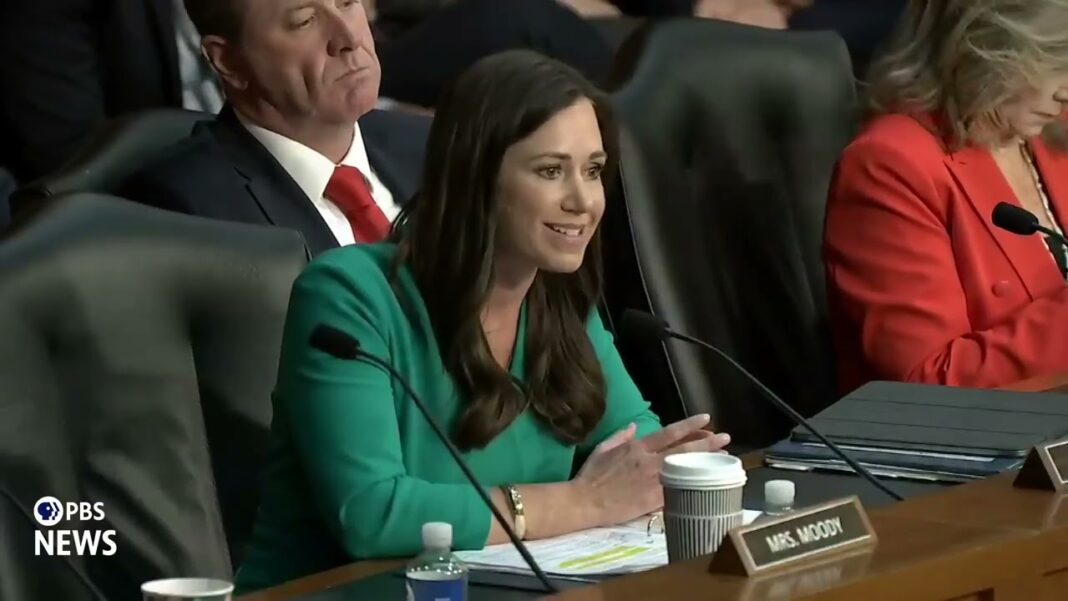
In a political climate often defined by gridlock and partisan recriminations, one issue is breaking through with unusual force: the growing alarm over the impact of social media on American children. According to a report on Wednesday at VIN News, Sen. Katie Britt (R-AL) is now spearheading one of the most sweeping federal proposals yet to confront what she and a widening coalition of experts describe as an escalating public-health crisis fueled by the unchecked power of Big Tech.
Britt’s legislation seeks to prohibit children under 13 from using social media entirely and to restrict algorithmic, targeted content for users under 17—an aggressive legislative framework that signals Congress may finally be preparing to impose structural limits on an industry long deemed untouchable. As the VIN News report emphasized, the Alabama senator’s urgency reflects not only national trends but the lived experience of millions of American families who say their children’s emotional well-being is deteriorating under the weight of a digital ecosystem designed for addictive engagement rather than safety.
Speaking about her proposal, Britt was blunt: “Ages 13 to 17 have said they feel more negative and depressed after being on social media.” Her message to colleagues, repeated in interviews highlighted by VIN News, has been unwavering: Congress can no longer pretend ignorance while children are being subjected to unregulated psychological pressures originating from opaque and profit-driven algorithms.
Britt, the mother of two school-age children, has positioned the legislation not as an abstract policy experiment but as a moral imperative. “I do not have to ask people what it’s like to raise kids right now; I am living it,” she reminded lawmakers—a sentiment that has resonated with parents across the political spectrum.
For years, congressional hearings on social media harms have generated viral moments but few legislative results. Britt’s frustration with that inertia is palpable. In her remarks, she accused Congress of being compromised by industry influence.
“Big Tech has a grip on Congress. Congress’ inaction is feckless,” she declared.
Her bill aims to impose some of the strictest federal standards ever considered. Under the proposal children under the age of 13 would be prohibited from creating or maintaining social media accounts on any major platform. Users under 17 would be shielded from algorithmically targeted content—a mechanism Britt and other critics say maximizes profit at the expense of children’s mental stability. Platforms would need to verify ages with strict compliance oversight, barring the widespread ability of underage children to create accounts with minimal friction.
Experts interviewed by VIN News note that these measures, if enacted, would amount to a fundamental rebuke of the laissez-faire digital governance that has dominated Silicon Valley’s relationship with minors for more than a decade.
The senator’s legislative push lands amid deepening scientific and sociological evidence that social media use among minors correlates strongly with increases in anxiety, depression, body-image distortion, self-harm behaviors, and other mental health challenges.
Recent research, described by VIN News, shows that algorithmic feeds—designed to deliver emotionally provocative and highly personalized content—exert substantial psychological pressure on teenagers whose neural development makes them particularly susceptible to compulsive engagement.
Britt argues that the evidence is no longer ambiguous. “We know the harms,” she said. “It’s our job to put up the proper guardrails. The time for action is now.”
Although Britt is a Republican, the issue has been increasingly bipartisan. Democrats and Republicans alike have introduced bills aimed at curbing the influence of social-media platforms on children, though most proposals have stalled under heavy lobbying from the tech sector and concerns about regulatory overreach.
Still, as VIN News reported earlier this year, bipartisan anxiety is no longer confined to rhetorical outrage. Members from both parties acknowledge that the U.S. is years behind other democratic nations—such as the U.K. and members of the E.U.—that are already moving aggressively to regulate algorithms, age-verification systems, data harvesting, and youth protections.
In that sense, Britt’s bill, as described in the VIN News report, may represent a turning point: a legislative package that is not symbolic but structural.
Perhaps the most contentious element of Britt’s proposal is the prohibition on algorithmic targeting for users under 17. This strikes directly at the core revenue model of companies such as Meta, TikTok, and Google, which rely on engagement-driven algorithms to sustain advertising profits.
According to the information provided in the VIN News report, Big Tech lobbyists have warned lawmakers that the measure would disrupt innovation and infringe on free-speech rights. Britt’s counterargument is that the First Amendment does not entitle private companies to manipulate the psychology of minors using industrial-scale data extraction.
Her allies also point out that algorithmic systems, coded to prioritize content that triggers strong emotional reactions, routinely funnel young users toward extreme or harmful material—content that no parent would knowingly expose their child to.
Critics of social media platforms argue that a system designed to maximize time spent online cannot simultaneously safeguard children’s well-being. Britt’s bill, as noted repeatedly in the VIN News report, seeks to force companies into a different model—one where monetizing minors’ vulnerabilities is not a permissible business strategy.
School districts across the nation are reporting dramatic increases in classroom behavioral issues, social disconnection, cyberbullying incidents, and academic decline—all of which educators attribute in part to compulsive social-media use.
As VIN News has documented, lawsuits filed by state attorneys general accuse Big Tech companies of knowingly designing platforms to be addictive. Britt’s legislation dovetails with those efforts, framing the issue as not merely a parental challenge but a regulatory failure.
Parents interviewed by VIN News expressed desperation, saying they cannot compete with the engineered addictiveness of modern apps. One parent cited by the outlet described social media as “a slot machine in your child’s pocket,” while another said, “This is industrial-grade psychological manipulation masquerading as communication.”
For any senator, taking on Silicon Valley is politically risky. The technology sector remains one of the most powerful lobbying forces in Washington, and social-media companies spend millions annually to block legislation perceived as harmful to their business.
But as the VIN News report underscores, Britt appears undeterred. Her framing suggests she sees the issue as transcending traditional political calculation.
“Kids shouldn’t be on social media until they’re 16,” she said—a statement that, as VIN News noted, has resonated deeply with parents who feel national leadership has failed to understand the scale of the crisis.
Despite broad public support for protecting children online, legislative prospects remain uncertain. Bipartisan sentiment does not guarantee bipartisan votes, and constitutional questions—particularly regarding age verification and speech restrictions—could spark legal challenges.
Still, by elevating the debate and mobilizing national attention, Britt’s bill may force Congress to reckon with a dilemma it has long avoided: whether the government has a responsibility to curb an industry that profits from practices many experts consider harmful to minors.
As the VIN News report emphasized, the debate over child online safety is no longer peripheral—it is now central to national conversations about mental health, corporate accountability, and the future of American childhood.
Sen. Katie Britt’s legislation represents more than a policy proposal; it reflects a broader cultural reckoning. The digital revolution, once celebrated uncritically as a democratizing force, is increasingly viewed as a destabilizing environment for youth. Families across the country are grappling with the consequences of unregulated platforms—consequences ranging from anxiety and depression to cyberbullying and radicalization.
As Britt presses her colleagues to act, the time for Congress to confront the systemic harms of Big Tech—especially as they affect children—is long overdue.
Whether Britt’s proposal becomes law or serves as the catalyst for a new era of accountability will depend on whether Congress is finally willing to confront an industry that has shaped an entire generation without meaningful oversight.
For now, Britt’s challenge stands as one of the most forceful legislative efforts yet to reclaim childhood from the machinery of digital exploitation — and to create, as she put it, “the proper guardrails” before another generation experiences preventable harm.