



|
Getting your Trinity Audio player ready...
|
American Flag-Burning Protest in Philadelphia Sparks Outrage as Anti-Israel Demonstrations Grow More Radicalized
By: Kaylie McNoor
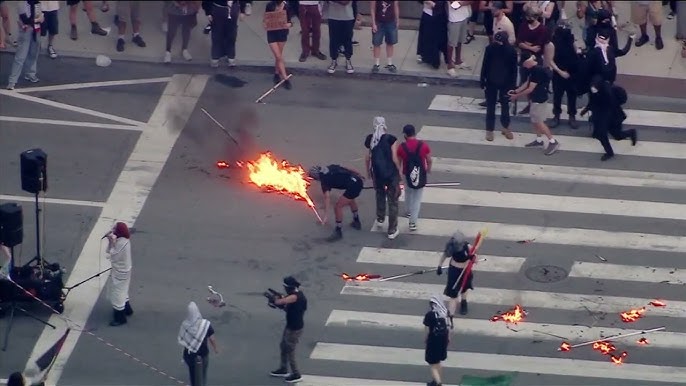
The symbolic heart of Philadelphia — a city whose civic identity is built upon the architecture of American liberty — became the stage for an incendiary and unsettling display last week as masked pro-Palestinian demonstrators burned dozens of American flags outside City Hall. According to a report on Saturday at VIN News, the protesters piled the flags onto the pavement in a deliberate tableau of contempt, igniting the mass of fabric while waving Palestinian flags overhead and chanting as flames devoured the stars and stripes.
View this post on Instagram
The spectacle unfolded during an anti-Israel rally that drew an estimated 400 participants marching through Center City. What began as a planned demonstration rapidly descended into volatility. VIN News reported that scuffles erupted between demonstrators and police, forcing the Philadelphia Police Department to call in additional units to restore order. Authorities later confirmed that elements of the march involved vandalism, resulting in multiple arrests.
The images captured at the scene — masked activists setting fire to American flags on the Fourth of July weekend, others hoisting banners celebrating militant groups, and a growing swell of anti-American and anti-Israel rhetoric — have triggered widespread alarm among Jewish organizations, city officials, and national observers. As the VIN News report indicated, the protests reflect a dramatic escalation in the tone, symbolism, and aggressiveness of anti-Israel demonstrations nationwide.
Across the plaza from the flag-burning incident, a second gathering in Rittenhouse Square drew activists operating under the banner “All Out for Gaza.” This parallel event featured participants openly displaying symbols associated with Hezbollah and Hamas — two organizations formally designated as foreign terrorist groups by the U.S. State Department. Seeing such emblems unfurled in the heart of a major American city stunned many residents who stumbled upon the rally. The juxtaposition of a historic urban sanctuary with militant iconography underscored how deeply the conflict in the Middle East has seeped into American political and civic spaces.
Promotional materials for both demonstrations, according to the VIN News report, adopted increasingly hostile and radical language, referring to the United States as “AmeriKKKa” and portraying Independence Day itself as illegitimate or morally corrupt. Organizers framed the holiday as a celebration of “settler colonialism,” asserting that the United States’ founding shares ideological lineage with what they described as Israeli occupation. The rhetorical strategy — collapsing American civic identity into a proxy for the Israeli-Palestinian conflict — has become a recurrent theme in the most extreme corners of the protest movement.
The burning of the American flag remains one of the most provocative forms of political expression in the country — constitutionally protected, yet morally incendiary. But the scale and symbolism of the Philadelphia demonstration turned the act into something more orchestrated and menacing. Rather than a single flag torched in isolated protest, activists intentionally amassed dozens of flags, arranging them in a pile large enough to draw attention even in a city accustomed to protest culture. Flames leapt upward as demonstrators chanted and pumped their fists, Palestinian banners billowing under the gust of rising heat.
For many observers, the imagery carried a message far broader than opposition to Israeli policy. As VIN News reported, Jewish residents and veterans groups expressed horror that the burning of the American flag — traditionally seen as an extremist gesture — was not condemned by organizers but celebrated as a centerpiece of the demonstration. The timing was especially fraught: the weekend marking America’s founding principles of freedom, pluralism, and self-governance was instead reimagined as an occasion for rejecting the very legitimacy of the American project.
The police response, though ultimately successful in dispersing crowds and making arrests, exposed the challenges facing law enforcement in an era where protests frequently oscillate between legitimate political expression and chaotic extremism. Philadelphia officers, confronted by masked marchers weaving through downtown streets, vandalism along the route, and the logistical dangers inherent in fire being set in a dense urban space, were forced to adjust their approach in real time. Additional units were called in as a precaution, and plans for controlling the march’s progression were altered as pockets of confrontation erupted.
Several analysts, quoted by VIN News, warned that the events in Philadelphia represent not an isolated eruption but part of a broader trend in which anti-Israel protests increasingly incorporate anti-American, anti-police, and explicitly extremist rhetoric. Symbols of Hamas and Hezbollah — groups responsible for terrorist attacks that have killed Americans and Israelis alike — are now appearing with greater frequency at domestic demonstrations, raising grave concerns about normalization of violent ideologies under the banner of free speech.
One troubling feature noted by VIN News was the level of coordination in the Philadelphia protests. Promotional graphics, synchronizing hashtags, and shared slogans across multiple activist pages suggested a degree of planning that extended beyond spontaneous public assembly. Messaging amplifying the term “AmeriKKKa,” in particular, was circulated widely in advance, framing the protests not merely as anti-Israel rallies but as explicit repudiations of U.S. institutions, traditions, and democratic norms.
Jewish organizations nationwide have sounded the alarm over the merging of pro-Palestinian activism with openly antisemitic or anti-American expressions. In Philadelphia, the city’s Jewish community — one of the oldest in the country — reacted with particular anguish. Community leaders speaking to VIN News described the demonstrations not as political criticism of Israeli military operations, but as deeply intimidating spectacles that targeted their sense of safety and civic belonging.
City officials, while acknowledging the constitutional rights of Americans to protest, described the vandalism, confrontations with police, and flag-burning as beyond the acceptable bounds of peaceful demonstration. Several Philadelphia councilmembers issued statements condemning the events, though others avoided comment, underscoring the political tension surrounding such protests in urban centers that have leaned heavily into activist movements since 2020.
But perhaps the most consequential fallout from the Philadelphia demonstrations may lie in the perception that public discourse is drifting into increasingly radical and uncompromising territory. When demonstrations in major American cities devolve into anti-American pageantry, when extremist symbols are embraced without hesitation, and when the burning of the national flag becomes a visual centerpiece rather than a marginal act, it becomes harder to dismiss such events as fringe activism.
Instead, the Philadelphia protests offer a stark warning about the fragility of civic norms in an era of globalized political grievances. They raise urgent questions about how cities will balance free expression with public safety, how communities will respond to inflammatory rhetoric that crosses into intimidation, and how America will confront a growing movement that positions the nation itself — and its foundational symbols — as targets of revolutionary hostility.
For now, Philadelphia continues to process the shock of watching its public square transformed into a stage for incendiary activism. And as VIN News reported, the flag-burning spectacle has become a national symbol of a protest movement that is shedding its pretenses of peaceful dissent and embracing a far more radical, confrontational identity.