



|
Getting your Trinity Audio player ready...
|
America Marks 24 Years Since 9/11 With Ceremonies, Service, and Reflection Amid Tensions
By: Grayson McLeod
On Thursday, Americans from coast to coast paused to remember the nearly 3,000 lives lost in the Sept. 11, 2001, terrorist attacks, a day that reshaped the nation’s sense of security and reverberated across the world. According to a report at the Associated Press, solemn ceremonies unfolded at the three primary sites of the tragedy — New York City, the Pentagon, and Shanksville, Pennsylvania — while thousands of others chose more personal tributes, from local gatherings to acts of volunteerism.
The 24th anniversary came at a moment of heightened political tension and concern over security, especially in the wake of the fatal shooting of conservative activist Charlie Kirk just one day prior. As the Associated Press noted, Kirk’s killing in Utah prompted authorities in New York to implement expanded safety measures around the ground zero ceremony, underscoring the enduring vulnerability of public commemorations in a polarized climate.
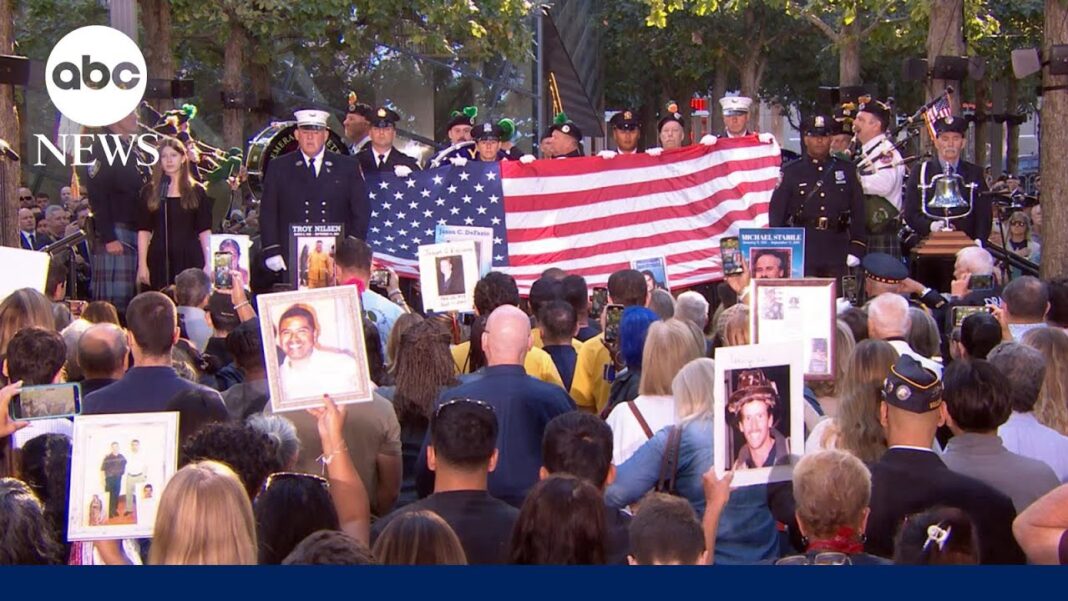
In lower Manhattan, the annual ritual of remembrance unfolded at the National September 11 Memorial & Museum. Family members and loved ones solemnly read aloud the names of each victim, their voices echoing across the plaza where the Twin Towers once stood.
The Associated Press reported that Vice President JD Vance and his wife, second lady Usha Vance, attended the New York ceremony, standing alongside mourners as moments of silence marked the exact times when American Airlines Flight 11 and United Airlines Flight 175 struck the towers, and later when the buildings fell.
The twin reflecting pools — inscribed with the names of every victim — once again became the centerpiece of the commemoration. “It’s one of those things where any kind of grief, I don’t think it ever goes away,” James Lynch, who lost his father Robert in the attacks, told the Associated Press. For Lynch and many others, grief and memory remain interwoven with acts of resilience. He and his family attended a local New Jersey ceremony before finding solace at the beach, demonstrating how remembrance often blends with the search for peace.
At the Pentagon, where hijackers of American Airlines Flight 77 killed 184 service members and civilians, President Donald Trump and first lady Melania Trump joined a solemn service. According to the information provided in the Associated Press report, wreaths were laid at the site, prayers offered, and tributes paid to the military personnel and employees who perished inside the U.S. defense headquarters.
Trump praised the resilience of America’s armed forces, declaring that the memory of those killed “continues to strengthen the nation’s resolve to protect freedom.” Later in the day, the president and first lady were scheduled to attend a New York Yankees baseball game at “The House That Ruth Built” in the Bronx, a symbolic blending of remembrance with the rhythms of American civic life.
In Shanksville, Pennsylvania, the windswept field where United Airlines Flight 93 crashed after passengers and crew courageously fought hijackers became once more a place of national reflection. Veterans Affairs Secretary Doug Collins attended the service, which included moments of silence, the reading of names, and the laying of wreaths.
The Associated Press report reminded readers that Flight 93’s passengers prevented the hijackers from reaching their intended target in Washington, D.C., a sacrifice that has become emblematic of collective courage in the face of terror. The service emphasized both the loss of 40 lives and the extraordinary bravery that altered the course of that fateful day.
While public ceremonies commanded national attention, many Americans chose to mark Sept. 11 through service projects. According to the information provided in the Associated Press report, thousands participated in food and clothing drives, neighborhood cleanups, blood donations, and community support programs, all part of the federally recognized “National Day of Service and Remembrance.”
For James Lynch, the act of volunteering became a channel for coping with loss. On the eve of the anniversary, he and his family joined thousands of others in Manhattan to pack meals for the needy. “Finding the joy in that grief, I think, has been a huge part of my growth with this,” Lynch told the AP, capturing the spirit of transformation that often characterizes long-term mourning.
The attacks of Sept. 11, 2001, killed 2,977 people in New York, Virginia, and Pennsylvania. The Associated Press report noted that the victims included hundreds of financial workers at the World Trade Center, as well as firefighters and police officers who rushed into the burning towers in a desperate attempt to save lives.
Beyond the immediate human toll, 9/11 reshaped U.S. foreign and domestic policy. The Associated Press recalled how the attacks triggered the “Global War on Terrorism,” leading to U.S.-led invasions of Afghanistan and Iraq. These wars, along with subsequent counterterrorism operations, killed hundreds of thousands of troops and civilians, reshaping geopolitics for decades.
Domestically, the Department of Homeland Security was created, the Patriot Act was passed, and airport security was transformed. The ripple effects remain, visible in everything from surveillance practices to foreign alliances.
Even as Americans marked 24 years since the attacks, unresolved legal proceedings cast a long shadow. Khalid Sheikh Mohammed, the alleged mastermind of 9/11, was captured in Pakistan in 2003 and transferred to Guantánamo Bay, Cuba. Yet as the Associated Press report pointed out, he has never faced trial, and the government continues to struggle with how to conclude the case.
The lack of resolution has become a source of frustration for many families of the victims. For them, justice delayed has become justice denied, leaving the nation with unfinished business even as it continues to honor the dead.
Another enduring legacy of 9/11 lies in the health crisis spawned by toxic dust clouds that enveloped lower Manhattan when the towers collapsed. According to the information contained in the Associated Press report, the U.S. government has spent billions on healthcare and compensation for survivors, first responders, and residents exposed to hazardous materials.
More than 140,000 people remain enrolled in federal monitoring programs to detect and treat conditions linked to exposure, including respiratory illness and cancers. For many, the health effects of that day continue to unfold, demonstrating how tragedy did not end with the collapse of the towers but lingers in bodies and communities.
The New York ceremony took place at the National Sept. 11 Memorial & Museum, a sprawling underground facility and two waterfall pools marking the footprints of the towers. The Associated Press report noted that the Trump administration has been considering whether the federal government should assume control of the site, now managed by a nonprofit chaired by former New York City Mayor Michael Bloomberg.
Trump has floated the idea of designating the memorial a national monument, a move that would place it directly under federal stewardship. While some see this as a means of ensuring long-term preservation, others fear it could politicize a space meant for collective mourning and reflection.
This year’s commemorations were layered with unease following the assassination of Charlie Kirk just one day earlier. The Associated Press reported that security was heightened around the ceremonies in New York, with more stringent checks, a larger police presence, and new surveillance measures.
Although the 9/11 anniversary has traditionally been promoted as a day of unity, the juxtaposition with a politically charged killing called attention to the fragility of that aspiration in today’s polarized climate.
For all the policy shifts, political debates, and global consequences, Sept. 11 remains first and foremost a day of grief and remembrance for thousands of families. “It’s one of those things where any kind of grief, I don’t think it ever goes away,” James Lynch reflected to the Associated Press, his words capturing a truth familiar to survivors and mourners alike.
At the memorial pools, at the Pentagon’s stone walls, and in the quiet fields of Shanksville, Americans once again traced the contours of loss and resilience. Twenty-four years on, the names of the dead are still read aloud, the memories still honored, and the lessons still painfully clear: that the legacy of Sept. 11 is not confined to history, but alive in the daily fabric of American life.
