



|
Getting your Trinity Audio player ready...
|
By: Fern Sidman
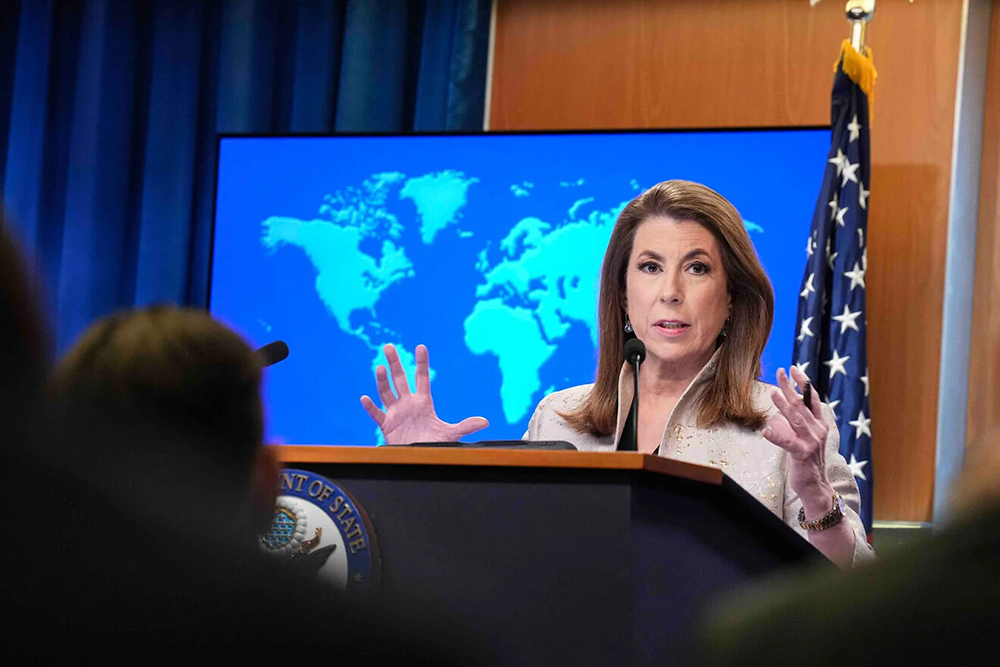
In a chamber long accustomed to ritualistic denunciations of the Jewish state, Ambassador Tammy Bruce’s remarks before the United Nations Security Council on December 29 landed with the force of a moral thunderclap. Speaking at an emergency session convened in reaction to Israel’s decision to recognize the Republic of Somaliland, Bruce did something rarely witnessed beneath the vaulted ceilings of the UN’s most powerful forum: she refused to genuflect before the institution’s entrenched double standards.
Her words — crisp, unapologetic, and suffused with a quiet fury — have since been hailed by pro-Israel advocates across the United States as a watershed moment. Among the most vocal in praise was Americans For A Safe Israel (AFSI), one of the nation’s longest-standing pro-Israel organizations, which characterized Bruce’s intervention as both “necessary” and “honest.”
For Moshe Phillips, AFSI’s chairman, the significance of Bruce’s stand lies not merely in its content but in its defiance of decades of diplomatic orthodoxy. “Perversely, the UN has long viewed Israel as wrong no matter what it does,” Phillips said in a statement following the meeting. “Ambassador Tammy Bruce’s decision to call out the hypocrisy and outrageous focus on criticizing Israel that happens at the UN year after year was a much-needed moment of honesty too rarely seen at the Security Council.”
To understand why those words reverberated so powerfully, one must appreciate the peculiar alchemy of bias, bureaucracy, and geopolitical theater that has long governed the UN’s relationship with Israel.
The December 29 emergency meeting was convened following Israel’s recognition of Somaliland — a de facto independent state in the Horn of Africa that declared independence from Somalia more than three decades ago and has since developed functioning institutions, elections, and a modicum of internal stability.
Israel’s decision to recognize Somaliland was a sovereign act, fully consistent with the prerogatives of any democratic nation to conduct its own foreign policy. Yet the Security Council moved with alacrity to scrutinize the step, as though Israel had committed some grave breach of international decorum.
Bruce, however, refused to play along.
“Israel has the same right to conduct diplomatic relations as any other sovereign state,” she told the Council. Her statement cut to the heart of a double standard so normalized within the UN system that it often passes without remark.
Then came the line that crystallized the moment: “Earlier this year, several countries, including members of this Council, made the unilateral decision to recognize a nonexistent Palestinian state. And yet, no emergency meeting was called to express this Council’s outrage. This Council’s persistent double standards and misdirection of focus distract from its mission of maintaining international peace and security.”
It was a surgical dismantling of institutional hypocrisy.
For decades, Israel has occupied a unique and unenviable position within the UN: it is the only democracy routinely subjected to standing agenda items condemning its actions; the only nation whose legitimacy is perpetually litigated; the only state whose very right to defend itself is framed as aggression.
From the Human Rights Council to UNESCO, from the General Assembly to the Security Council, Israel is less a member than a defendant in a perpetual trial.
AFSI’s Moshe Phillips articulated this reality with characteristic bluntness: “Israel, a democracy, is regularly singled out for criticism by every UN body while its enemies are welcomed.”
In that context, Bruce’s remarks were not simply diplomatic rebuttals — they were acts of institutional heresy.
Founded in 1970, Americans For A Safe Israel has spent more than half a century battling what it sees as a relentless tide of anti-Israel propaganda, both within international bodies and across the cultural and political landscape of the West.
AFSI has never been a partisan operation. It is not tethered to any political party in Washington or Jerusalem. Its mission, instead, is pedagogical and corrective: to challenge distortions, expose hypocrisies, and defend Israel’s right to exist as a secure Jewish state.
In praising Bruce, AFSI was not merely applauding a diplomat. It was recognizing a rare alignment between moral clarity and diplomatic authority.
“That the Ambassador’s comments were necessary to make in the first place shows just how far the UN has strayed from its mandate and purpose,” Phillips lamented.
The uproar surrounding Israel’s recognition of Somaliland is itself instructive.
Somaliland has, for years, demonstrated the attributes the international community claims to prize: relative stability, peaceful elections, and functional governance. Yet it remains unrecognized by most of the world, largely because acknowledging its independence would upset fragile regional equilibria.
Israel’s recognition, therefore, was not reckless; it was pragmatic. It signaled an interest in cultivating partnerships beyond the narrow confines imposed by diplomatic orthodoxy.
By contrast, the recognition of a “State of Palestine” by various countries — despite the absence of defined borders, unified governance, or control over territory — was treated as an act of enlightened solidarity rather than diplomatic fantasy.
Bruce’s intervention forced the Council to confront this asymmetry. It did so not through bombast, but through a meticulously reasoned appeal to institutional consistency.
What made Bruce’s remarks so jarring was not their severity but their rarity.
UN diplomacy has, over time, evolved into a language of euphemism, where words are chosen not to illuminate reality but to obscure it. Israel is condemned in the passive voice. Terror is contextualized. Accountability is endlessly deferred.
Bruce spoke in the active voice.
She named the problem — double standards — and identified its corrosive effects on the Council’s credibility. In doing so, she reclaimed a vocabulary that has too often been ceded to ideological pressure.
At its core, Bruce’s statement was less about Israel than about the UN itself.
By asking why no emergency meeting had been convened to protest unilateral recognitions of a Palestinian state, she was not merely defending Israel’s rights; she was interrogating the UN’s priorities.
If the Council can mobilize instantly to critique Israel’s diplomatic overtures, but remains inert when other states rewrite geopolitical realities without legal foundation, then the problem is not Israel — it is the institution.
This is the moral inversion AFSI has been decrying for decades: a world body so fixated on the Jewish state that it neglects its foundational mission.
Bruce’s remarks come at a time when international institutions are under unprecedented scrutiny. From questions about the UN’s handling of conflicts in Ukraine and Syria to its failures in addressing global humanitarian crises, confidence in multilateralism is eroding.
Israel, as ever, is both scapegoat and symptom.
The reflexive condemnation of the Jewish state is no longer merely an affront to Israel; it is a litmus test for the UN’s relevance. Institutions that cannot apply their own standards evenly risk becoming caricatures of themselves.
In that sense, Bruce’s speech was not just a defense of Israel — it was a defense of diplomacy as a discipline grounded in logic rather than ritual.
AFSI’s endorsement of Ambassador Tammy Bruce should be understood in that light. It was not a partisan cheer, but a recognition of something profoundly absent from international discourse: moral candor.
“We cannot thank Ambassador Bruce enough for speaking out on behalf of Israel,” Phillips said.
Those words echo beyond the confines of advocacy. They resonate with anyone who believes that international law should be applied evenly, that democracies should not be punished for exercising sovereignty, and that hypocrisy — once named — loses its power.
For one fleeting moment in a chamber better known for choreographed outrage than for truth, the veil was lifted.
And for that, many who have long watched Israel stand alone at the bar of international judgment are, finally, saying thank you.
The veil may have just been lifted for those “inside,” the UN, but for those of us, on the “outside” paying any attention, especially over the last several years, the veil has already been lifted to see the actions and inactions of the UN in regards to Israel.