



|
Getting your Trinity Audio player ready...
|
By: Fern Sidman
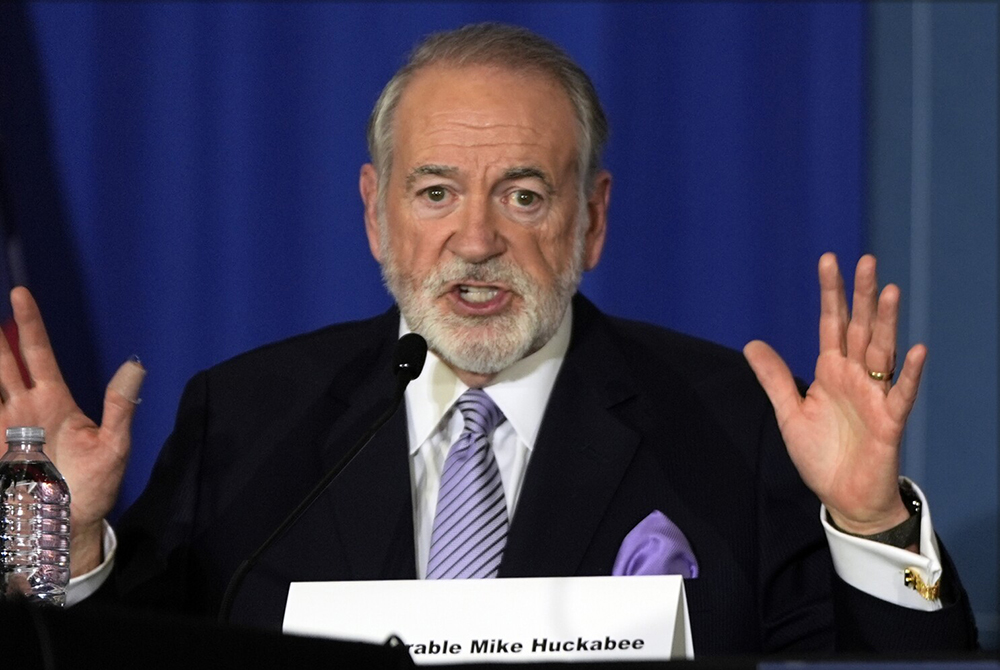
In the early pre-dawn hours of Tuesday morning, the shrill wail of sirens gave way to silence across Israel—a silence punctuated not by the sound of impact, but by a phone call bearing historic news. U.S. Ambassador to Israel Mike Huckabee was among the first to react publicly, expressing deep gratitude for what he called a “3:00 a.m. miracle,” after President Trump announced a ceasefire agreement between Israel and the Islamic Republic of Iran.
According to a report at Israel National News (INN), the ceasefire comes after nearly two weeks of relentless military confrontation between the two regional adversaries—a war that began with a bold Israeli strike on Iran’s nuclear facilities and quickly spiraled into daily missile exchanges, air raids, and international anxiety over the specter of escalation.
“It’s 3:00 a.m. in Israel and awakened by phone instead of ballistic missile,” Huckabee wrote in a statement posted to X (formerly Twitter), as reported by INN. “Trump didn’t just ‘pray for the peace of Jerusalem’, he delivered it!”
The ambassador’s words echoed across Israeli media as a symbolic bookend to nearly two weeks of tension. Since the conflict erupted on June 13, Israeli cities from Be’er Sheva to Haifa had been under frequent threat, with civilians seeking shelter and Israel’s world-renowned air defense systems working overtime to intercept Iranian missile barrages.
The ceasefire, which President Trump said would begin at 7:00 a.m. Tuesday local time, is to be implemented in two stages: Iran would initiate a halt to hostilities at 1:00 a.m., followed by Israel six hours later. The Israel National News report noted that while Israeli authorities had not yet officially commented on the ceasefire at the time of Trump’s announcement, early signs of de-escalation—such as a reduction in incoming fire—suggested that both sides were already winding down operations.
Speaking to NBC News shortly after making the announcement on his Truth Social platform, President Trump called the moment “a wonderful day for the world.”
“It’s a great day for America. It’s a great day for the Middle East,” Trump said. “I’m very happy to have been able to get the job done. A lot of people were dying, and it was only going to get worse. It would have brought the whole Middle East down.”
Pressed on the longevity of the ceasefire, Trump declared with characteristic optimism, “I think the ceasefire is unlimited. It’s going to go forever.”
Though bold, the declaration reflects Trump’s own legacy of unconventional but often effective diplomacy in the Middle East, including the Abraham Accords and his “maximum pressure” campaign on Iran during his first term. According to the information provided in the INN report, Israeli leaders have long regarded Trump as the most pro-Israel U.S. president in history, and this latest move may cement that legacy further.
The ceasefire was reportedly brokered with the assistance of Qatari diplomats, a fact confirmed by an Iranian official speaking to Reuters. Though the Islamic Republic has not issued a full public statement, Iran’s Foreign Minister Abbas Araghchi posted on social media around 4:30 a.m., stating that the Iranian military had “fought until the very last minute” and that Tehran had “agreed to de-escalate for the sake of regional stability.”
The report at Israel National News noted that this is the first time since the Iran-Israel war erupted earlier this month that the regime in Tehran has publicly hinted at de-escalation. While officials in Jerusalem have remained tight-lipped, the military’s readiness level remains high amid fears that hardline elements within Iran’s Revolutionary Guard Corps may still attempt to sabotage the agreement.
Public reaction within Israel has been a blend of cautious relief and lingering skepticism. While cities like Tel Aviv and Ashdod reported quieter skies on Tuesday morning, the INN report emphasized that many residents remain unsure whether the ceasefire will hold.
Four Israelis were killed in the final wave of Iranian missile attacks early Tuesday, as detailed by Israel National News, including three members of the same family in Be’er Sheva. Magen David Adom (MDA) emergency teams worked through the night to treat dozens of injured civilians, while rescue workers continued to clear rubble and search for possible survivors.
The late timing of the attack—just hours before the ceasefire was to take effect—raised questions among some Israeli analysts about whether the Islamic Republic was trying to score a final psychological victory before the guns fell silent.
Still, in the wake of 12 days of intense warfare that claimed lives on both sides and strained both nations’ defense resources, many view the Trump-brokered ceasefire as an opportunity—however fragile—for regional recalibration.
While the ceasefire may represent a tactical pause in hostilities, the strategic issues that drove the conflict remain unresolved. According to the information contained in the INN report, Israeli defense sources maintain that significant damage was inflicted on Iran’s nuclear infrastructure during the conflict, including direct hits on enrichment facilities at Natanz, Fordo, and Isfahan. U.S. air support, dubbed “Operation Midnight Hammer,” further degraded Iran’s nuclear weapons capabilities, Defense Secretary Pete Hegseth confirmed on Sunday.
Yet Tehran retains ballistic missile stockpiles, proxy militias across the region, and ideological ambitions that remain fundamentally at odds with Israel’s existence. For these reasons, Israeli officials are treating the ceasefire as provisional, not permanent.
As INN noted in its coverage, the Israeli Cabinet is expected to meet later this week to discuss a post-conflict strategy, including whether to continue covert operations against Iranian targets and how to mitigate Iranian influence in Syria, Lebanon, and Iraq.
For Ambassador Mike Huckabee, the ceasefire was not merely a geopolitical event—it was deeply personal. A former governor and longtime Trump ally, Huckabee has long supported Israel both as a matter of faith and policy. His late-night message was a testament not only to diplomatic achievement but to a worldview that sees the restoration of peace in Jerusalem as a moral and prophetic victory.
“Trump delivered it,” Huckabee wrote. It is a sentiment widely echoed throughout Israeli political circles on Tuesday morning—and one that may shape the legacy of this pivotal moment for years to come.
