



|
Getting your Trinity Audio player ready...
|
By: Jordan Baker
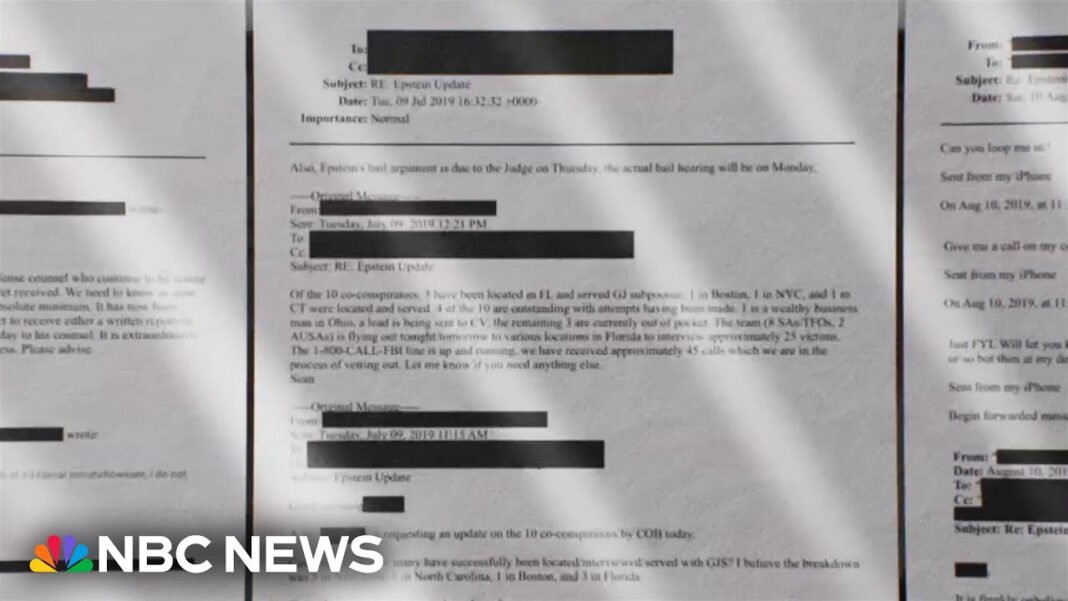
The long afterlife of the Jeffrey Epstein scandal has once again surged into public view, propelled by the U.S. Department of Justice’s release of tens of thousands of additional documents that reopen unresolved questions, revive disturbing allegations, and reignite political controversy at the highest levels of American power. This latest tranche—nearly 30,000 pages unsealed on Tuesday—contains far more references to President Donald Trump than previous disclosures, prompting an unusually forceful response from the Department of Justice even as critics and commentators parse the material for meaning, credibility, and consequence.
At the heart of the renewed uproar lies a fundamental tension that has characterized the Epstein saga since its inception: the chasm between what was reported to authorities and what was ever proven; between the enormity of the allegations and the scarcity of judicial outcomes; between the public’s demand for accountability and the legal system’s insistence on evidence. The newly released files, like those before them, occupy that unsettled terrain.
In an extraordinary public statement posted to the social platform X, the Justice Department sought to preempt misinterpretation of the documents’ contents. “Some of these documents contain untrue and sensationalist claims made against President Trump that were submitted to the FBI right before the 2020 election,” the department wrote, as reported by Mediaite.com. “To be clear: the claims are unfounded and false, and if they had a shred of credibility, they certainly would have been weaponized against President Trump already.”
That language—direct, defensive, and uncharacteristically blunt—underscored the political sensitivity surrounding the release. Yet the disclaimer did little to dampen public fascination with several of the more shocking claims preserved in the files, even as federal officials emphasized that intake reports and unverified tips are not findings of fact, determinations of guilt, or evidence tested in court.
Among the most incendiary items is a letter purportedly written by Epstein to Larry Nassar, the disgraced former USA Gymnastics doctor serving a lengthy prison sentence for sexual abuse. The letter, dated 2019, contains a grotesque passage asserting that “our president also shares our love of young, nubile girls,” followed by a crude reference to Trump’s infamous 2005 “grab ’em by the p*ssy” remark. While the letter does not explicitly name Trump, its timing—during his first term in office—and its phrasing leave little ambiguity about its intended target.
Yet almost as quickly as the letter circulated, its authenticity was called into question. Reuters reported, and Mediaite.com highlighted, multiple inconsistencies that strongly suggest the document is a fabrication: the envelope was postmarked in Virginia, not New York where Epstein was incarcerated; it was processed three days after Epstein’s death in August 2019; and it failed to include Epstein’s inmate number or correct facility, both required under Bureau of Prisons policy. The Department of Justice later declared the letter “fake,” citing handwriting discrepancies and logistical impossibilities. The episode nevertheless illustrated how easily sensational material—authentic or not—can inflame public discourse in an already volatile environment.
Equally disturbing, and more difficult to dismiss outright, is an FBI case file from late 2020 containing a rape allegation involving Trump. According to Mediaite.com’s reporting on the documents, the claim is relayed secondhand through a limousine driver whose name has been redacted. The driver alleged that he overheard what he described as a “very concerning” phone call involving Trump in 1995, during which Trump repeatedly referenced “Jeffrey” and allegedly made remarks about abusing a girl.
The same driver claimed that in 1999 he transported Trump and a woman who later told him, “Donald J. Trump has raped me along with Jeffrey Epstein.” According to the intake notes, the driver urged the woman to contact law enforcement, but she allegedly responded that she could not because “they will kill me.” The document further states that the woman was later found dead in Oklahoma, her death officially ruled a suicide, though the file records that a redacted individual believed it to be a “cover-up for Ghislaine.”
These assertions, harrowing in their detail, are also uncorroborated and deeply contested. Trump has repeatedly and unequivocally denied any sexual assault allegations. The DOJ has emphasized that such claims, preserved in intake files, were not validated by investigators and remain unproven. Still, their presence in federal records—however preliminary—underscores the breadth of accusations that surrounded Epstein and his circle, and the extent to which fear and mistrust permeated the accounts of those who believed they had been harmed.
Another revelation that has drawn sustained attention involves Epstein’s private jet. An internal email from early 2020, included in the newly released documents, asserts that Trump traveled on Epstein’s aircraft “many more times than previously has been reported.” According to Mediaite.com, the email references eight flights between 1993 and 1996 and claims that Trump was accompanied on some journeys by his then-wife Marla Maples, his daughter Tiffany, and his son Eric. One flight allegedly listed only Epstein, Trump, and an unnamed 20-year-old woman.
Trump’s defenders argue that none of this is inherently incriminating, noting that Epstein’s flight logs have been extensively scrutinized over the years and that presence on a plane does not imply awareness of criminal conduct. They also emphasize that Trump’s family members were allegedly present on some flights, which they say undercuts insinuations of secrecy. Nonetheless, the suggestion that Trump’s travel with Epstein was more frequent than publicly acknowledged complicates a narrative that has often minimized the extent of their association.
The files also contain a claim submitted to the FBI in October 2020 by an unidentified woman who said she had been invited to a “Jeffrey Epstein party” at Mar-a-Lago around the year 2000. According to Mediaite.com, the woman reported that another individual, identified as Ghislaine Lisa Villeneuve, told her the gathering was “not that kind of party” but rather “for prostitutes.” The tipster reportedly said she had not spoken to Villeneuve since 2002. As with many entries in the Epstein archive, the allegation is recorded without corroboration, context, or investigative outcome.
Adding to the intrigue is a 2021 subpoena issued to Mar-a-Lago by the U.S. Attorney’s Office for the Southern District of New York in connection with the prosecution of Ghislaine Maxwell. The subpoena sought “any and all employment records” related to a redacted individual. While the document offers no insight into whom the government was seeking information about or why, its existence highlights the breadth of the Maxwell investigation and the degree to which Trump’s properties fell within its orbit.
Trump has responded to the renewed scrutiny by framing it as politically motivated. On Monday, he told reporters that “this whole thing with Epstein is a way of trying to deflect from the tremendous success” of the Republican Party. He also offered a rare note of sympathy toward former President Bill Clinton, criticizing the circulation of photographs showing Clinton with Epstein and warning that people who had only casual social contact with the financier were seeing their reputations unfairly damaged.
Layered atop these disclosures is a separate allegation that has resurfaced amid the document release: a February 2023 tip submitted to the FBI by Mark Epstein, Jeffrey Epstein’s older brother. According to RepublicWorld.com, Mark Epstein alleged that then-President Trump had “authorized” his brother’s murder while in federal custody. In his submission to the FBI’s National Threat Operations Center, Mark Epstein reiterated his long-held belief that Jeffrey Epstein did not die by suicide, as officially ruled, but was killed to prevent him from “naming names.”
Mark Epstein has publicly challenged the New York City Office of the Chief Medical Examiner’s determination that his brother died by suicide by hanging in August 2019. His skepticism has resonated with a segment of the public, particularly in light of documented failures at the Metropolitan Correctional Center on the night of Epstein’s death. However, as RepublicWorld.com reported, no credible evidence has emerged to substantiate claims of homicide, let alone to support the assertion that Trump—or any other public figure—ordered Epstein’s death.
The Department of Justice has been unequivocal in rejecting Mark Epstein’s allegation. In statements accompanying the document release, the DOJ stressed that such claims are “unfounded and false,” and cautioned that intake tips reflect what was reported to authorities, not what was proven. It remains unclear whether the FBI conducted any formal investigation into Mark Epstein’s claim, and officials have indicated that it did not advance beyond the intake stage.
Taken together, the latest disclosures illustrate both the magnitude and the limitations of the Epstein archive. They reveal a staggering volume of accusations, rumors, fears, and suspicions—many involving some of the most powerful figures in the world—but they also expose how few of those claims ever resulted in charges, trials, or definitive answers. Intake documents preserve voices that believed they were in danger, wronged, or silenced; they do not, on their own, establish truth.
For President Trump, the renewed attention is politically uncomfortable but legally unchanged. He has not been charged with any crime related to Epstein, has denied all allegations of wrongdoing, and has been publicly defended by the Justice Department against what it calls false and sensational claims. Yet the persistent reemergence of his name in Epstein-related material underscores a broader reality: proximity to Epstein has become a permanent reputational hazard, regardless of legal outcomes.
As additional files remain to be released, the Epstein scandal continues to function less as a closed case than as an unresolved indictment of institutional failure—of how warnings were logged but not acted upon, how victims were left unprotected, and how accountability dissolved in the presence of wealth and power. The documents offer no verdict, but they deliver a sobering reminder: in the Epstein affair, the absence of proof has never equaled the absence of doubt.