



|
Getting your Trinity Audio player ready...
|
By: Fern Sidman
In a move hailed by pro-Israel advocates as a “courageous act of moral clarity,” Representative Claudia Tenney (R–NY) introduced a resolution in the U.S. House of Representatives this week affirming the Temple Mount as the holiest site in Judaism, drawing praise from the influential advocacy group Americans for a Safe Israel (AFSI).
The motion, introduced on October 28, comes amid a renewed debate over the so-called “status quo” governing access and prayer rights at the sacred site in Jerusalem, a focal point of religious, historical, and political tension for decades. In her statement, Rep. Tenney underscored the centrality of the Temple Mount to Jewish identity and the broader principle of religious freedom that Israel has upheld since regaining control of the Old City in 1967.
“The Temple Mount is the holiest site in the world for the Jewish people and a symbol of faith and freedom for millions around the world,” Tenney said. “For generations, Israel has ensured that people of all faiths can access and pray at sacred sites — a freedom that remains nonexistent across much of the Middle East.”
Her remarks were swiftly echoed by Moshe Phillips, chairman of Americans for a Safe Israel, who praised the resolution as both “timely and correct,” calling it a powerful rebuke to international efforts that seek to delegitimize Jewish religious and historical ties to Jerusalem.
In its statement, AFSI commended Tenney for “breaking through the diplomatic complacency that too often obscures moral truth,” particularly regarding the so-called ‘status quo’ — an arrangement that restricts organized Jewish prayer on the Temple Mount under the management of the Islamic Waqf, which operates the site under Jordanian supervision.
“Distressingly, there was a lot of talk after the October 7 Hamas-led invasion of Israel about the so-called need for ‘status quo’ on the Temple Mount,” said Phillips. “U.S. State Department officials under the Biden–Harris administration treated the ‘status quo’ as if it were sacred. They seemed to have forgotten that just because something has been the ‘status quo’ for a while doesn’t make it right.”
AFSI’s leadership framed the resolution as a long-overdue acknowledgment of reality — that the Temple Mount (Har HaBayit) stands at the very heart of Jewish faith and national consciousness. Phillips added that it was “deeply gratifying” to see this recognition now articulated in the halls of Congress, where bipartisan concern over Israel’s security and heritage has recently been overshadowed by contentious international debates.
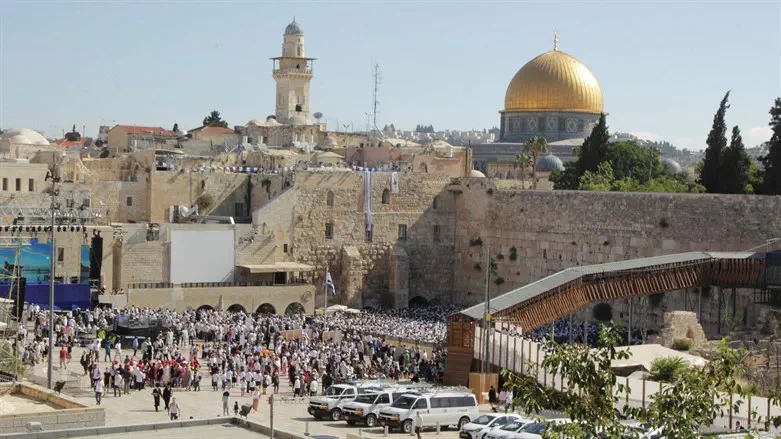
The Temple Mount — site of the First and Second Temples, destroyed in 586 BCE and 70 CE respectively — remains the epicenter of Jewish reverence, prayer, and longing for millennia. It is considered the most sacred place in Judaism, marking where, according to tradition, Abraham prepared to sacrifice Isaac and where the Holy of Holies once stood.
Despite this, since Israel’s victory in the 1967 Six-Day War, successive governments have maintained a delicate balance at the site, allowing the Islamic Waqf to administer day-to-day control while Israel retains overall sovereignty. Non-Muslim visitors, including Jews, may enter during limited hours, but Jewish prayer is generally prohibited to avoid inflaming tensions with the Muslim world.
In the years since, Jewish activists and religious leaders have increasingly challenged this arrangement, arguing that freedom of worship — a right enshrined in Israeli law — should not be curtailed by political or diplomatic sensitivities.
AFSI, founded in 1970 and among the earliest American groups to advocate for full Jewish sovereignty over all of Jerusalem, has long been at the forefront of this discussion. “It is alarming,” Phillips said, “that foreign governments continue to condemn even the notion of organized Jewish prayer at Judaism’s holiest site.”
Citing a 2017 survey reported by The Jerusalem Post, Phillips noted that 68% of Israelis believe Jews should be allowed to pray openly on the Temple Mount. “The Temple Mount is the heart of Israel, and Israelis know it,” he said. “Now, because of Representative Claudia Tenney, American lawmakers have an opportunity to speak out in agreement with the majority of Israelis.”
The statement underscores a significant shift in both Israeli and American discourse surrounding Jerusalem’s sacred geography. Whereas for decades U.S. policymakers — Republican and Democrat alike — largely deferred to diplomatic caution, Tenney’s resolution signals a growing willingness among pro-Israel legislators to confront what they see as moral and historical distortions perpetuated by international institutions such as UNESCO, which in past resolutions failed to acknowledge Jewish ties to the site.
AFSI’s endorsement, issued in Washington and Jerusalem simultaneously, praised Tenney’s initiative for “restoring the conversation to its rightful center: truth.”
For Tenney, whose record of support for Israel includes co-sponsoring the Defending Judea and Samaria Act and opposing U.S. aid to Hamas-affiliated entities, the Temple Mount resolution is both symbolic and strategic. It aligns with her broader vision of American foreign policy rooted in moral clarity and unwavering alliance with democratic partners.
“Israel’s stewardship of Jerusalem is a model of tolerance,” she said in her statement. “Where others have burned synagogues, razed churches, or outlawed prayer, Israel has opened its gates to all faiths. That is a truth that should be celebrated, not obscured.”
Her words, AFSI noted, resonate especially in a moment when international actors — including several European governments and United Nations bodies — have sought to pressure Israel into maintaining restrictive “arrangements” at the Mount. The organization argued that such pressure represents “a capitulation to intolerance,” rewarding those who threaten violence whenever Jewish prayer or sovereignty is discussed.
Founded over half a century ago, Americans for a Safe Israel has been a consistent and unapologetic advocate for full Jewish sovereignty across Israel’s historical and biblical heartland. Long before mainstream American organizations began championing the unity of Jerusalem, AFSI was already urging U.S. policymakers to recognize the indivisibility of the city and the centrality of the Temple Mount to Jewish identity.
Over the decades, AFSI has run educational programs, advocacy campaigns, and missions to Israel, emphasizing security, Jewish heritage, and factual public discourse as antidotes to what it calls the “rising tide of anti-Israel propaganda.” The group remains unaffiliated with any political party, maintaining that its sole loyalty is to the principles of Jewish self-determination and truth in historical representation.
In praising Tenney’s motion, AFSI reaffirmed that “clarity about Jerusalem is clarity about Israel.”
Though Tenney’s resolution has yet to be voted on, it has already drawn interest among several members of Congress known for their pro-Israel advocacy, including members of both parties who have expressed frustration at the Biden administration’s cautious handling of Israel’s internal sovereignty issues.
According to sources close to the House Foreign Affairs Committee, several lawmakers are considering co-sponsorship, viewing the resolution as an opportunity to reaffirm America’s recognition of Jerusalem not merely as Israel’s capital — as codified under President Trump’s 2017 proclamation — but as the eternal spiritual center of the Jewish people.
Observers note that this legislation arrives at a sensitive diplomatic moment. In the aftermath of Hamas’s October 7 massacre, debates about Israel’s security, territorial rights, and religious freedoms have intensified both domestically and internationally. Against this backdrop, Tenney’s motion has struck a chord among Jewish and Christian Zionists alike who see in it a defense of faith-based authenticity amid what they perceive as political appeasement.
In commending Representative Tenney’s initiative, Americans for a Safe Israel has framed the debate not merely as a political matter, but as a civilizational one — a test of whether the United States will stand with truth or yield to diplomatic expedience.
“The Temple Mount is not a bargaining chip,” AFSI Chairman Moshe Phillips concluded. “It is the beating heart of Jewish faith and history. Recognizing that fact is not an act of provocation; it is an act of honesty.”
Tenney’s resolution, though symbolic, represents a decisive shift in tone — from cautious neutrality to unapologetic affirmation. It underscores that in Washington, as in Jerusalem, truth about the past remains the surest guide to justice in the present.

A major problem and dealing with it is long overdue. The mosque , elephant in the room, should be removed by a coalition and placed in the massive Arab lands.