



|
Getting your Trinity Audio player ready...
|
By: Jerome Brookshire
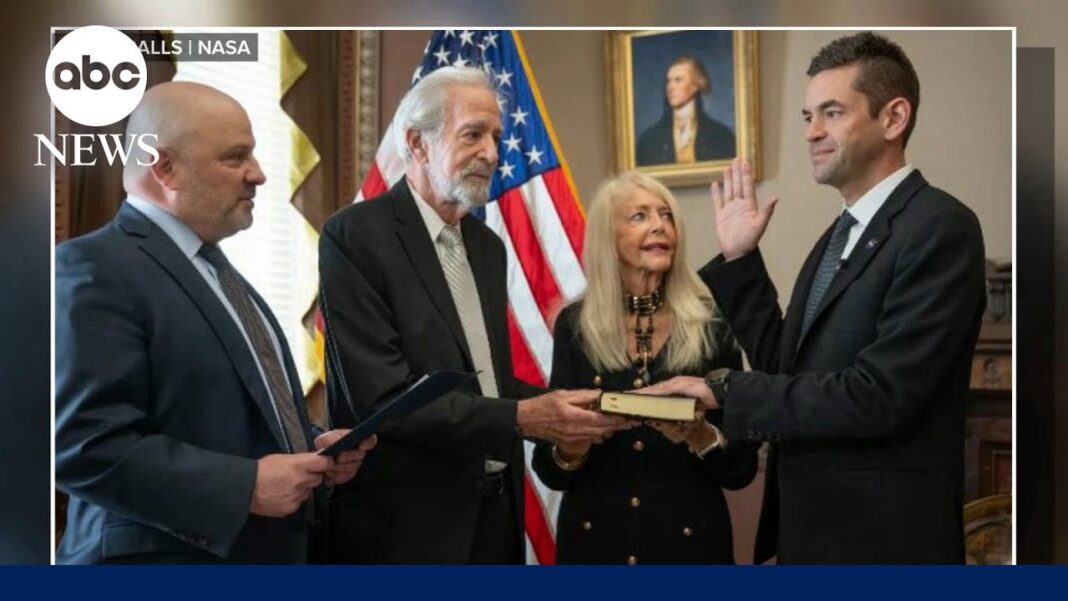
In a moment rich with symbolism and strategic consequence, billionaire entrepreneur and private astronaut Jared Isaacman was formally sworn in on Thursday as NASA’s 15th administrator, marking the beginning of a consequential new chapter for the United States’ civil space program. As VIN News reported, Isaacman’s confirmation and rapid assumption of office come at a pivotal juncture—one defined by renewed geopolitical competition in space, accelerated technological innovation, and a presidential mandate to restore American preeminence beyond Earth’s atmosphere.
Isaacman’s swearing-in ceremony, held at the Eisenhower Executive Office Building, took place only hours after a private meeting with President Donald Trump at the White House. Emerging from the Oval Office, the new NASA administrator projected confidence, clarity of purpose, and a striking alignment with the administration’s ambitions. According to the information provided in the VIN News report, Isaacman made clear that his tenure would be defined by urgency and execution, pledging not only to fulfill the president’s space priorities but to surpass existing timelines wherever possible.
“My objective is to ensure the President’s vision is achieved, and ideally ahead of schedule,” Isaacman declared, signaling a departure from incrementalism and an embrace of accelerated progress.
Central to Isaacman’s agenda is a reinvigorated commitment to the Artemis program, NASA’s flagship initiative aimed at returning American astronauts to the moon. Yet, as VIN News reported, Isaacman’s vision extends far beyond a reprise of the Apollo-era triumphs. Rather than fleeting landings or symbolic flag-planting, he has articulated a determination to establish a permanent and sustainable human presence on the lunar surface.
This emphasis on durability and infrastructure marks a significant philosophical shift. Under Isaacman’s leadership, the moon is not merely a destination but a proving ground—a launchpad for deeper exploration of the solar system, including the long-envisioned human mission to Mars. Isaacman has repeatedly framed the lunar return as an indispensable stepping stone, one that will allow NASA to test technologies, life-support systems, and operational models necessary for interplanetary travel.
“The lunar return must be about permanence,” Isaacman said in post-ceremony remarks cited by VIN News. “We are not going back to the moon simply to visit. We are going to stay.”
Isaacman’s appointment represents a notable infusion of private-sector sensibilities into one of America’s most storied public institutions. As the founder of Shift4, a payment processing company he built into a multibillion-dollar enterprise, Isaacman brings a reputation for operational efficiency, risk tolerance, and decisive leadership. VIN News reported that these qualities were central to his appeal within the Trump administration, which has sought to inject what it describes as a “mission-first culture” into federal agencies.
Unlike many of his predecessors, Isaacman did not rise through the traditional ranks of government or aerospace bureaucracy. Instead, his credentials were forged through entrepreneurship and direct personal involvement in spaceflight. A veteran of two private SpaceX missions, including the historic first all-civilian spacewalk, Isaacman has experienced space not as an abstract policy domain but as a lived reality.
That experiential perspective is expected to influence his approach to NASA’s partnerships with commercial space companies. Isaacman has been a vocal proponent of leveraging private-sector innovation to reduce costs, accelerate development, and expand access to space—an approach that aligns closely with NASA’s evolving public-private model.
Isaacman assumes leadership of NASA at a time when the stakes of space exploration are once again intertwined with global power dynamics. China has made no secret of its lunar ambitions, announcing plans to establish its own moon base and positioning itself as a rival to American leadership in space.
Against this backdrop, Isaacman’s pledge to return astronauts to the moon ahead of schedule carries both scientific and strategic weight. The Artemis program is no longer merely a scientific endeavor; it is a statement of national capability and resolve. By accelerating timelines and emphasizing permanence, Isaacman aims to ensure that the United States sets the norms, standards, and infrastructure for humanity’s next phase of space exploration.
In his statement following the swearing-in ceremony, Isaacman articulated this vision with characteristic directness. He said he looked forward to “restoring a mission-first culture at NASA—focused on achieving ambitious goals, to return American astronauts to the Moon, establish an enduring presence on the lunar surface, and laying the groundwork to deliver on President Trump’s vision of planting the Stars and Stripes on Mars.” The VIN News report highlighted the deliberate phrasing, noting its resonance with both patriotic symbolism and long-term strategic intent.
Isaacman’s path to the NASA administrator’s office was not without complication. Although he was confirmed by the Senate on Wednesday in a decisive 67–30 vote, his nomination had previously been withdrawn and later renewed by President Trump. The initial withdrawal reportedly stemmed from concerns about Isaacman’s past political donations and associations—issues that were ultimately deemed insufficient to outweigh his qualifications and vision.
The renewed nomination in November and subsequent confirmation underscored the administration’s confidence in Isaacman as the right figure to lead NASA during a period of transformation. Lawmakers from both parties acknowledged his unconventional background but praised his enthusiasm for exploration and his commitment to American leadership in space.
Isaacman succeeds acting administrator Sean Duffy, who had been serving concurrently as transportation secretary. The VIN News report noted that this transition restores singular focus to NASA’s leadership at a time when clarity and decisiveness are paramount.
Beyond rockets and destinations, Isaacman has signaled an intent to recalibrate NASA’s internal culture. Drawing on his entrepreneurial experience, he has spoken of streamlining decision-making, empowering engineers and mission teams, and fostering an environment where calculated risk is not merely tolerated but embraced.
Isaacman has expressed admiration for NASA’s workforce while also acknowledging the challenges posed by bureaucratic inertia. His emphasis on a “mission-first culture” is widely interpreted as a call to refocus the agency on tangible outcomes rather than process-driven caution.
This approach is likely to resonate with a new generation of engineers and scientists who have come of age in an era of rapid technological change and commercial spaceflight. At the same time, it may provoke debate within an institution long shaped by hard-earned lessons about safety and reliability.
While the moon dominates the near-term agenda, Isaacman has been unequivocal that Mars remains the ultimate objective. VIN News reported that he views the establishment of a lunar base not as an end in itself but as a rehearsal for the far more complex challenge of sustaining human life on another planet.
Mars, with its hostile environment and immense distance from Earth, represents the ultimate test of human ingenuity and cooperation. By laying the groundwork now—through lunar infrastructure, advanced propulsion systems, and long-duration habitation experiments—Isaacman believes NASA can turn what once seemed like science fiction into a realistic, if still daunting, goal.
As Jared Isaacman begins his tenure as NASA administrator, expectations are high and the margin for error is narrow. Yet, as the VIN News report observed, few leaders have assumed this role with such a rare combination of personal spaceflight experience, entrepreneurial acumen, and presidential backing.
In the months and years ahead, Isaacman’s success will be measured not only by launch schedules and mission milestones but by his ability to align NASA’s storied legacy with the demands of a rapidly changing space landscape. If his early statements are any indication, he intends to lead with urgency, ambition, and an unambiguous belief in America’s capacity to reach farther than ever before.