



|
Getting your Trinity Audio player ready...
|
“A Date Which Lives in Infamy”: Revisiting the Cataclysmic Shock of Pearl Harbor, 84 Years Later
By: Fern Sidman – Jewish Voice News
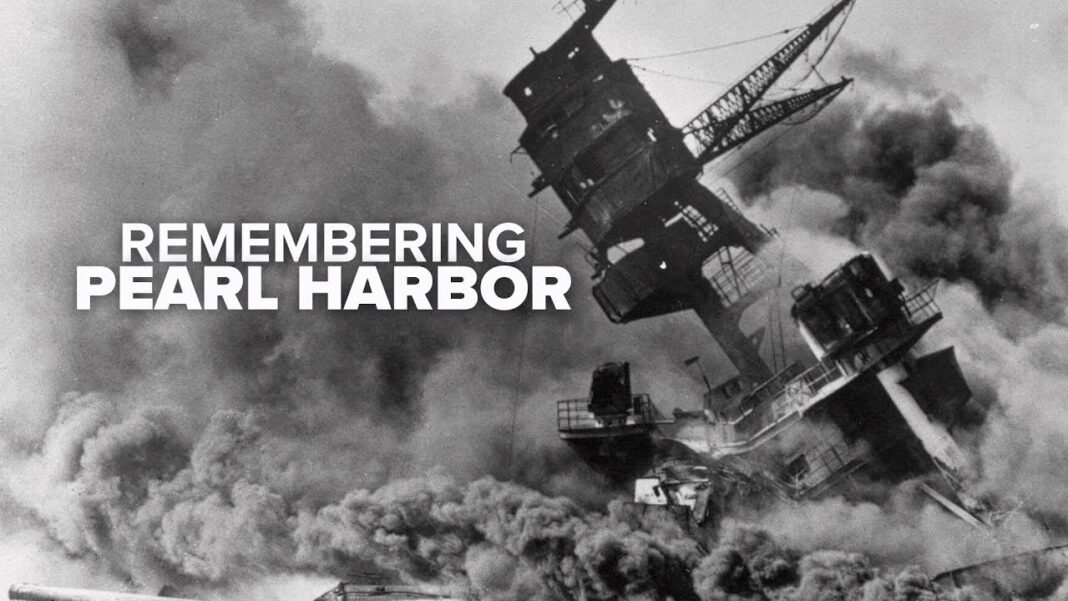
Eighty-four years ago today, on the tranquil Sunday morning of December 7, 1941, the United States was thrust violently and irrevocably into global war. What had begun as a warm Pacific dawn over Oahu became, within minutes, a tableau of smoke, fire, twisted metal, and unimaginable loss. The Japanese surprise assault on the American naval base at Pearl Harbor—meticulously planned, devastatingly executed—remains one of the most consequential events in modern history, altering the trajectory of World War II and reshaping America’s place in the world.
At 7:55 a.m., the calm of the harbor was pierced by the radio call that would enter military legend. Mitsuo Fuchida, the lead pilot of the Imperial Japanese Navy strike force, broadcast three clipped syllables—“Tora, Tora, Tora”—signaling that surprise had been achieved and the operation was underway. Within seconds, formations of Japanese aircraft descended upon their targets: battleships, airfields, hangars, and personnel who had no reason to expect an attack and no time to respond effectively.
What followed was a catastrophe so profound that it became etched not only into the American memory but into the national conscience. As generations have recognized, and as every commemoration of this day reaffirms, the assault on Pearl Harbor was not merely a military defeat but a seismic psychological blow—an event often described as a moment of national “dishonor” and the most devastating American intelligence failure prior to the September 11 terrorist attacks.
Despite rising tensions between the United States and Japan throughout 1941, the American military establishment did not anticipate an assault on the Hawaiian Islands. Diplomacy was ongoing, and U.S. strategists largely believed that Japan, if it chose to fight, would aim southward toward Southeast Asia, not eastward toward the fortified heart of America’s Pacific power.
This assumption proved catastrophically incorrect.
Two coordinated attack waves—one at 7:53 a.m. and the second at 8:55 a.m.—struck airfields and naval installations with surgical precision. Japanese torpedo bombers skimmed over the harbor waters, dive-bombers plummeted toward ships and barracks, and fighters strafed soldiers who ran for cover as chaos engulfed the island.
In the span of the brief attack, the United States suffered staggering losses: 12 warships destroyed, 188 aircraft obliterated, and 2,459 service members and civilians killed. Many aircraft never left the ground; they were positioned wingtip-to-wingtip—a configuration intended to prevent sabotage but that rendered them fatally vulnerable to aerial assault.
The USS Arizona exploded with such force that it remains, even today, a submerged tomb for more than a thousand sailors. The USS Oklahoma capsized, trapping hundreds of men inside. Fires roared through fuel lines and ammunition stores as rescue crews battled to save the wounded amid unimaginable carnage.
The surprise attack not only devastated the Pacific Fleet but shattered America’s sense of invulnerability. As historians have long observed, Pearl Harbor marked the abrupt end of American isolationism and the beginning of its ascendancy as a global military superpower.
Long before the sun rose over Oahu on that ill-fated morning, the architect of the attack, Admiral Isoroku Yamamoto, had concluded that war with the United States was inevitable. A brilliant strategist who had studied at Harvard and served as a naval attaché in Washington, Yamamoto understood America’s industrial capacity and foresaw that Japan could not win a prolonged conflict against such a nation.
Yet he also believed that Japan’s only chance—however slim—was to neutralize the U.S. Pacific Fleet swiftly and decisively. The attack on Pearl Harbor was, in Yamamoto’s view, a necessary preemptive strike that would grant Japan a crucial year to consolidate its hold over China and Southeast Asia. Without crippling American naval power, Tokyo’s imperial ambitions would likely fail.
Thus began the meticulous and secretive preparations for the assault. Six aircraft carriers, the heart of the strike force, sailed undetected across the northern Pacific. Hundreds of fighter planes, torpedo bombers, and dive-bombers were trained intensively for the mission. The attack was devised as a three-wave assault, with the third wave intended to destroy Pearl Harbor’s repair docks, fuel storage tanks, and dry docks—facilities essential for the long-term recovery of the U.S. fleet.
But the third wave never materialized.
Admiral Chuichi Nagumo, commander of the carrier strike force, faced a crucial decision after the second wave withdrew. Although the American fleet lay shattered, the fuel tanks, repair facilities, and workshops remained intact—and it was precisely these targets that would have crippled American naval capabilities for years.
Nagumo, wary of uncertain conditions and fearing the possibility of American counterattacks, chose to withdraw rather than launch the third wave.
It was a decision that would haunt Japan’s wartime fortunes.
By sparing Pearl Harbor’s essential infrastructure, Nagumo inadvertently enabled the United States to rebuild its Pacific Fleet with remarkable speed. Within months, American carriers, operating from intact dry docks and supplied by preserved fuel stores, were back at sea. It was this rapid recovery that proved decisive in later battles such as the Coral Sea and Midway—conflicts that irrevocably shifted the balance of power in the Pacific.
The attack on Pearl Harbor lasted less than two hours, but its consequences reverberated immediately. On December 8, 1941, President Franklin D. Roosevelt addressed Congress, describing the previous day as “a date which will live in infamy.” His call for a declaration of war against Japan was approved almost unanimously, with only one dissenting vote.
Britain declared war simultaneously, expanding the Pacific conflict into a truly global theater. Three days later, on December 11, Nazi Germany and Fascist Italy declared war on the United States—drawing America fully into World War II on both major fronts.
What Japan had sought to avoid—a long geopolitical struggle with a vastly industrialized adversary—had now become unavoidable.
Over eight decades later, the Pearl Harbor attack remains one of the most meticulously studied military events in history, both for its strategic audacity and for the devastating lapses in American preparedness that enabled its success. It stands as a testament to the dangers of complacency, the unpredictability of war, and the enduring truth that nations may be most vulnerable at moments of presumed safety.
Yet Pearl Harbor is remembered not only for tragedy but for transformation. The attack galvanized American society, igniting nationwide mobilization that would ultimately help turn the tide of World War II. The young men who died that morning became symbols of sacrifice; the ships that burned in the harbor became monuments of resilience; and the United States, awakened to a new global reality, assumed the mantle of leadership that would shape the postwar world.
When Mitsuo Fuchida whispered “Tora, Tora, Tora” into his radio transmitter, he set in motion forces far beyond his imagination. Those three words ignited a chain reaction that would engulf continents, topple empires, and redefine international order.
Today, commemorations across the nation honor the memory of the 2,459 Americans—sailors, soldiers, aviators, nurses, dockworkers, and civilians—whose lives were lost in the attack. Their sacrifice serves as a solemn reminder of the fragility of peace and the enduring responsibilities of vigilance, preparedness, and national unity.
History has many turning points, but few so sudden, shocking, and transformative as the morning when the skies over Pearl Harbor darkened with the shadows of Japanese aircraft—and the United States awoke to a world at war.