



|
Getting your Trinity Audio player ready...
|
By: Fern Sidman
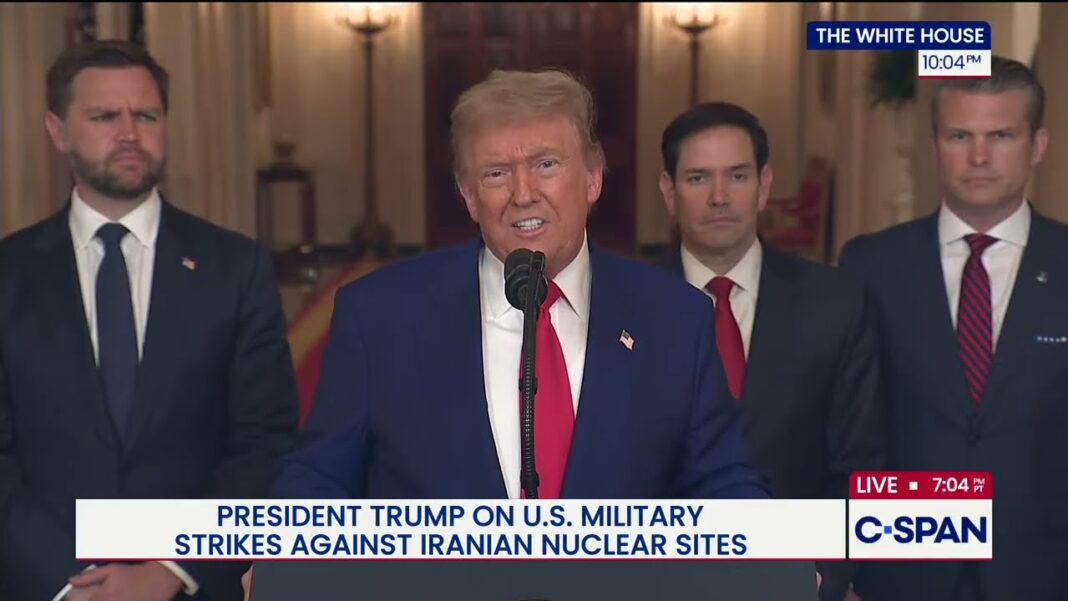
In an extraordinary and unified display of support, lawmakers across Capitol Hill—spanning the entire spectrum of Republican leadership and several bipartisan voices—hailed President Donald J. Trump’s targeted military strike on Iran’s nuclear facilities as both justified and strategically essential. The attack, aimed at halting the Islamic Republic’s rapidly advancing nuclear weapons program, marked one of the most consequential foreign policy actions of Trump’s second term.
According to senior defense officials, the precision operation, conducted in coordination with Israeli intelligence and military assets, struck hardened nuclear sites in Fordow, Natanz, and Esfahan, sites that analysts have long regarded as the backbone of Iran’s nuclear infrastructure. The strikes were lauded for their efficacy and minimal collateral damage, and they appear to have set back Iran’s enrichment capabilities significantly.
Speaker of the House Mike Johnson summed up the sentiment on the Hill, stating: “The President made the right call, and did what he needed to do. The world’s largest state sponsor of terrorism simply could not be allowed the opportunity to obtain and use nuclear weapons.” Johnson emphasized that President Trump fully respects congressional authority, but the urgency of the threat demanded immediate executive action—an echo of past precedents for limited, preemptive military strikes under both Republican and Democratic administrations.
From the well of the Senate, the outpouring of praise was swift and expansive. Senate Majority Leader John Thune declared: “The regime in Iran has rejected all diplomatic pathways to peace. The mullahs’ misguided pursuit of nuclear weapons must be stopped.” His words were reinforced by Senate Foreign Relations Committee Chair Jim Risch, who noted, “A nuclear-armed Iran would without doubt spark a nuclear arms race around the world. This strike puts an end to those ambitions.”
Risch went further, affirming that while “this is Israel’s war,” the United States’ involvement makes the world safer, not just for Israel but for the global community. “Only American weapons could do what has been done,” he said, in what became a recurring theme throughout the day’s statements—namely, that only the unique capabilities of the U.S. military could deliver such a devastating, effective blow to a regime determined to cross the nuclear threshold.
Senators from across the Republican leadership echoed those sentiments, many emphasizing the role of U.S. servicemembers and the moral clarity of American leadership. Senator Tom Cotton remarked, “Iran has waged a war of terror against the United States for 46 years. We could never allow Iran to get nuclear weapons. President Trump made the right call.” Likewise, Senator Ted Cruz praised not only the strike but its precision: “Tonight’s actions have gone far in foreclosing the apocalyptic threat posed by an Iranian nuclear arsenal.”
Even those with more measured tones, such as Senator Bill Cassidy, underscored the ultimate goal of peace: “Iran’s nuclear program is a threat to peace and stability. Peace must remain the goal.” And Senator John Cornyn put it more bluntly: “This is what leadership on the world stage looks like.”
This was not the work of a divided Republican conference. Rather, it was a moment of near-total alignment among its members. Senator Lindsey Graham simply called it “the right call,” while Senator Marsha Blackburn emphasized that “peace can only be achieved through strength.” Senator Joni Ernst offered a more strategic observation: “By leading with peace through strength, President Trump is making the world a safer place and protecting Americans.”
One of the most important takeaways from the widespread reaction was the degree to which lawmakers viewed the strike as a final step following failed diplomacy. Senator Dave McCormick stated: “This targeted attack on Iran’s nuclear facilities is the result of the Iranian regime’s failure to make a deal despite months of President Trump’s good faith efforts to negotiate.” That narrative—of exhausted diplomatic options, ignored red lines, and escalating Iranian provocation—was reflected in nearly every statement issued in the hours after the strike.
In the House of Representatives, the response mirrored that of the Senate—resounding, resolute, and unapologetic. House Republican Conference Chair Lisa McClain proclaimed, “President Trump is delivering PEACE THROUGH STRENGTH. Today’s successful mission destroyed Iran’s nuclear capabilities, protected American lives, and will make the world safer.”
Representative Brian Fitzpatrick, a veteran of foreign policy committees, offered one of the most comprehensive statements: “This was the right call—and a necessary one. Make no mistake: a nuclear Iran is an existential threat—not just to Israel, but to the entire free world.”
Many members tied the operation directly to President Trump’s long-standing foreign policy doctrine—“Peace through Strength”—and credited his leadership for avoiding the need for future prolonged engagements. Representative Dan Crenshaw, a veteran himself, rebutted critics who feared escalation: “You think this means WWIII? You’re wrong. You think it means American soldiers deploying to Iran? You’re wrong… You think it means long-term stability in the Middle East and a safer future for Americans? You’re right.”
Indeed, multiple lawmakers, such as Representative Andy Harris and Representative Claudia Tenney, stressed the importance of seizing this moment to dismantle the regime’s nuclear ambitions once and for all. “Iran cannot and will not have nuclear weapons and today is a direct result of the Ayatollah’s reckless choices,” Tenney said.
Several members used religious language to frame the moment. “God bless our troops,” said Representative Troy Nehls. “God bless our Commander in Chief,” echoed Representative Jim Jordan. Others framed it as a moral imperative: “We gave Iran every opportunity to stop enriching uranium. They refused, so America ended their nuclear weapons program tonight,” said Representative Carol Miller.
Many also reiterated the significance of American-Israeli cooperation in the mission. “We must always stand with Israel,” stated Representative Roger Williams. And in a direct address to the Iranian regime, Representative Ryan Zinke warned, “They will lose their Army, Navy, what’s left of their Air Force AND they will lose their refineries. This is a fight they will not win.”
While critics of the strike—including some international leaders—warn of possible escalation, Capitol Hill is standing firmly behind the President. As Representative Greg Steube noted, “The Ayatollah’s refusal to negotiate in good faith confirms what we’ve long known: Iran cannot be trusted with nuclear weapons.”
The overwhelming support underscores how deeply the specter of a nuclear Iran has united a fractured Congress. As Representative Mike Lawler pointed out, “War has not been declared. However, a nuclear Iran has been prevented.” Representative Steve Womack concluded, “President Trump’s decision ultimately makes America and our allies safer.”
For President Trump, the strike represents not only a decisive military operation but also a moment of political vindication. After years of pressure, diplomacy, and threats, his administration delivered on what had been a foundational promise since the 2016 campaign: Iran will not obtain a nuclear weapon on his watch.
Now, as the dust settles over the mountains of Fordow and the centrifuge halls of Natanz lie silent, the world watches closely. But if the resounding reaction from Capitol Hill is any indication, America’s political leadership believes the message to Tehran was loud, clear—and long overdue.