



|
Getting your Trinity Audio player ready...
|
By: Fern Sidman
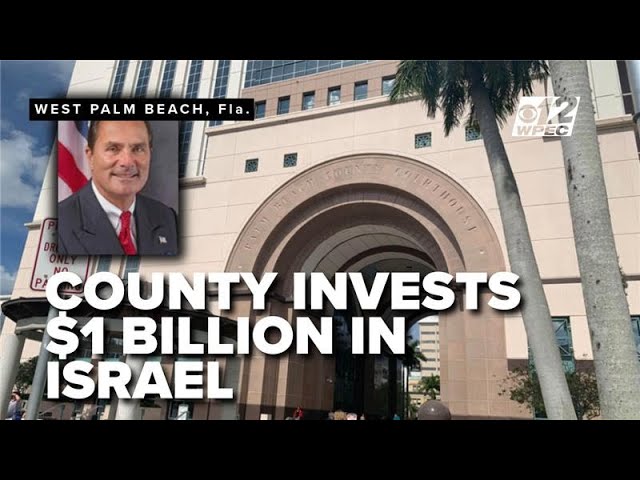
Palm Beach County has just etched its name into the annals of public-sector finance, completing a landmark $350.5 million purchase of Israel Bonds that pushes the county’s total holdings to an unprecedented $1 billion. As VIN News reported on Wednesday, no single investor anywhere in the world has ever amassed such a portfolio of Israel Bonds, making the Florida county’s decision both a financial milestone and a global statement of trust in the instrument’s stability.
The announcement was delivered Tuesday by Mike Caruso, Palm Beach County’s Clerk of the Circuit Court and Comptroller and expanded upon during a detailed press conference the following day. According to the information provided in the VIN News report, Caruso emphasized that the decision was not ideological or political, but grounded squarely in disciplined portfolio management, fiduciary responsibility, and market timing.
“This is about safety, liquidity, and returns,” Caruso said, explaining that Israel Bonds currently outperform many other allowable investments under Florida law, including U.S. Treasury securities. For taxpayers, that calculus is projected to yield approximately $47.2 million in additional interest income over the next three years.
VIN News reported that the $350.5 million purchase was not impulsive, nor was it opportunistic in the narrow sense of reacting to market headlines. Instead, it followed a deliberate reassessment of the county’s investment policy framework, culminating in a unanimous October vote by the Palm Beach County Board of County Commissioners to temporarily raise the cap on Israel Bonds from 15 percent to 18 percent of the county’s total investment portfolio.
That change was crucial. Palm Beach County manages an investment portfolio of approximately $6 billion, the proceeds of which help fund government operations, mitigate taxpayer burdens, and stabilize fiscal planning. Under Florida statutes, local governments may only invest in a narrow universe of fixed-income instruments—among them certificates of deposit, money-market funds, U.S. government securities, and Israel Bonds.
By lifting the cap, the commissioners effectively cleared the runway for Caruso’s office to move aggressively while market conditions remained favorable.
Caruso explained that interest rates on Israel Bonds were materially higher than competing instruments at the time of purchase, creating what he described as a “rare alignment” of safety and yield. For a county whose annual operating budget exceeds $8 billion, even fractional improvements in interest performance can translate into tens of millions of dollars in additional revenue.
To understand the significance of Palm Beach County’s decision, it is necessary to appreciate the nature of Israel Bonds themselves. Issued by the State of Israel through the Development Corporation for Israel, these bonds have been sold internationally since 1951, financing everything from infrastructure projects and water desalination plants to transportation networks and technological innovation.
Israel Bonds are rated investment-grade by major credit agencies, and that their default risk has historically been low—even during periods of geopolitical tension. Over the decades, they have become a staple of conservative portfolios held by municipalities, universities, pension funds, and nonprofit institutions across the United States.
Palm Beach County’s new $1 billion total, however, elevates the county from participant to global standard-bearer.
“This is the largest investment in Israel Bonds ever made by a single investor,” county officials confirmed to VIN News.
One of the most striking elements of the story, as highlighted in the VIN News report, is the level of professional oversight governing Palm Beach County’s investment operations. Caruso, who serves as the county’s chief financial officer, manages the $6 billion portfolio with a team of certified investment professionals, adhering to a stringent Investment Policy that emphasizes transparency, risk mitigation, liquidity, and regular reporting.
The policy is not static. It is reviewed periodically and amended when market conditions or statutory constraints warrant. The October decision to lift the cap on Israel Bonds was made only after extensive internal modeling and consultation, ensuring that the move would not jeopardize the county’s liquidity profile or exposure limits.
In the words of Caruso, “This is not about chasing yield. It’s about securing strong, reliable returns within the guardrails of public-sector fiduciary duty.”
For residents of Palm Beach County, the implications are far from abstract. Income generated from the county’s investment portfolio is applied directly to offset operational costs, which in turn reduces the pressure on property taxes and service fees.
VIN News reported that the additional $47.2 million in projected interest income over the next three years will provide meaningful fiscal relief at a time when local governments across the nation are grappling with rising costs, infrastructure demands, and inflationary pressures.
In effect, the Israel Bonds purchase functions as a quiet subsidy for county services—one that does not require raising taxes or cutting programs.
Palm Beach County’s portfolio composition reflects a philosophy of balance rather than bravado. Under Florida law, riskier assets such as equities, private equity, or speculative debt are prohibited. This forces public-sector managers to innovate within a conservative framework.
As the VIN News report detailed, the portfolio currently includes U.S. Treasury and agency securities, certificates of deposit at FDIC-insured institutions, money-market funds meeting strict regulatory criteria and Israel Bonds.
By expanding its allocation to Israel Bonds, the county did not abandon prudence; it reweighted its holdings toward an asset class offering superior yield within the same risk envelope.
The timing of the purchase was as critical as the decision itself. According to the information contained in the VIN News report, Caruso’s office monitored the interest-rate environment closely, identifying a narrow window in which Israel Bonds offered a particularly attractive premium over Treasuries.
At a moment when global markets remain unsettled—buffeted by inflation concerns, central-bank tightening, and geopolitical uncertainty—the county opted to lock in returns that, in Caruso’s estimation, would outperform alternatives for several years.
While Palm Beach County insists that its investment is strictly a financial maneuver, its symbolic resonance is difficult to ignore. VIN News reported that municipal finance officers from across the United States and abroad have already begun contacting Caruso’s office to inquire about the structure, mechanics, and regulatory considerations underlying the record-breaking purchase.
In doing so, Palm Beach County has inadvertently established a benchmark for public-sector portfolio management—a case study in how local governments can responsibly expand their investment horizons without violating statutory constraints or exposing taxpayers to undue risk.
Caruso has indicated that no further increases to the Israel Bonds allocation are currently planned, and that the county will return to its standard cap once the temporary 18 percent threshold expires. But the message has already been delivered: disciplined public investment can be both innovative and conservative, ambitious and accountable.
As the VIN News report observed, Palm Beach County’s billion-dollar commitment to Israel Bonds is not merely a financial transaction—it is a recalibration of what is possible in the world of municipal finance. It stands as evidence that even within the tight strictures of public law, strategic insight and professional rigor can unlock value for citizens.
For Palm Beach County taxpayers, the benefits will materialize quietly, line by line, in balanced budgets and funded services. For the global investment community, the county’s move will reverberate for years as a testament to what happens when fiduciary responsibility meets opportunity—and seizes it.
