



|
Getting your Trinity Audio player ready...
|
With Flags, Faith, and Song: Israel Celebrates 58 Years of a Reunited Jerusalem
By: Fern Sidman
Beneath the golden glow of the Western Wall and the clear night sky, thousands gathered on Sunday to mark Yom Yerushalayim, the 58th anniversary of the reunification of Jerusalem during the 1967 Six Day War—a moment etched in modern Jewish history as the miraculous return of the Jewish people to their eternal capital.
The main state ceremony took place at the Kotel Plaza, where a striking spectacle captivated attendees: an enormous Israeli flag measuring 28 by 46 meters was unfurled, stretching across the stone-paved square in a powerful symbol of national unity, Jewish sovereignty, and spiritual resilience. As the crowd erupted in song, voices harmonized in renditions of beloved Jerusalem anthems, recorded on site to preserve the spirit of the occasion.
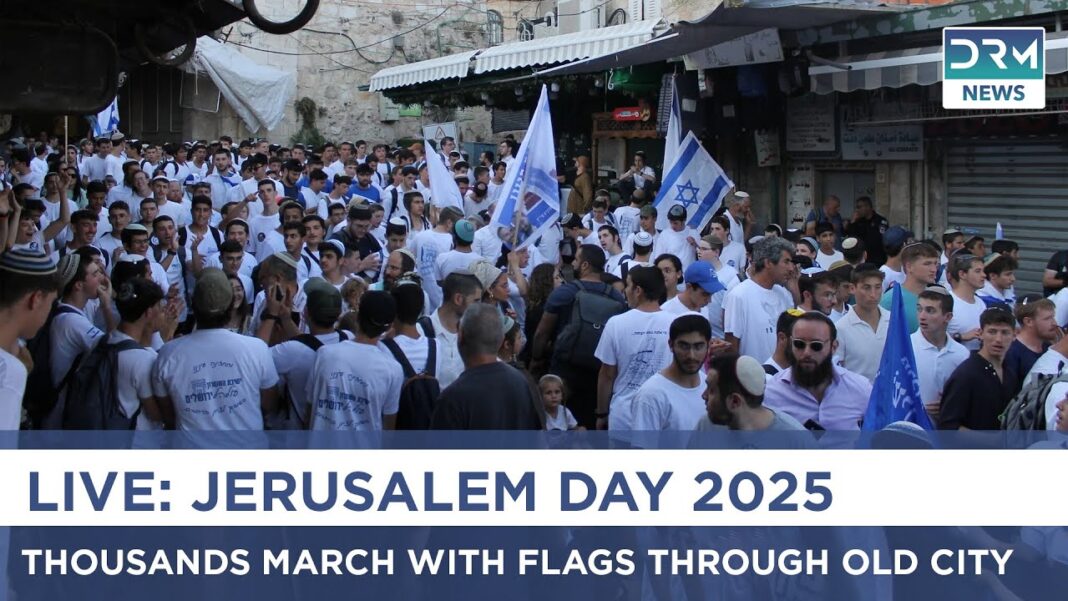
Celebrations lasted late into the night. Dancing filled the ancient alleyways of the Old City, accompanied by waves of white and blue flags and the unmistakable sound of joy. In a noteworthy sign of unity, even charedi yeshiva students, many of whom do not typically participate in state commemorations, joined the festivities—a gesture reflecting a broadening embrace of the significance of Jerusalem Day across diverse segments of Israeli society.
“Jerusalem is not merely a city; it is the heart of our nation, a symbol of our survival, and the seat of our soul,” one participant told The Jewish Voice, echoing a sentiment shared by many attendees.
The occasion was marked not only by local pride, but by strong international support—most notably from the United States. Former Arkansas Governor and U.S. Ambassador Mike Huckabee released a special recorded message to honor the celebration and reaffirm the deep bond between America and the State of Israel.
“Jerusalem is the eternal capital of the Jewish people,” Huckabee stated emphatically, praising President Donald Trump’s historic decision to move the U.S. Embassy from Tel Aviv to Jerusalem in 2018. “That moment of moral clarity was not just a political decision—it was a fulfillment of historical justice,” he said.
Huckabee went further, drawing a direct line between current geopolitical struggles and shared democratic values, particularly in the face of Israel’s war against Hamas in Gaza.
“Your fight is our fight. Your enemies are our enemies. And Israel’s victory is our victory,” he declared, reinforcing bipartisan American support for Israel’s right to self-defense amid continued threats from terror groups backed by Iran.
JERUSALEM DAY CELEBRATIONS AT
WESTERN WALL BEGIN WITH GIANT ISRAELI FLAG
THOUSANDS GATHER AT THE WESTERN WALL PLAZA TO MARK THE START OF JERUSALEM DAY, WHICH COMMEMORATES THE REUNITING OF THE EASTERN AND WESTERN SIDES OF THE CITY pic.twitter.com/ig89RsUZIM— The Jewish Voice (@TJVNEWS) May 26, 2025
The celebration comes at a time of deep national introspection in Israel, as the country continues to recover from the October 7th attacks and pursues military operations in Gaza to dismantle Hamas’s infrastructure. Amid this turbulence, the return to Jerusalem in 1967 remains a beacon of inspiration—a victory reclaimed against overwhelming odds, and a rallying cry for national resilience.
Fifty-eight years ago, during the Six Day War, Israeli paratroopers stormed the Old City and stood once more before the Western Wall, reclaiming Jewish access to the holiest site in Judaism after nearly two decades of Jordanian control. That moment, immortalized in photographs of weeping soldiers, became a defining triumph for modern Israel.
Every year since, Yom Yerushalayim has served as both a celebration of liberation and a reflection on the unity and sacrifice required to preserve Israel’s sovereignty and values.
Sunday night’s ceremony encapsulated that spirit: a mix of youthful exuberance and solemn remembrance, with families, soldiers, rabbis, and foreign dignitaries standing shoulder-to-shoulder at the Kotel.
The celebrations will continue throughout the week, with educational programs, tours, lectures, and commemorative events organized across the country—many of them centered in Jerusalem’s historic districts. Schools are hosting lessons on the reunification, synagogues are holding special prayers, and institutions like the Jerusalem Municipality and Ministry of Education have rolled out public awareness campaigns to highlight the city’s centrality in Jewish heritage.
While political debates about Jerusalem’s status on the global stage continue, there was no ambiguity in the message delivered on Sunday: Jerusalem remains the indivisible capital of the Jewish people, a city that reflects their past, anchors their present, and illuminates their future.
