



|
Getting your Trinity Audio player ready...
|
By: Fern Sidman
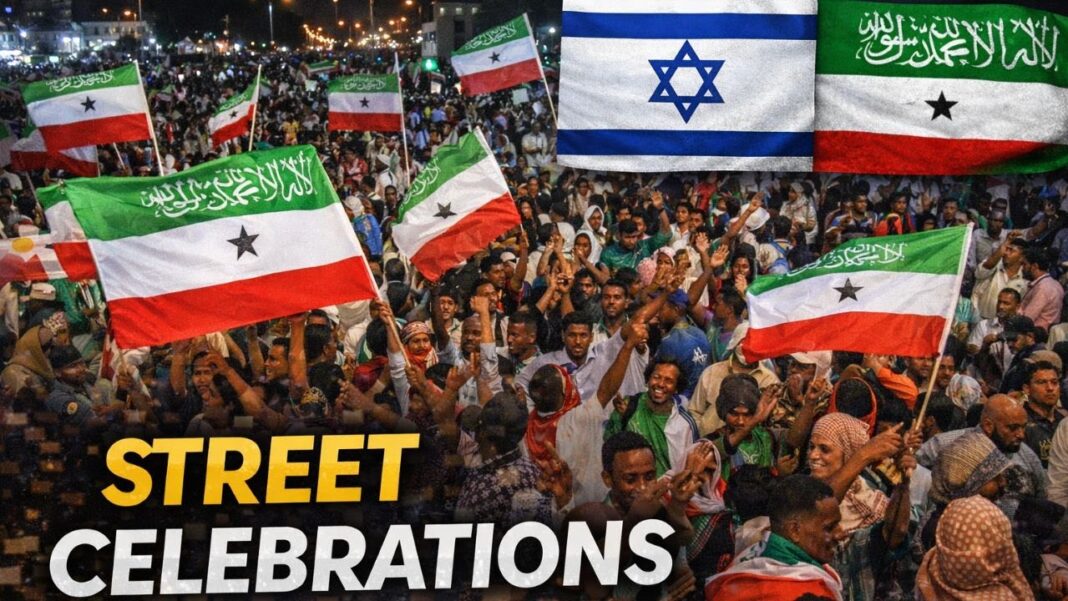
In the heated global reaction to Israel’s recent recognition of Somaliland, a chorus of skepticism has emerged, questioning the wisdom and relevance of forging ties with a territory that most of the world still refuses to acknowledge as a sovereign state. Yet amid the diplomatic din, one of Israel’s most seasoned Middle East scholars has issued a stark warning: dismiss Somaliland at your peril.
Prof. Uzi Rabi, a senior researcher at Tel Aviv University’s Dayan Center for Middle East Studies, argues that the emerging partnership between Jerusalem and Hargeisa is not only legitimate but potentially transformative for Israel’s strategic posture in the Horn of Africa. Speaking in an interview with 103FM and reported by Israel National News on Sunday, Rabi castigated critics for trivializing Somaliland out of ignorance rather than analysis.
“People are turning it into a joke because they simply do not understand the reality,” Rabi said. “This is a very significant place — six times the size of Israel. You are talking about a country located in a hornet’s nest that wants to chart a different course, similar to Azerbaijan in the Caucasus. It wants to turn westward.”
His words have resonated deeply within Israeli strategic circles, where Somaliland is increasingly viewed as an underappreciated geopolitical asset at the crossroads of Africa, the Middle East and global maritime trade.
For more than three decades, Somaliland has existed in a peculiar state of diplomatic invisibility. Having declared independence from Somalia in 1991 following the collapse of the central government, it has since built functioning institutions, conducted elections, maintained its own security forces and — crucially — kept jihadist organizations largely at bay.
Yet while it has outperformed many internationally recognized states in terms of governance and stability, Somaliland has been denied the formal recognition that opens the doors to international lending, diplomatic normalization and development assistance.
Israel’s decision to recognize Somaliland therefore represents a radical break with the status quo — and, as Israel National News has reported, one that could herald a broader reconfiguration of alliances around the Red Sea basin.
Prof. Rabi’s assessment cuts to the core of why Somaliland matters. At stake is access to the Bab al-Mandeb Strait, the narrow chokepoint that links the Red Sea to the Gulf of Aden and, by extension, the Suez Canal to the Indian Ocean.
“From there, the US supports efforts against the Houthis in Yemen and maintains access to Bab al-Mandeb, one of the most strategic waterways in the world,” Rabi explained, according to the Israel National News report. “This is precisely where Israel should be operating.”
Bab al-Mandeb is no abstract cartographic detail. Nearly 10 percent of the world’s maritime trade passes through this corridor, including energy shipments from the Gulf to Europe. Disruption at this chokepoint — whether by piracy, Iranian proxies or regional war — would reverberate through global markets.
Israel, which has faced mounting threats from the Iranian-backed Houthi movement in Yemen, understands that maritime security in this corridor is not a peripheral concern but a central pillar of national security.
By forging ties with Somaliland, Israel potentially secures a foothold in a region that has become a battleground between Iranian influence, Western strategic interests and regional power rivalries.
International reaction to Israel’s move has been swift and hostile. Somalia, backed by the African Union and the Organization of Islamic Cooperation, has condemned the recognition as a violation of sovereignty and international law. Several Security Council members have hinted at possible resolutions rebuking Jerusalem.
But Rabi is unmoved.
“Are we really afraid of Security Council condemnations?” he asked rhetorically, as reported by Israel National News. “In my view, this move has US approval.”
That assertion, if accurate, reframes the entire episode. While Washington has publicly adopted a cautious tone, Rabi’s remarks suggest that behind closed doors, the Trump administration may see Israel’s Somaliland initiative as aligned with broader American objectives in the Horn of Africa.
The United States has long relied on access to bases and ports in the region to conduct operations against al-Qaeda, ISIS and now the Houthis. A stable, pro-Western Somaliland could therefore become an invaluable partner in containing Islamist terrorism and safeguarding maritime routes.
Perhaps the most intriguing aspect of Rabi’s analysis is his comparison between Somaliland and Azerbaijan.
Like Azerbaijan, Somaliland is a small polity navigating a perilous regional environment dominated by larger, often hostile actors. Both have sought to break free from post-Soviet or post-colonial geopolitical constraints by cultivating strategic partnerships with Israel and the West.
Israel National News has previously highlighted how Israel’s deepening relationship with Azerbaijan reshaped its access to the Caucasus and Central Asia, creating new intelligence corridors and energy partnerships. Rabi suggests Somaliland could play a similar role in East Africa — a Western-oriented outpost in a region where Iran, Turkey, China and Russia are all competing for influence.
Rabi also addressed the broader regional context, turning his attention to Iran, Israel’s most implacable adversary.
“Iran has reached severe poverty levels, with collapsing infrastructure — water, electricity, widespread rationing, and an austerity-driven economy,” he said, according to the Israel National News report. “The missile displays are a substitute for real progress.”
His analysis paints a picture of a regime increasingly reliant on theatrical displays of military strength to mask deep structural decay.
“Iran lacks the ability to advance its nuclear project or meaningfully enrich uranium,” Rabi added. “These shows are simply a way of shouting, ‘We are still here.’”
For Israel, this diagnosis carries profound implications. A weakened Iran, grappling with domestic crises and unable to project sustained power, may be less capable of obstructing Israeli initiatives in peripheral regions such as the Horn of Africa.
In that sense, Somaliland’s turn westward is not occurring in a vacuum; it is unfolding at a moment when Iran’s regional architecture is under strain and when Western-aligned actors are searching for new nodes of cooperation.
The Israel National News report emphasized that recognition is only the first step. What matters now is whether Israel and Somaliland can translate diplomatic symbolism into concrete cooperation.
Potential areas include maritime security in the Red Sea–Gulf of Aden corridor, intelligence sharing on Islamist networks operating in East Africa and Yemen, infrastructure development, including ports and logistics hubs and energy transit routes linking Africa to the Middle East and Europe.
Such initiatives would embed Israel more deeply into a region historically neglected by its foreign policy establishment.
Prof. Rabi’s intervention is therefore more than an academic footnote. It is a call to recognize that Israel’s diplomatic future may lie not only in Washington, Brussels or the Gulf capitals, but also in places the international community has long ignored.
Somaliland, he argued, is not a joke. It is a geopolitical experiment — a society seeking to redefine itself as a Western-facing state in one of the world’s most volatile neighborhoods.
As Israel National News continues to chronicle this unfolding story, one conclusion becomes increasingly difficult to avoid: the Horn of Africa is no longer a peripheral theater in Israel’s strategic imagination. It is becoming a proving ground for a more agile, forward-looking foreign policy — one that sees opportunity not only in recognized capitals, but in resilient territories striving to step out of the shadows and into the world.