




|
Getting your Trinity Audio player ready...
|
By: Fern Sidman
For Israel, air superiority is not a luxury—it is the last, indispensable line of national survival. In a region where hostile actors openly proclaim genocidal intent, where Iranian proxies stretch from Lebanon to Yemen, and where alliances shift with dizzying speed, the ability to dominate the skies has been the Jewish state’s decisive advantage since its founding. That is why Turkey’s renewed campaign to reenter the F-35 Lightning II program must be understood not as a narrow procurement issue, but as a strategic threat to Israel’s qualitative and quantitative military edge.
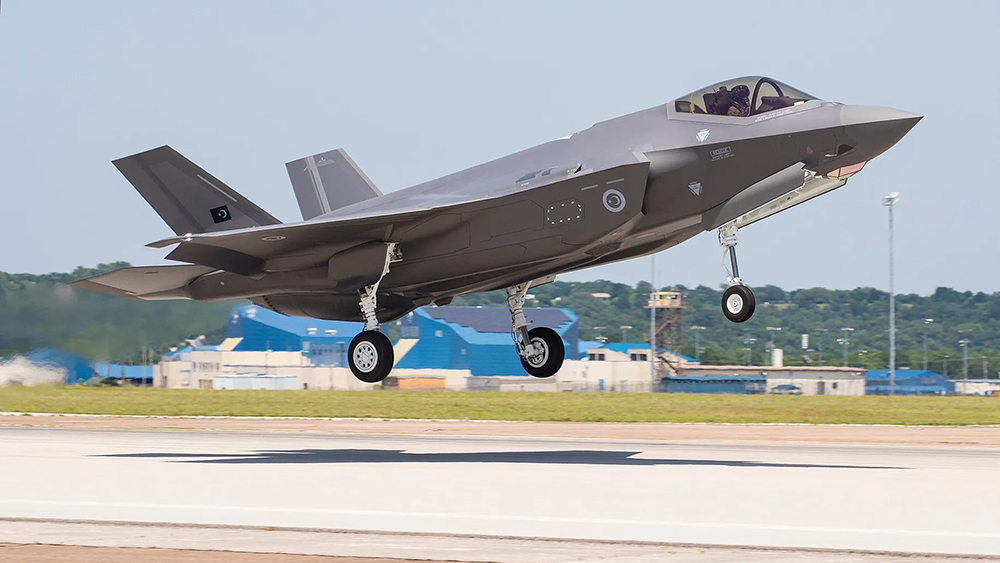
As nationalinterest.org reported on Wednesday, Turkish President Recep Tayyip Erdoğan is once again pressing Washington to reverse Ankara’s expulsion from the F-35 program, a punishment imposed after Turkey defiantly purchased the Russian S-400 “Triumf” air-defense system. Yet beneath the procedural language of sanctions and compatibility lies a far deeper problem: the F-35 is not merely an American aircraft—it is, in crucial respects, an Israeli one.
The F-35 is the world’s most advanced multirole stealth fighter because it is not a single national product, but the culmination of decades of shared innovation among America’s closest allies. Nowhere is this truer than with Israel.
Israel is not just an end-user of the F-35; it is a co-architect. Its engineers have developed proprietary avionics, electronic warfare components, mission systems, and software architectures that are integrated into the aircraft’s operational framework. The Israeli Air Force’s customized F-35I “Adir” is uniquely adapted to Israel’s threat environment, optimized for penetrating dense air-defense networks in Iran, Syria, and beyond.
As the nationalinterest.org report emphasized, this Israeli technological footprint transforms any prospective sale of the F-35 into a de facto transfer of Israeli intellectual property. That reality alone should disqualify Turkey—a country that has increasingly positioned itself as a regional rival—from ever receiving the platform.
Israel’s Deputy Foreign Minister Sharren Haskel was unequivocal when asked about Ankara’s bid to rejoin the program. Speaking to Greece’s Kathimerini, she warned: “A lot of the technology inside the airplane is technology produced by Israel. And obviously this is not something that we will share with them.” Her words, cited by nationalinterest.org, reflect not diplomatic pique but hard strategic logic.
There was a time when Turkey and Israel enjoyed a discreet but effective strategic partnership. That era is over. Erdoğan’s Turkey has embraced Hamas, hosted its operatives, amplified its propaganda, and framed itself as the political champion of Islamist causes across the Middle East.
This is not a rhetorical shift—it is a strategic one. Hamas is not merely Israel’s enemy; it is an Iranian proxy organization committed to the eradication of the Jewish state. A government that openly supports Hamas cannot credibly be entrusted with a weapons system infused with Israeli technology.
The nationalinterest.org report underscored how Ankara’s regional posture now places it in direct competition with Israel in the Eastern Mediterranean, Syria, and the broader Middle East. In that context, Turkey is no longer a benign NATO ally—it is a rival whose ambitions increasingly collide with Israel’s security architecture.
The United States is legally bound to preserve Israel’s qualitative military edge (QME) over all potential adversaries. This doctrine is not symbolic; it is operational. It ensures that even when hostile states possess numerical superiority, Israel retains a decisive technological advantage that deters war and enables victory if deterrence fails.
The F-35 is the cornerstone of that edge. It gives Israel unmatched situational awareness, stealth penetration capability, and electronic warfare dominance. It allows Israeli pilots to operate over Tehran, Damascus, or Beirut while remaining invisible to most modern air-defense systems.
Allowing Turkey to acquire the same platform—particularly one containing Israeli technology—would dilute that advantage. Worse, it would do so in the hands of a government whose relationship with Jerusalem has become openly adversarial.
As nationalinterest.org has reported, Israeli officials harbor “serious” concerns not only about Turkey’s political trajectory but about the structural risks inherent in sharing this technology with Ankara at all.
The S-400 issue is often framed as the technical obstacle blocking Turkey’s return to the F-35 program. But for Israel, it is far more than a compatibility problem—it is a red line.
Russia is not a neutral actor in the Middle East. It is deeply embedded in Syria, coordinates militarily with Iran, and supplies advanced weaponry to Israel’s enemies. A Turkey that possesses both Russian air-defense systems and Israeli-infused stealth fighters is not just a security anomaly—it is a potential intelligence catastrophe.
The report at nationalinterest.org has made clear that even if Ankara were to “return” or “destroy” its S-400s, the damage to trust is irreversible. Data leakage is not a theoretical risk; it is the currency of modern warfare. The mere integration attempt of Russian systems into Turkey’s network architecture has likely exposed vulnerabilities that cannot be undone.
From Israel’s vantage point, the S-400 purchase was not a policy mistake—it was a strategic declaration that Turkey is willing to subordinate alliance cohesion to its own ambitions, even when that ambition intersects with Russian military interests hostile to Israel.
While Turkey seeks reentry into the F-35 club, Israel has deepened its alliance with Greece—Turkey’s historical rival. Athens has joined the F-35 program, and Israel is now supplying Greece with advanced defense systems. As Haskel noted, this cooperation is “essential” to future security.
This alignment is not accidental. It reflects a growing recognition that stability in the Eastern Mediterranean depends on an axis of democracies committed to deterring revisionist actors. Turkey, under Erdoğan, has placed itself outside that framework.
Greece’s embrace of Israeli technology, coupled with Israel’s access to the F-35, is quietly reshaping the regional balance of power. Introducing Turkey into that equation—armed with the same aircraft—would fracture this emerging architecture and inject instability into a region already teetering on escalation.
There is also a moral reality that cannot be ignored. Israel is fighting existential wars against terrorist organizations that target its civilians, glorify mass murder, and openly celebrate atrocities. Turkey’s support for Hamas is not a diplomatic footnote—it is a moral disqualification.
To permit Ankara access to Israeli-developed military technology while it shelters and endorses Israel’s sworn enemies would constitute a profound betrayal of both American law and strategic ethics.
The report at nationalinterest.org has framed this dilemma as one of alliance integrity: can the United States credibly claim to defend Israel’s security while transferring its most sensitive technologies to a state that actively undermines it?
The Trump administration now faces a defining choice. It can attempt to placate Turkey in the name of alliance management, or it can uphold the principle that certain lines—support for terrorist organizations, strategic flirtation with Russia, and open rivalry with Israel—carry consequences.
Allowing Turkey back into the F-35 program would not be a gesture of reconciliation; it would be a concession that weakens Israel, empowers a hostile actor, and erodes the very logic of the qualitative military edge doctrine.
As nationalinterest.org has documented, the F-35 was never meant to be a universal commodity. It is the crown jewel of Western air power, entrusted only to partners who share not merely treaties, but values.
Turkey no longer meets that standard.
Israel’s air force has saved the Middle East from catastrophe more times than history records—by destroying nuclear reactors, intercepting missile salvos, and deterring wars before they began. The F-35 is the next chapter in that legacy.
To preserve peace, Israel must retain its technological and operational superiority. To preserve that superiority, Turkey must remain outside the F-35 program.
Anything less would not just endanger Israel. It would destabilize the region, fracture the Western alliance, and hand strategic advantage to those who thrive on chaos.
