



|
Getting your Trinity Audio player ready...
|
By: Fern Sidman
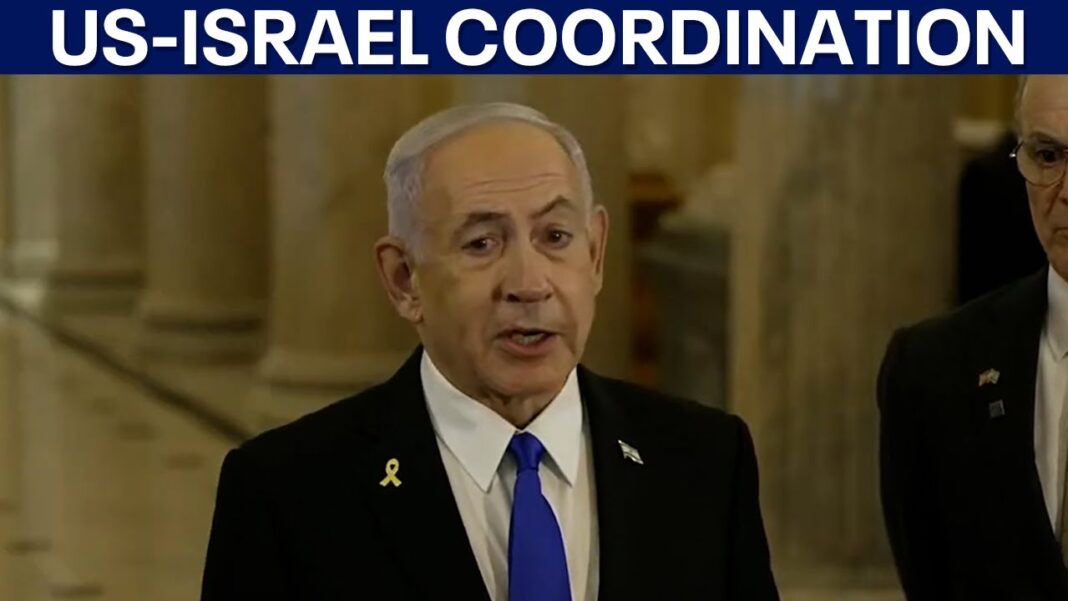
In a powerful and unapologetic speech delivered Wednesday night at the Blair House in Washington, Israeli Prime Minister Benjamin Netanyahu offered an emphatic defense of Israel’s recent military actions against Iran and paid high tribute to President Donald Trump for his decisive support. The reception, attended by U.S. senators, generals, Evangelical and Jewish leaders, served as both a geopolitical manifesto and a deeply personal declaration of Israel’s historic resilience in the face of existential threats.
As reported by The Jewish News Syndicate (JNS) on Thursday, Netanyahu’s remarks made clear that Israel’s preemptive operations—jointly coordinated with the United States—against Iran’s nuclear infrastructure marked not merely a military engagement, but a civilizational stand against theocratic tyranny.
“In great devastation, they would come with nuclear warheads. They would destroy your cities. They say, ‘Death to Israel.’ We’re simply in the way, but the real goal is death to America,” Netanyahu warned, drawing a stark line between the Iranian regime’s ambitions and the security of the West.
Addressing the audience of dignitaries, the Israeli leader thanked President Trump for what he described as “historic” and “unprecedented” leadership, particularly in authorizing strikes on the Natanz, Fordow, and Isfahan nuclear sites last month—strikes which the JNS report confirmed were crucial in halting Iran’s fast-advancing nuclear capabilities.
“Trump didn’t wait to be bombed. He didn’t wait for a Pearl Harbor. He acted first, and he acted with clarity, courage, and moral conviction,” Netanyahu said, praising not only the former president’s resolve but also the American B2 pilots who executed the mission with precision.
JNS reported that Netanyahu drew a direct line from these actions to the broader arc of history, comparing the coordinated U.S.-Israel military action to the Allied fight against fascism in World War II. He lamented that the U.S. did not join that war until attacked and said he was grateful Trump did not make the same mistake in the face of Iran’s nuclear belligerence.
“We worked together as a team—a team like no other,” Netanyahu declared, to robust applause. “And in that partnership, we delivered the benefits of victory against an evil regime. That changes history.”
Netanyahu also revealed the biblical inspiration behind the name of Israel’s military campaign: Operation Rising Lion. Drawing from the weekly Torah portion of Balak, he recounted the ancient story of the Moabite king Balak and the prophet Balaam, whom Balak had enlisted to curse Israel.
“But Balaam didn’t deliver. Instead, he delivered a prophecy: ‘The people shall rise like lions.’ Our soldiers are lions—our fighting soldiers, our people. So we rose like lions,” Netanyahu said, connecting millennia of Jewish perseverance to the bravery of IDF soldiers confronting Iran’s proxies and missile arsenals.
According to the information provided in the JNS report, Netanyahu went on to describe the Islamic Republic’s dual threats—its rapidly progressing nuclear program and its intent to install tens of thousands of long-range missiles capable of devastating Israeli cities. Had Israel and the U.S. failed to act, he warned, Iran would have achieved a functional nuclear weapon “within a year.”
“If you act, you might need to act again. But if you don’t act, you will die,” the prime minister stated starkly, emphasizing the deadly calculus of waiting in the face of genocidal regimes.
Though the night was dominated by military retrospection, Netanyahu made space for a forward-looking vision of diplomacy. Referring obliquely to current negotiations under wraps, he echoed the same strategic discretion that preceded the Abraham Accords—normalization agreements with the UAE, Bahrain, Sudan, and Morocco, brokered in part by Trump’s White House.
“We’re working on it. The less said, the better,” Netanyahu teased, suggesting that new diplomatic breakthroughs may be on the horizon. “We’ve already changed the Middle East, but we’re going to change it even further.”
The JNS report said that Netanyahu pointed to the Abraham Accords as proof of what determined diplomacy, coupled with strategic strength, can achieve. “President Trump and I worked for three years with a close team on the Abraham Accords. Nobody knew, and then it happened,” he said.
In a poignant moment, Netanyahu turned personal, offering heartfelt thanks to his wife, Sara Netanyahu, who accompanied him to Washington. He referenced the biblical line “Whatever Sarah tells you, listen to her,” adding, “She stood by me all these years amid much sacrifice and with incredible courage. Without her unrelenting support and wise judgment, I could not have done this.”
According to the information contained in the JNS report, the prime minister also closed his address with a passionate reaffirmation of Israel’s historic mission—framing the Jewish return to their ancestral homeland as more than national revival. It is, he said, a moral imperative and a statement of survival.
“We did not make the journey of 3,500 years of Jewish history—overcoming the greatest odds any people have faced, coming back to our ancestral homeland, building our state—to have it demolished by these mad ayatollahs,” Netanyahu declared.
“This could not have been done without the innate mission of the Jewish people to reclaim our homeland and build our future in our ancestral home. It is a powerful thing.”
The Blair House address was, in many ways, a summation of Netanyahu’s worldview: a fusion of biblical destiny, modern geopolitics, and unsparing clarity about the dangers facing Israel and the West. As the JNS report noted, it also reaffirmed the enduring alliance between Jerusalem and Washington—an alliance forged in trust, tested in war, and, if Netanyahu has his way, destined to continue shaping the Middle East for generations to come.
With Iran’s nuclear ambitions thwarted—for now—and diplomatic doors creaking open once again, Netanyahu’s final words served as a rallying cry: “We have secured unbelievable victories. It gives us an opportunity to chart a different course for our people, our region and the world.”
