



|
Getting your Trinity Audio player ready...
|
Washington to Convene First ‘Board of Peace’ Summit on Feb. 19 to Raise Funds for Gaza Rebuilding
By: Fern Sidman
As Washington prepares to host the first working session of the newly constituted Board of Peace on February 19, the initiative is already burdened by a weight of expectations that borders on the prohibitive. According to multiple diplomatic sources cited by The Times of Israel in a report that appeared on Saturday, the United States has extended invitations to the 26 other countries represented on the panel, convening an assembly whose stated mandate is to shepherd Gaza toward a postwar political and humanitarian architecture. Yet the choreography of this gathering, coinciding as it does with the opening of the holy month of Ramadan, is emblematic of the delicate calculus that has come to define international diplomacy around the Strip: religious calendars intersect with geopolitical urgency; humanitarian imperatives collide with hard security realities; and lofty institutional ambitions contend with a pervasive skepticism that the conditions for peace are even remotely in place.
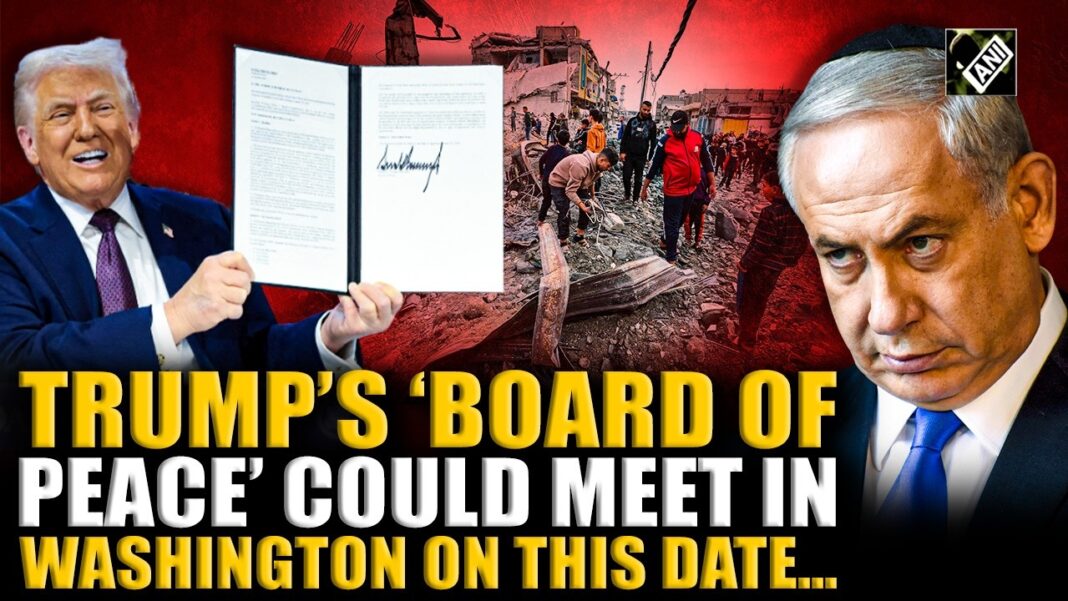
The Times of Israel has reported that the invitations were dispatched on Friday afternoon, confirming earlier disclosures by Axios and underscoring the pace with which Washington is attempting to translate its Davos-born vision into operational reality. The Board of Peace was formally unveiled on the sidelines of the World Economic Forum last month, where a signing ceremony sought to imbue the initiative with an aura of multilateral legitimacy. Yet the ceremony itself revealed the first fissures in the coalition. Though several dozen states were invited, fewer than two dozen ultimately participated, a reticence that The Times of Israel report attributed to discomfort with the Board’s charter.
Critics worry that the panel’s expansive mandate—perceived by some as an attempt to eclipse the United Nations—signals a broader American impatience with existing multilateral frameworks. This unease was compounded by a contemporaneous diplomatic quarrel between Washington and Western capitals over Greenland, further chilling enthusiasm for a U.S.-led institutional experiment.
American officials have moved quickly to assuage these concerns, telling allies, as The Times of Israel report noted, that the Board of Peace will initially confine its remit to Gaza, in accordance with a UN Security Council resolution that grants the panel a two-year mandate to oversee the Strip’s postwar management. Even this more circumscribed ambition, however, confronts formidable obstacles.
The February 19 meeting is intended not merely as a policy forum but as a fundraising summit, with organizers privately acknowledging that several billion dollars will be required to translate humanitarian blueprints into tangible infrastructure and governance mechanisms. The scale of this financial ask, juxtaposed with the ambiguity of the political horizon in Gaza, has already dampened enthusiasm among potential donors.
The Times of Israel has chronicled the pervasive hesitancy among states invited to participate. Many capitals remain unconvinced that Hamas will relinquish its arsenal or that Israel will acquiesce to further territorial withdrawals from the Strip—two preconditions that are widely viewed as indispensable for any durable postwar settlement.
The mediators who have labored in the interstices of the Gaza conflict—Egypt, Qatar, and Turkey—have for months floated the outlines of a gradual disarmament process, envisioning an incremental surrender of heavier weaponry in exchange for amnesty, employment opportunities, or financial inducements. Yet, as The Times of Israel reported, no formal proposal has yet been presented to Hamas, and Israeli officials have signaled scant appetite for a protracted disarmament timetable that could extend for months. From Jerusalem’s vantage point, the persistence of armed factions in Gaza represents an intolerable security risk, rendering any drawn-out process a nonstarter.
Compounding these uncertainties is the stalled emergence of the National Committee for the Administration of Gaza, the technocratic body that is ostensibly slated to replace Hamas in governing the enclave. Established last month with much fanfare, the committee has yet to set foot in Gaza, an absence that speaks volumes about the chasm between institutional design and on-the-ground feasibility.
Nickolay Mladenov, the Board of Peace’s designated envoy for Gaza, has been laboring to assemble a package of humanitarian and administrative measures that could furnish the committee with a semblance of legitimacy upon entry. His efforts, however, have been met with resistance from the Israeli government, which has insisted that only life-saving aid be permitted into areas where Hamas retains a presence. Given that nearly the entirety of Gaza’s two million residents reside in such zones, this stipulation risks hollowing out the humanitarian dimension of the Board’s mission before it even begins.
The timing of the Washington meeting further complicates the diplomatic tableau. Prime Minister Benjamin Netanyahu is slated to be in the U.S. capital from February 18 to 22, a visit that will overlap with the Board of Peace’s inaugural working session. Netanyahu’s absence from the Davos signing ceremony, attributed to the international arrest warrant he faces, had already cast a shadow over Israel’s engagement with the initiative.
While the prime minister has voiced objections to the Trump administration’s decision to include Qatar and Turkey on the Board of Peace’s Gaza Executive Board, Arab diplomats speaking to The Times of Israel have speculated that Netanyahu will find it diplomatically untenable to boycott the Washington gathering, particularly given that he is already in town. To do so, they suggest, would be construed as a deliberate snub of the U.S. president, imperiling the delicate equilibrium of the U.S.-Israel relationship at a moment of acute regional volatility.
Indeed, President Donald Trump and Netanyahu are scheduled to meet at the White House on February 18, one day before the Board of Peace convenes. The proximity of these engagements underscores the extent to which the initiative is entangled with the broader strategic dialogue between Washington and Jerusalem. For the Trump administration, the Board of Peace represents both a diplomatic gambit and a reputational stake: an attempt to imprint an American vision on the postwar order in Gaza while demonstrating leadership in a conflict that has long confounded international efforts at mediation.
For Israel, the calculus is more ambivalent. Participation offers a seat at the table where Gaza’s future may be shaped, but it also risks conferring legitimacy on processes and partners—most notably Qatar and Turkey—that Jerusalem regards with deep suspicion.
The Times of Israel has been attentive to the symbolic resonance of convening the Board of Peace at the threshold of Ramadan. For Muslim leaders, the holy month is a period of heightened spiritual observance and communal obligation, potentially complicating travel and participation. Yet the symbolism cuts both ways. To convene a forum dedicated to Gaza’s future at a moment of religious significance could be read as an appeal to moral conscience, an implicit acknowledgment that the humanitarian catastrophe in the Strip demands urgency even amid sacred rhythms. Whether this symbolism will translate into substantive engagement remains an open question.
Beneath the choreography of invitations, summits, and bilateral meetings lies a more sobering reality: the Board of Peace is attempting to construct an edifice of governance and reconstruction atop terrain that remains politically unstable and militarily contested. The Times of Israel report emphasized the skepticism that pervades diplomatic circles, a skepticism rooted not in abstract cynicism but in the accumulated lessons of prior initiatives that faltered amid the intractable dynamics of Gaza. The specter of Hamas’s continued entrenchment, the absence of a credible alternative governance structure on the ground, and Israel’s security imperatives collectively conspire to render any blueprint for postwar administration precarious.
And yet, to dismiss the Board of Peace outright would be to succumb to a fatalism that has too often paralyzed international engagement with Gaza. The initiative’s very audacity—its willingness to contemplate a new multilateral mechanism, however controversial—reflects an acknowledgment that existing frameworks have failed to arrest the cycle of devastation and recrimination.
As The Times of Israel report observed, the Board’s proponents are keenly aware of the reputational risks of overpromising and underdelivering. The fundraising ambitions articulated for the February 19 conference, while daunting, also signal a recognition that without substantial financial commitments, any talk of reconstruction and governance will remain a hollow exercise.
The coming weeks will test whether the Board of Peace can transcend the skepticism that shadows its inception. The Washington meeting, modest in its formal scope yet immense in its symbolic import, will serve as an early indicator of whether a critical mass of states is prepared to invest political capital in this nascent architecture. For Netanyahu, the overlapping engagements in Washington present both a diplomatic tightrope and an opportunity to shape the contours of an initiative that, for better or worse, is likely to influence Gaza’s trajectory in the years to come.
For Washington, the challenge will be to reconcile its expansive ambitions with the granular realities of a conflict zone where trust is scarce and leverage is unevenly distributed.
In the final analysis, the Board of Peace enters the stage at a moment when Gaza’s future is suspended between war’s residue and peace’s elusive promise. Whether this new forum can navigate the labyrinth of competing interests, institutional rivalries, and on-the-ground constraints will determine not only its own credibility but also the prospects for any meaningful postwar order in the Strip. The February 19 meeting may thus be remembered less for the declarations it produces than for the light it sheds on the international community’s capacity—or incapacity—to reimagine governance in one of the world’s most intractable arenas.
