



|
Getting your Trinity Audio player ready...
|
Washington Sounds the Alarm: Americans Told to Flee Iran as Nationwide Turmoil Intensifies
By: Fern Sidman
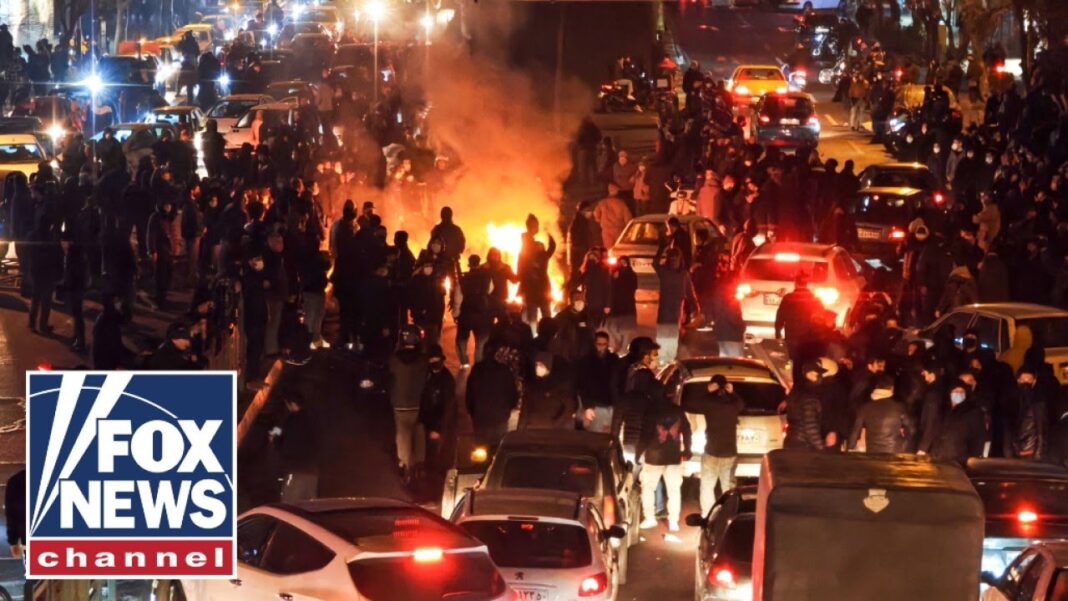
As the streets of Tehran, Mashhad and scores of provincial cities convulse with fury, desperation and bloodshed, the United States has issued its most dire warning to citizens in Iran in decades. In an extraordinary security alert released Monday, the Trump administration instructed Americans to evacuate the Islamic Republic immediately, signaling that Washington now views the situation not merely as unrest, but as a spiraling national emergency with unpredictable and potentially catastrophic consequences.
According to report on Tuesday by The Jewish News Syndicate (JNS), the virtual U.S. Embassy for Iran told U.S. nationals to “leave Iran now,” and to do so without reliance on government assistance. The alert, which the JNS report noted was distributed amid a near-total communications blackout imposed by Tehran, urged Americans to prepare exit plans, consider land routes through Armenia or Türkiye, and brace for prolonged internet outages and intensified surveillance.
“Increased security measures, road closures, public transportation disruptions and internet blockages are ongoing,” the advisory warned, adding that U.S. citizens face a “significant risk of questioning, arrest and detention.”
For observers steeped in the rhythms of Middle Eastern crises, the phrasing is chilling. JNS analysts described the message as the kind typically reserved for war zones on the cusp of foreign intervention or domestic collapse.
Behind the scenes in Washington, the machinery of contingency planning is grinding into motion. JNS, citing U.S. defense and intelligence sources, reported that President Trump has been briefed on a menu of military and covert options that go far beyond conventional airstrikes.
Two Defense Department officials told CBS News that these options include cyber-operations, sabotage of regime infrastructure and covert action designed to cripple the Islamic Republic’s ability to repress its population. A full national security meeting is scheduled at the White House, where Trump’s top advisers will review updated scenarios, though it remains unclear whether the president himself will attend.
White House Press Secretary Karoline Leavitt, in comments highlighted by JNS, emphasized that while diplomacy remains the administration’s preferred path, “the president is keeping all options on the table.”
“Nobody knows better than Iran that President Trump is unafraid to use military power if he deems it necessary,” she said, while adding that Washington is receiving markedly different messages in private from Tehran than those broadcast publicly.
The Iranian regime, for its part, has responded with a mix of bravado and barely veiled alarm. Foreign Minister Abbas Araghchi confirmed that communications with U.S. envoy Steve Witkoff remain active, telling Al Jazeera that discussions continued “before and after the protests.”
Yet he derided Washington’s proposals as fundamentally “incompatible” with Trump’s threats, a phrase that JNS commentators interpreted as diplomatic code for paralysis.
Supreme Leader Ayatollah Ali Khamenei, meanwhile, unleashed a characteristically venomous social-media tirade. In posts dated Jan. 9, he accused Trump of “arrogantly judging the world,” sneering that the American president “too will fall.”
“The rioters have put their hopes in him,” Khamenei wrote. “If he’s so capable, he should manage his own country.”
But the bravado rings hollow in a nation hemorrhaging lives.
JNS has tracked wildly divergent casualty figures emerging from Iran, each more horrifying than the last. On Tuesday, an unnamed Iranian official told Reuters that approximately 2,000 people had been killed, blaming “terrorists” for the deaths of demonstrators and security forces alike.
Yet opposition-linked outlet Iran International painted a far darker picture, asserting that at least 12,000 people were killed in what it called the largest mass slaughter in modern Iranian history, concentrated over just two nights—Jan. 8 and 9.
The U.S.-based Human Rights Activists News Agency (HRANA), whose tallies JNS frequently references for their methodological rigor, reported at least 646 confirmed deaths since Dec. 28, including 505 protesters and 113 members of the security forces. It is currently investigating an additional 579 alleged fatalities.
The arrest count is equally staggering: 10,721 detentions nationwide, according to HRANA, with protests erupting in 585 locations across all 31 provinces.
The uprising began, as so many Iranian revolts have, with the price of bread.
Soaring inflation, rolling blackouts, water shortages and the collapse of the rial—now trading at roughly 1.46 million to the dollar—ignited fury among bazaar merchants and urban workers. But as JNS has reported, what started as an economic protest has metastasized into an existential rebellion against clerical rule.
Strikes have shuttered markets in key commercial centers. Demonstrators chant slogans demanding the end of the Islamic Republic itself. The unrest is being exacerbated by renewed U.N. “snapback” sanctions and the lingering damage from Israeli and U.S. strikes on Iranian nuclear and energy facilities last June—blows that further crippled an already fragile infrastructure.
The regime’s response has been brutally consistent: deploy the Basij and Revolutionary Guard units, flood the streets with security forces, cut the internet, silence witnesses.
Jerusalem is watching the storm with unblinking intensity.
The JNS report cited Israel’s Kan News in reporting that Israeli defense officials believe Trump will honor his warning to intervene should Iranian authorities escalate their use of lethal force. Such intervention, Kan cautioned, could quickly spiral into direct confrontation between Israel and Iran.
IDF spokesperson Brig. Gen. Effie Defrin sought to tamp down speculation Monday, stating that the Israel Defense Forces are “prepared for defense and on alert for surprise scenarios if required,” while stressing that the protests remain “an internal Iranian matter.”
Yet his admonition—“Do not lend a hand to rumors”—was itself a tacit admission of how combustible the situation has become.
The confluence of these developments reads like the preface to a geopolitical earthquake.
A regime that has ruled through fear for 45 years now faces the most widespread and sustained revolt in its history. Its currency is in freefall. Its people are starving. Its prisons overflow. And its leaders can no longer rely on silence to mask the carnage.
The American evacuation warning, unprecedented in its bluntness, is not merely about protecting U.S. citizens. It is a flare in the night sky, illuminating Washington’s growing conviction that Iran is approaching a point of no return.
Whether that culminates in diplomacy, cyber-warfare or military intervention remains uncertain. But as JNS has emphasized throughout its coverage, the crisis has already crossed from protest into historical rupture.
For now, the message to Americans inside Iran is stark: leave. For the Iranian people themselves, trapped in a nation where the internet has gone dark and the morgues are overflowing, there is no such exit. Their fate—and perhaps the future of the Middle East—hangs on decisions being made in Washington, Jerusalem and Tehran in the coming days.