



|
Getting your Trinity Audio player ready...
|
By: Fern Sidman
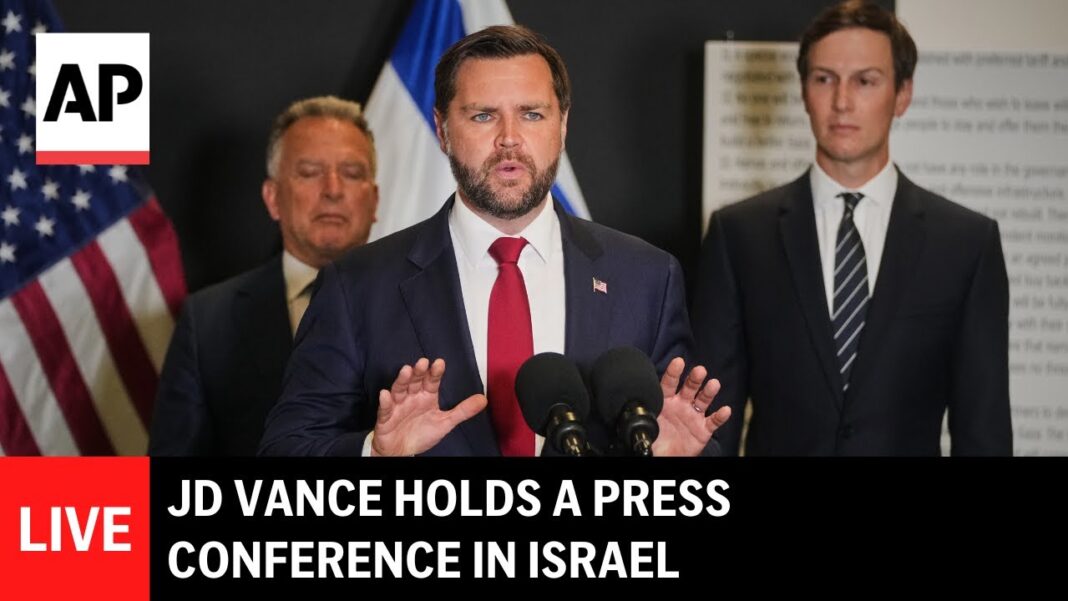
Standing before a row of microphones at an IDF staging area in southern Israel, Vice President J.D. Vance projected both confidence and caution as he addressed reporters Tuesday evening, marking one week since the launch of President Donald Trump’s 20-point peace plan for the Middle East. Speaking under the harsh desert lights, Vance declared that “things are going, frankly, better than I expected,” while making clear that the path toward lasting stability in Gaza would depend on Hamas’s compliance and the unified resolve of Israel’s allies.
According to a report that appeared on Tuesday at Israel National News, Vance’s visit was designed to bolster the delicate ceasefire between Israel and Hamas, a truce that remains fragile following years of intermittent warfare and bloodshed. His remarks underscored the dual nature of the U.S. mission — part reassurance, part ultimatum — as Washington seeks to secure peace while warning that failure to disarm could invite devastating consequences for the terrorist organization that still controls Gaza.
Vance opened his remarks with a rare note of optimism, emphasizing that the Trump administration’s framework was holding better than some skeptics had predicted. “We are one week into President Trump’s historic peace plan in the Middle East,” he said, “and things are going, frankly, better than I expected they were.” His comments, as reported by Israel National News, reflected a measured confidence that the ceasefire, if maintained, could mark the beginning of a broader regional stabilization.
But beneath that optimism lay the reality that the situation remains tenuous. The ceasefire agreement, a cornerstone of Trump’s 20-point plan, requires Hamas to fully disarm, release hostages, and allow reconstruction efforts to proceed under international oversight — all conditions that have historically proven difficult to implement.
In one of the most pointed exchanges of the evening, Vance was asked about Turkey’s potential role in enforcing the ceasefire and assisting in Gaza’s reconstruction, a delicate issue given Ankara’s longstanding support for Hamas.
“We think everybody has a role to play here,” Vance said, carefully framing his response to avoid alienating Israel while keeping open the door to regional cooperation. “Some of that’s going to be financial, some of that’s going to be in reconstruction, some of that’s just in communication with the various parties.”
As the Israel National News report noted, Vance emphasized that the United States would never impose foreign troops or policies on Israel, stating plainly: “We’re not going to force anything on our Israeli friends when it comes to foreign troops on their soil.” At the same time, he argued that Turkey, despite its past sympathies for Hamas, has already played “a very constructive role.”
He acknowledged Turkey’s history bluntly — “Turkey has supported Hamas in the past,” he said — but insisted that the path forward required looking beyond past grievances. “No one who is a party to this conflict can look at it and not point at something they don’t like or disagree with,” he said. “The way that we’re going to get to peace is to focus on the future, which is what the President of the United States has asked us to do.”
Another emotional focus of the vice president’s remarks centered on the repatriation of deceased hostages who remain in Gaza. Families across Israel have waited months — in some cases, years — for news of their loved ones taken or killed by Hamas, and Vance addressed their anguish directly.
“It is a focus of everybody here to get those bodies back home to their families so that they can have a proper burial,” he said, according to the report at Israel National News. But he cautioned that this process would not happen quickly.
“Some of these hostages are buried under thousands of pounds of rubble,” Vance explained. “Some of the hostages — nobody even knows where they are. That doesn’t mean we shouldn’t work to get them, and that doesn’t mean we don’t have confidence that we will. It’s just a reason to counsel in favor of a little bit of patience.”
His comments acknowledged the enormous logistical and humanitarian challenges facing Israeli and American recovery teams operating in areas still riddled with unexploded ordnance and collapsed infrastructure.
Turning to the larger architecture of President Trump’s peace initiative, Vance outlined the fundamental expectations for Hamas and the conditions for Gaza’s political future. “Our warning to Hamas is very straightforward,” he said. “The terms of the 20-point plan that the President put out there are very clear.”
“Hamas has to disarm,” he continued. “Hamas has to actually behave itself. And Hamas — while all the fighters can be given some sort of clemency — they’re not going to be able to kill each other and they’re not going to be able to kill their fellow Palestinians.”
According to the information provided in the Israel National News report, Vance’s statement captured the essence of Washington’s new approach: a combination of clemency and accountability, designed to give lower-ranking militants a path toward reintegration while ensuring that Hamas’s leadership faces the full consequences of its actions.
“This is going to take time,” Vance said. “But right now, where I stand, I feel confident we’re going to be in a place where this peace lasts, where it’s durable.”
His remarks called attention to the administration’s focus on longevity — not a temporary lull in violence, but the creation of an enduring security framework that prevents Hamas from rearming and restrains its political influence.
While the vice president spoke with measured diplomacy throughout most of his appearance, his tone hardened when pressed on what the United States would do if Hamas refused to comply with the disarmament terms.
“If Hamas doesn’t cooperate,” Vance said firmly, “then as the President of the United States has said, Hamas is going to be obliterated.”
The remark, reported prominently by Israel National News, highlighted the administration’s willingness to back its diplomatic initiatives with military deterrence. Yet Vance notably refrained from setting any timetable for Hamas to act, suggesting that while Washington’s patience is not unlimited, its strategy still prioritizes sustained pressure and negotiation over immediate confrontation.
Throughout his remarks, Vance struck a tone that combined moral clarity with pragmatic caution — a hallmark of Trump-era diplomacy, as the Israel National News report observed. He urged patience not as a sign of weakness but as a recognition of the complexity of the task ahead. “It’s difficult,” he repeated several times, referring both to the physical challenges of rebuilding Gaza and the political minefield of dealing with factions that have thrived on chaos and martyrdom.
The vice president’s comments also hinted at a broader strategic goal: building a coalition of regional partners to stabilize Gaza without forcing Israel into untenable security arrangements. By giving space to countries such as Turkey to contribute financially or diplomatically — under tight constraints — Washington aims to share the burden while preserving Israel’s full autonomy over its defense.
As Israel National News detailed in its coverage of Vance’s visit, the vice president’s role is as much about reassurance as enforcement. His trip signals unwavering American support for Israel’s right to self-defense, while also encouraging a cautious optimism that peace, however fragile, may be achievable through discipline and persistence.
For Israel, the test lies in balancing deterrence with reconstruction. For the United States, the challenge is maintaining a coalition broad enough to fund and enforce the deal — yet narrow enough to prevent anti-Israel actors from hijacking its implementation.
Vance concluded his remarks on an optimistic note, reiterating his belief that President Trump’s plan could bring a sustainable end to hostilities if its terms are fully implemented. “We feel confident,” he said, “that we will be in a place where this peace lasts, where it’s durable.”
Still, the vice president’s warning to Hamas — that failure to cooperate would invite its destruction — served as a stark reminder that the ceasefire’s future remains precarious.
As Israel National News reported, the administration’s strategy hinges on a simple but demanding equation: Hamas must lay down its arms, the region must commit to rebuilding, and Israel must retain the security assurances that its survival demands.
The coming weeks will reveal whether the fragile truce can withstand the pressures of politics, vengeance, and history. For now, the message from Washington is clear: patience will be extended — but not indefinitely.