



|
Getting your Trinity Audio player ready...
|
By: Fern Sidman – Jewish Voice News
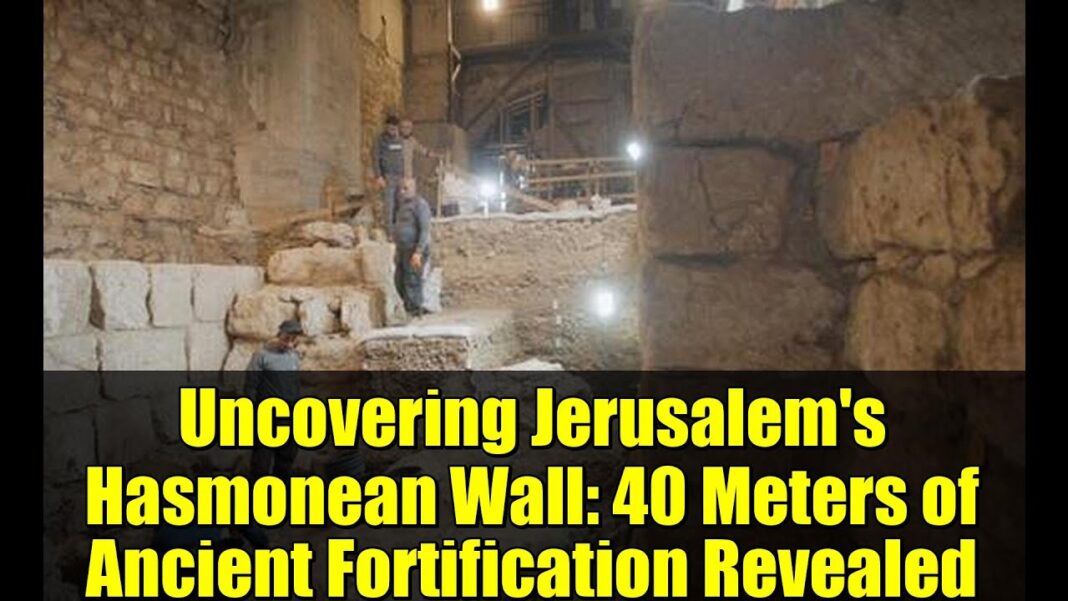
The unearthing of a remarkably preserved segment of Jerusalem’s ancient fortifications—dating back more than 2,100 years—has cast new light on the city’s turbulent Hasmonean era, offering archaeologists one of the most significant glimpses in recent memory into the physical architecture that safeguarded Jewish sovereignty in antiquity. As reported on Monday by World Israel News, the Israel Antiquities Authority (IAA) announced Monday that excavations near the Tower of David in the Old City have revealed a substantial stretch of the famed “First Wall,” an expansive Hasmonean fortification mentioned prominently in classical sources but only partially understood through limited physical evidence.
The newly uncovered wall, discovered within the Kishle compound adjacent to the citadel, measures more than 40 meters in length and roughly five meters in width. Though only a remnant of the original structure remains, excavation directors Dr. Amit Re’im and Dr. Marion Zindel described the find as “particularly impressive in both its size and degree of preservation,” citing the use of massive, expertly hewn stones typical of late Hellenistic Judea. The IAA noted that when fully intact, the wall would have risen over ten meters, forming an imposing defensive barrier around Jerusalem during the latter part of the second century BCE.
Its discovery has been heralded by scholars and government officials alike as a vivid testament to the resilience, political ambition, and military engineering of the Hasmonean dynasty—a Jewish ruling house that emerged after the Maccabean revolt and governed the land for more than a century. According to the World Israel News report, Heritage Minister Rabbi Amichai Eliyahu hailed the find as “tangible and moving evidence of Jerusalem’s might and stature during the Hasmonean period,” adding that such discoveries “demonstrate and exhibit our proud heritage to the world” and bring the stories of Hanukkah “to life on the ground.”
The First Wall, referenced extensively by the first-century Jewish historian Flavius Josephus, was one of the most critical components of Jerusalem’s ancient defensive network. Josephus described its path, its gates, and its imposing 60 fortified towers, all of which underscored the city’s strategic importance and the Hasmonean state’s determination to reinforce its capital against repeated invasions.
The section uncovered by the IAA appears to confirm Josephus’s account of the wall’s construction and architectural sophistication. Yet it also raises fresh questions, particularly regarding the mystery surrounding its destruction. Dr. Re’im and Dr. Zindel noted that the wall did not merely collapse over time nor succumb to the ravages of a routine military confrontation. Instead, it appears to have been purposefully, systematically dismantled—a finding that significantly complicates the historical narrative.
“This is predetermined destruction,” the archaeologists emphasized. “Not the result of the ravages of time, nor of a random enemy attack, but a deliberate execution of a well-planned action.”
According to the information provided in the World Israel News report, the IAA has proposed two competing theories to explain this intentional demolition. One possibility points to the Hasmoneans themselves, who may have dismantled the wall as part of a peace agreement with the Seleucid ruler Antiochus VII Sidetes. During his campaign to reclaim Judea for the Hellenistic empire, Antiochus besieged Jerusalem between 134 and 132 BCE, and historical accounts suggest that John Hyrcanus I—the Hasmonean leader at the time—agreed to raze the city’s fortifications in exchange for the lifting of the siege.
The second possibility implicates King Herod, who ascended to power several decades later and is known to have destroyed or renovated many Hasmonean structures as part of his effort to assert a distinct political and architectural identity. Herod, ever conscious of posterity, may have intentionally demolished the earlier Hasmonean wall to erase symbolic reminders of the dynasty he supplanted.
Previous excavations offer compelling support for both theories. As noted by World Israel News, digs carried out in the 1980s at the base of the First Wall uncovered a massive cache of Hellenistic-era weaponry, including catapult stones, slingstones, lead bullets, and arrowheads—artifacts attributed to the Seleucid assault under Antiochus VII. These weapons, which were found clustered around the wall’s foundations, indicate that the Hasmonean defenses successfully repelled the onslaught, preventing the siege engines from breaching the city perimeter.
The sheer concentration of ammunition also underscores the ferocity of the conflict. Despite enduring a relentless bombardment, the Hasmonean fortifications held firm—a testament to the strength and strategic importance of the wall newly revealed by the IAA’s excavation.
Yet no corresponding evidence of destruction by natural decay or enemy breach has been found. Instead, the uniformity of the wall’s dismantling suggests a calculated operation, whether carried out by Hyrcanus under siege or by Herod in peacetime.
Either scenario underscores the wall’s significance: it was central enough to Jerusalem’s identity that its removal required a monumental political or military event.
The Hasmonean dynasty, though relatively brief in its rule, left an indelible mark on Jewish history. Emerging from the Maccabean revolt—an uprising immortalized in the Hanukkah narrative—the Hasmoneans transformed Judea from a vassal territory under Seleucid dominion into a sovereign Jewish kingdom. Their period of rule was characterized by political expansion, religious consolidation, and monumental construction projects, including the fortifications of Jerusalem.
As the World Israel News report noted, archaeological discoveries from this era provide essential context for understanding the foundations of Jewish national identity, particularly at a moment when historical narratives are increasingly contested on the global stage.
The location of the First Wall—spanning Mount Zion, the City of David, the Citadel courtyard, and the western periphery of the Old City—illustrates Jerusalem’s dramatic expansion during the Second Temple period. Its discovery adds a new layer to ongoing excavations that collectively trace the evolution of the ancient city’s boundaries.
Moreover, the wall’s strategic placement highlights Jerusalem’s vulnerability and its centrality in conflicts between rival Hellenistic powers and emergent Jewish leadership.
For modern Israelis—and for Jews worldwide—the excavation serves as a physical reminder of historical continuity. That such a monumental structure has been unearthed adjacent to the Tower of David, itself a symbol of millennia of Jewish presence in Jerusalem, underscores the endurance of the city’s cultural and spiritual identity.
As Rabbi Eliyahu noted to World Israel News, the excavation dovetails powerfully with the commemorative themes of Hanukkah, transforming the festival’s abstract celebration of resistance and reclamation into a tangible connection with the very stones that protected the Hasmonean capital.
The find also resonates in contemporary geopolitical discourse, at a time when the legitimacy of Jewish historical claims to Jerusalem is challenged in diplomatic arenas and public debates. The imposing Hasmonean wall, once thought lost to time, now stands as material testimony to Jewish statehood, resilience, and rootedness in the land more than two millennia ago.
While the newly exposed segment of the First Wall offers dramatic insights, it also invites further excavation and investigation. Many questions remain unresolved: Who ordered its dismantling? What political calculus drove that decision? How did the wall’s destruction shape the city’s subsequent defenses?
For now, archaeologists and historians alike view the discovery as a landmark moment in the study of ancient Jerusalem. As additional research unfolds, the First Wall may yet reveal new truths about the Hasmonean kingdom and the tumultuous centuries that shaped the spiritual and political center of the Jewish world.
What is clear is that each stone unearthed in Jerusalem reinforces a historical narrative that is not merely academic but deeply interwoven with the identity, memory, and national story of the Jewish people.