



|
Getting your Trinity Audio player ready...
|
By: Fern Sidman
Amid ongoing international criticism of Israel’s handling of humanitarian aid to the Gaza Strip, a series of recently released documents from the United Nations reveals a drastically different reality on the ground. According to data reviewed by World Israel News, more than 90 percent of humanitarian aid trucks entering Gaza over the past three months have been intercepted by Hamas or affiliated armed groups, rendering most relief efforts ineffective in reaching the civilian population.
This startling admission—outlined in a report quietly issued by the United Nations Office for Project Services (UNOPS)—challenges months of public messaging by several UN agencies that have consistently pointed to Israel as the primary obstacle to humanitarian access in Gaza. Instead, the latest findings suggest that organized militant groups, primarily Hamas, are the dominant disruptors of aid distribution, systematically diverting food and medical supplies intended for Gaza’s most vulnerable residents.
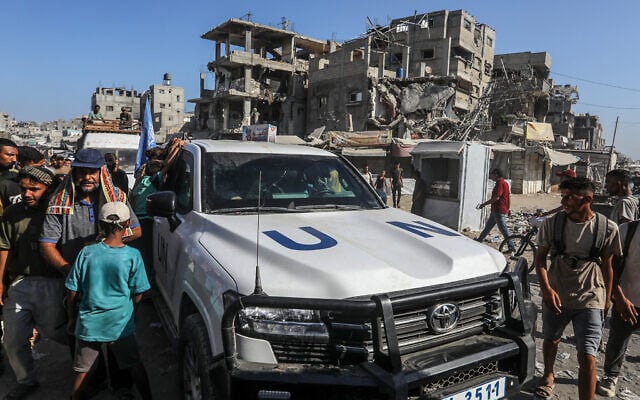
According to UNOPS records cited by World Israel News, 88 percent of all aid trucks that entered Gaza in May 2025 failed to reach designated UN distribution centers. These centers are meant to serve as secure, depoliticized zones where food, medicine, and other essentials can be handed directly to civilians under the oversight of international humanitarian actors.
In June, the problem intensified: out of 1,155 aid trucks approved to cross into the Gaza Strip, 90.7 percent were reported as intercepted or rerouted before reaching their intended destinations. That number rose even further in July, with only 66 of 1,161 trucks—just under six percent—reaching official UN depots.
UN sources who spoke with World Israel News on background confirmed that the vast majority of aid shipments are now being seized by Hamas or other Palestinian armed factions shortly after crossing into Gaza. Eyewitnesses and UN personnel describe scenes of heavily armed militants escorting trucks to undisclosed warehouses, where the contents are unloaded, stored, and in many cases, later sold at inflated prices on the black market.
These revelations stand in stark contrast to the public posture of several UN officials who have frequently criticized Israel for imposing restrictions at Gaza border crossings. Israeli authorities maintain that these measures are intended to prevent dual-use goods—such as concrete, fuel, and electronics—from being repurposed for terrorist infrastructure.
Despite the mounting evidence of systematic aid seizures by Hamas, some UN officials have continued to deflect attention toward Israel. Olga Cherevko, a spokesperson for the UN Office for the Coordination of Humanitarian Affairs (OCHA), told The Times of Israel that “long-standing restrictions have created an unpredictable environment, where communities lose confidence that aid will reach them.”
Cherevko added that some of the aid truck diversions are caused by “starving, desperate people,” although she did not provide evidence for how unarmed civilians would be able to stop and commandeer cargo vehicles—especially when those vehicles are often under the protection of armed groups.
Analysts cited by World Israel News question this framing, noting that “desperate civilians” are unlikely to possess the logistical capacity or firepower required to divert multi-ton shipments of aid. Moreover, the organized manner in which trucks are redirected to guarded warehouses points strongly to the involvement of militant factions rather than spontaneous civilian action.
Cherevko further argued that greater “confidence” in aid delivery would emerge only through sustained and uninterrupted convoys. She referenced a period during a prior ceasefire, saying that “incidents of this kind” were less frequent at the time, though she did not attribute that improvement to any reduction in Hamas control or interference.
As reported by World Israel News, the diverted aid is rarely distributed freely to civilians in need. Instead, Hamas and other armed factions reportedly stockpile much of the intercepted supplies in heavily guarded locations, then resell them to Gaza residents at exorbitant prices.
Local sources who spoke on condition of anonymity to World Israel News detailed how essential items such as flour, canned food, baby formula, and over-the-counter medication—originally intended as free humanitarian aid—are routinely sold in underground markets or by regime-connected vendors operating in public bazaars.
These practices have led to severe inflation in basic goods across Gaza, compounding the hardships faced by an already battered population. UN personnel on the ground have expressed frustration that they are unable to monitor where most aid ends up after it enters the Strip.
One senior humanitarian coordinator, quoted anonymously by World Israel News, said, “We’re essentially flying blind. We don’t know how much food is reaching families, and we have very little recourse when entire convoys vanish after entry.”
The new UNOPS data challenges months of rhetoric that placed the burden of Gaza’s worsening humanitarian conditions squarely on Israel. While it is true that Israel has maintained tight control over aid entry points, primarily to prevent weapons smuggling and dual-use material transfer, the figures suggest that the overwhelming barrier to effective aid delivery lies within Gaza itself.
Israeli officials, responding to the UN revelations, reiterated that they have facilitated the entry of thousands of aid trucks in coordination with international partners, only to see those efforts thwarted by Hamas. “We are not the ones stealing the food,” said an Israeli Defense Ministry official, speaking to World Israel News. “We inspect the trucks, approve the cargo, and transfer it through crossings. What happens next is the real scandal.”
In recent weeks, Israeli leaders have begun pressing UN agencies to publicly acknowledge the aid diversion problem. However, only a handful of statements, buried in reports like the UNOPS briefing, have addressed the issue with clarity.
The implications of the aid seizure are profound, not only for Gaza residents but also for the future of international humanitarian operations in conflict zones. Experts interviewed by World Israel News argue that continued silence from global institutions only empowers the bad actors disrupting relief operations.
“There needs to be a serious reckoning within the international community,” said a former UN logistics officer now working with a private aid consultancy. “If you know that 94 percent of your trucks are not reaching the hungry, then the system is broken. Period.”
Some Israeli commentators are calling for a reassessment of how aid is delivered to Gaza, including proposals to bypass Hamas-controlled zones by creating buffer areas for distribution under the protection of international peacekeepers or neutral third-party observers.
The latest data paints a grim picture of how humanitarian aid—often the last lifeline for civilians in conflict—can be manipulated and exploited by armed groups for political and financial gain. The overriding question remains: can international aid efforts adapt to circumvent those who abuse them, or will civilians remain at the mercy of power brokers who see food and medicine not as relief, but as leverage?
For now, the answer seems elusive. But with over 90 percent of humanitarian aid reportedly disappearing into the control of Hamas and its affiliates, one thing is certain: until that dynamic is disrupted, the people of Gaza will continue to suffer—not because of a lack of generosity from abroad, but because of exploitation at home.