



|
Getting your Trinity Audio player ready...
|
By: Abe Wertenheim
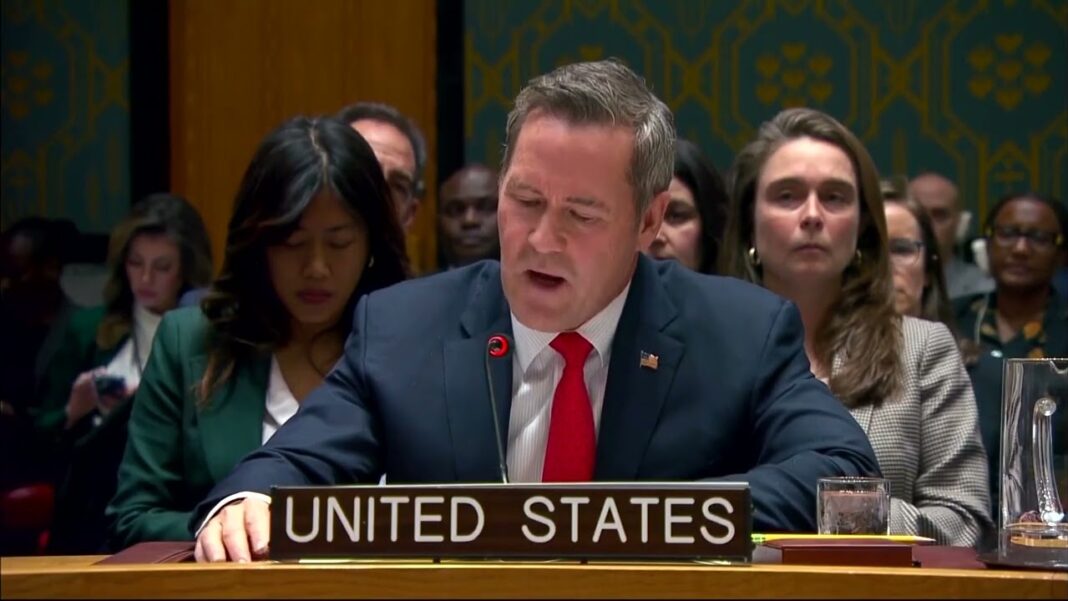
In a landmark diplomatic development, the United Nations Security Council on Monday adopted a U.S.-drafted resolution outlining a postwar framework for Gaza’s stabilization and governance, marking the first time since the 2023 Hamas invasion that the international community has formally endorsed a structured path toward regional peace. The vote passed with 13 members in favor, while Russia and China abstained, opting not to exercise their veto power.
According to a report at The Jewish News Syndicate (JNS), the resolution represents a sweeping endorsement of President Donald Trump’s peace framework, which calls for the creation of an international stabilization force in Gaza and the establishment of a new transitional governing authority, to be known as the Board of Peace. Trump will personally lead the initiative, which U.S. officials say aims to maintain stability in the region while laying groundwork for long-term reconstruction and limited Palestinian self-governance.
“We stand at a crossroads,” declared Mike Waltz, the U.S. ambassador to the United Nations, in remarks before the vote. “Today, we have the power to douse the flames and light a path to peace.”
As reported by JNS, the resolution authorizes the United States and its coalition partners to design and implement the multinational stabilization force, or International Stabilization Force (ISF), which will be responsible for enforcing the ceasefire, facilitating humanitarian aid, and overseeing the demilitarization of Hamas.
“The demilitarization of Hamas is a basic condition of the peace agreement,” stated Danny Danon, Israel’s ambassador to the United Nations. “There will be no future in Gaza as long as Hamas possesses weapons.”
The measure also establishes a partial withdrawal framework for the Israel Defense Forces (IDF), allowing Israel to maintain limited deployments in key strategic zones to prevent terror resurgence. While Israeli troops will gradually hand over control to the ISF in designated areas, Jerusalem will retain full security oversight in the event of renewed terrorist activity.
As outlined in the JNS report, the resolution formally endorses President Trump’s vision of a new Board of Peace, a transitional body tasked with managing Gaza’s reconstruction, civil governance, and coordination with international donors.
The resolution further stipulates that “conditions may finally be in place for a credible pathway to Palestinian self-determination and statehood,” but only after sweeping internal reforms are enacted within the Palestinian Authority (PA) and once Gaza’s reconstruction is demonstrably advanced.
“This plan has already silenced the guns and freed the hostages in this fragile first step,” Waltz told the Council. “The remaining hostages must come home.”
Waltz emphasized that the stabilization framework would be accompanied by a sustained international monitoring presence and strict mechanisms to ensure compliance by all parties involved. “For two years, Gaza has been a crucible of conflict—a hell on earth where Hamas’s brutality and terror met Israel’s fierce response,” he said.
The resolution received broad international backing, including from key European and Arab states. According to the JNS report, more than a dozen European heads of state, Palestinian Authority President Mahmoud Abbas, and several Arab and Muslim-majority nations signaled their support prior to the vote.
“With this kind of support, I ask you—if the region most affected, the Arab nations, the Muslim-majority nations, the Palestinians, and the Israelis can accept this resolution, how could anyone be against it?” Waltz asked the chamber. “Are you more righteous in this cause than those who must live with it and will ultimately benefit from this plan for peace?”
This coalition, which includes Egypt, the United Arab Emirates, Turkey, Pakistan, and Indonesia, has been described in the JNS report as a diplomatic breakthrough for Washington, reflecting the renewed influence of the Abraham Accords framework and the Trump administration’s ongoing efforts to expand normalization between Israel and the Arab world.
Moscow and Beijing both abstained, avoiding a direct veto but voicing reservations about the scope of U.S. authority under the resolution. Russia had circulated an alternate draft last week proposing that the U.N. Secretary-General take primary oversight of Gaza’s reconstruction rather than Washington.
Russian diplomats expressed concern that the resolution effectively grants the United States unilateral control over Gaza’s transitional governance and security arrangements. The alternative proposal, according to the JNS report, would have placed management of the stabilization effort under a U.N.-appointed administrator with limited U.S. involvement—an idea rejected by Washington and its allies.
Despite these objections, Moscow’s decision to abstain rather than block the resolution was viewed as a tacit acknowledgment of broad international consensus on the need for a structured peace framework.
While Israel supported the resolution’s emphasis on demilitarizing Gaza, senior officials expressed unease over the inclusion of language hinting at eventual Palestinian statehood. According to the information provided in the JNS report, this clause was added in the final hours of negotiation to secure European and Arab support.
Israeli officials have emphasized that the IDF will not relinquish operational control in any sector of Gaza until Hamas has been fully disarmed. Questions remain over whether the ISF or a successor body will be tasked with the active demilitarization of Hamas should the terror group refuse to disarm voluntarily.
“Gaza will be demilitarized down to the last tunnel,” Danon reiterated. “Israel will ensure, through the IDF or through any authorized international force, that Hamas will never again pose a threat to the Jewish state.”
Speaking on Sunday at the Tikvah 2025 Jewish Leadership Conference in New York City, Ambassador Waltz previewed the upcoming vote, telling attendees that the resolution would mark “one of the most important diplomatic moments in recent history.”
“Folks, tomorrow, knock on whatever I can, we will have a resolution backed by the eight Arab- and Muslim-majority countries that sat with President Trump during the U.N. General Assembly,” Waltz said, as cited in the JNS report. “The key Arab countries, plus Turkey, plus Pakistan, plus Indonesia, standing with us. We then got the Palestinian Authority to support this, and of course, we are working very closely with the government of Israel.”
He hailed the upcoming resolution as potentially “the best the United States and Israel have seen in the 80-year history of the United Nations,” crediting President Trump for orchestrating a rare coalition of support across traditionally adversarial nations.
“If it were the IDF in perpetuity, then frankly I don’t think we have a pathway to expanding the Abraham Accords, which is the number one objective of this administration,” Waltz added. “Tomorrow could truly, truly be a historic day.”
As JNS reported, the passage of the resolution ushers in a delicate transition period for Gaza. The first phase of implementation will see international forces deployed to oversee the ceasefire’s consolidation, followed by a gradual transfer of administrative responsibilities to the Board of Peace.
While the resolution envisions a demilitarized and internationally supervised Gaza, its success will hinge on the cooperation of regional actors, the steadfastness of the ceasefire, and Hamas’s compliance with disarmament terms.
For now, Monday’s vote stands as a milestone moment in the postwar rebuilding of Gaza—one that, for the first time in years, unites much of the international community behind a single vision for stability, reconstruction, and cautious optimism for the future.
I hope this can be done – I really do. I also (rightfully so) do not trust the Arab World based on previous history. However if Trump can pull this through it will be an amazing legacy of his. We need to trust the process, but at the same time keep vigilant.