



|
Getting your Trinity Audio player ready...
|
By: Fern Sidman
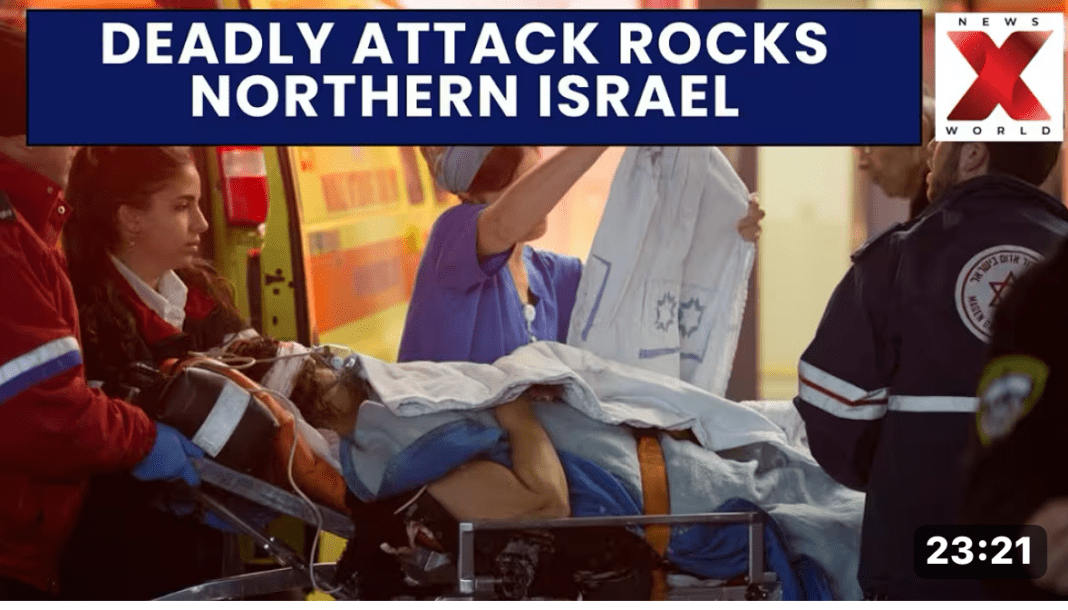
Northern Israel was plunged into grief and fury on Friday after a single Palestinian assailant carried out a deadly sequence of ramming and stabbing attacks that left two civilians dead and two others wounded, in what authorities described as a combined terror assault spanning multiple locations. As The Jewish News Syndicate (JNS) reported on Friday, the attacks unfolded with chilling speed across the Gilboa region, Beit She’an and the outskirts of Afula, transforming ordinary roadways and city streets into scenes of tragedy.
The first alert reached Magen David Adom’s 101 emergency call center at precisely 12:31 p.m. A report came in of a young woman lying injured on Route 71 near Kibbutz Ein Harod. Paramedics rushed to the scene, only to discover that the victim, later identified as 19-year-old Aviv Maor of Ein Harod, had been run over and then stabbed. Despite frantic efforts to save her life, she was pronounced dead at HaEmek Medical Center in Afula, The Jewish News Syndicate confirmed.
Only minutes earlier, in what police would later piece together as the beginning of the same murderous spree, a 68-year-old man was struck by a vehicle in Beit She’an. He was later identified as Shimshon Mordechai. Authorities said the impact was deliberate, classifying the incident as a terrorist attack. In the same city, a 16-year-old boy was injured in a separate ramming attack, suffering what MDA described as light wounds.
The terror did not end there. After fleeing the scene near Ein Harod in a vehicle later identified as belonging to his Israeli employer, the assailant drove toward Kibbutz Tel Yosef and eventually to the outskirts of Afula. There, according to the report at The Jewish News Syndicate, he exited the car and hurled a rock at a 37-year-old man, wounding him before being shot and killed at the entrance to the city by a security officer.
Police later identified the attacker as a 37-year-old Palestinian man from Qabatiya, near Jenin. The Kan public broadcaster reported that he had been working illegally in Israel, a fact that immediately reignited political and public debate over unauthorized Palestinian labor inside the country.
Within hours of the attack, Israel’s political leadership moved swiftly to express condolences, issue warnings and signal that retaliation against terror infrastructure would follow.
Prime Minister Benjamin Netanyahu released a statement conveyed by The Jewish News Syndicate, offering sympathy to the families of the victims and praising the civilian who stopped the attacker.
“While there have been many successful counter-terrorism operations over the past year, we unfortunately experience murderous attacks from time to time,” Netanyahu said. “The Government of Israel will continue to act to thwart anyone who seeks to harm its citizens.”
Defense Minister Israel Katz adopted a more uncompromising tone. In remarks carried by JNS, Katz instructed the Israel Defense Forces to take forceful action against Qabatiya, the village from which the terrorist originated.
“Every terrorist must be located and neutralized, and terrorist infrastructure in the village must be struck,” Katz declared. “Anyone who assists terrorism or provides sponsorship or backing for terrorism will pay the full price.”
Katz emphasized solidarity with the families of the slain. “My heart is with the bereaved families at this most difficult hour,” he said. “I wish to commend the security forces who acted swiftly, resolutely and professionally, and who neutralized the terrorist.”
At the site of the Ein Harod attack, Israel Police Commissioner Danny Levi briefed reporters, calling the events a “very serious incident.” He thanked the security officer who shot the attacker, adding, “The incident is over. The terrorist was neutralized. We are continuing to investigate the facts together with the Shin Bet and other security officials.”
The Jewish News Syndicate reported that Israeli President Isaac Herzog personally reached out to regional leaders, including Noam Jumaa, mayor of Beit She’an, and Danny Atar, head of the Gilboa Regional Council. Herzog asked them to relay his condolences and support to the residents.
“I wish to express my deep shock at the horrific killing spree and the combined terrorist attack in northern Israel carried out by a despicable terrorist,” Herzog said. “My heartfelt condolences to the bereaved families of those murdered, and my wishes for a speedy recovery to the wounded.”
Herzog stressed Israel’s commitment to reinforcing security in the north, an area that lies near the volatile seam between Israel proper and the Judea and Samaria region. “Israel is committed to reinforcing and strengthening this challenging border and, of course, to bolstering the security response in the area for the full safety of the residents,” he said, according to the JNS report.
Foreign Minister Gideon Sa’ar took to social media to link the attack to what he described as ongoing incitement by the Palestinian Authority. “The Palestinian Authority is deceiving the international community while continuing to pay salaries to terrorists and their families, and encouraging terror,” Sa’ar wrote in a tweet cited by The Jewish News Syndicate. “Terror will not win. We’ll continue to strengthen our hold on our land.”
Perhaps the most controversial reaction came from National Security Minister Itamar Ben-Gvir, who traveled to Afula and Beit She’an in the hours following the attacks. There, he urged Israeli citizens to arm themselves and enroll in weapons training programs.
“Security forces and armed civilians stop attacks,” Ben-Gvir said, according to the JNS report. “We’ve eased gun laws. Arm yourselves!”
Ben-Gvir also renewed his push for legislation introducing the death penalty for terrorists. “Terrorists don’t come to die; they come to live in prison. That must end,” he said.
His remarks were immediately polarizing, with supporters arguing that civilian readiness saves lives, while critics warned that a proliferation of firearms could escalate violence or lead to tragic mistakes.
As The Jewish News Syndicate has reported repeatedly over the past year, northern Israel has experienced a worrying uptick in lone-wolf attacks involving vehicles, knives and improvised weapons. These assaults, often carried out by individuals with no known organizational ties, present a unique challenge to Israel’s formidable security apparatus.
The Gilboa region, Beit She’an and the Jezreel Valley lie close to the Green Line, making them particularly vulnerable to infiltration by attackers from the northern West Bank. Qabatiya, the attacker’s hometown, has long been regarded by Israeli security services as a hotbed of militant activity.
Friday’s events once again highlighted the delicate balance Israel must strike between facilitating economic interaction—such as employment opportunities for Palestinians—and safeguarding its citizens from terror. The revelation that the assailant had been working illegally inside Israel has already prompted calls for tighter enforcement and stricter penalties for employers who flout labor regulations.
Beyond the strategic and political ramifications, the attacks have left families shattered.
Aviv Maor was just 19, a young woman from the pastoral community of Ein Harod, whose life was extinguished on a road she likely traveled countless times. Shimshon Mordechai, 68, was struck down in Beit She’an, a city accustomed to resilience yet now mourning another loss.
The Jewish News Syndicate spoke to residents who described a community plunged into shock. “We hear about attacks in Jerusalem or Tel Aviv, but you never think it will happen on your street,” one Beit She’an resident said. “Now it feels like nowhere is safe.”
Security officials emphasized that the investigation is ongoing, with the Shin Bet examining the attacker’s background, potential accomplices and any signs of prior planning or incitement. Whether the assault was inspired by online propaganda, personal grievance or organized networks remains unclear.
What is clear is that Israel continues to confront an adaptive form of terrorism—one that relies not on complex infrastructure but on everyday tools: a car, a knife, a stone.
This reality has reshaped the national conversation. From Netanyahu’s pledge to thwart future attacks, to Katz’s call for punitive action in Qabatiya, to Ben-Gvir’s exhortations to arm the populace, the political spectrum is converging around one grim conclusion: deterrence must be relentless, and complacency is deadly.
As funerals are prepared and the wounded recover, the north braces for the next steps—heightened security, possible IDF operations in Jenin-area villages, and renewed debate over how to stop the next attacker before he strikes.
The Jewish News Syndicate will undoubtedly continue to chronicle the unfolding consequences of this Black Friday in the Jezreel Valley. For now, the nation mourns Aviv Maor and Shimshon Mordechai, two lives stolen in a matter of minutes, victims of a terror wave that shows no sign of abating.
In the quiet after the sirens fade, Israel once again confronts the same haunting question: how many more Fridays like this must it endure before the cycle of violence is finally broken?