



|
Getting your Trinity Audio player ready...
|
By: Jon Hastings
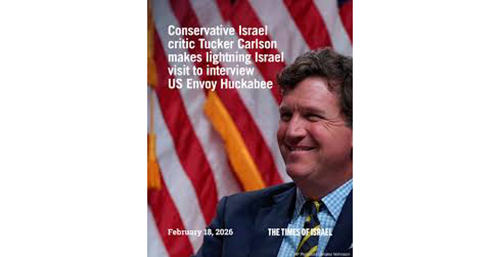
A volatile collision of theology, genetics, and geopolitics erupted into public controversy following a February 20, 2026, interview in which conservative commentator Tucker Carlson advanced the idea of widespread DNA testing for residents of Israel as a means of adjudicating ancestral claims to the land. The remarks, delivered during a wide-ranging conversation with United States Ambassador to Israel Mike Huckabee, detonated an immediate and intense backlash across political and communal lines, prompting accusations of antisemitism, echoes of eugenic thinking, and a profound misunderstanding of both Jewish history and the ethical boundaries of modern science. VIN News reported on Saturday that the interview rapidly became a flashpoint in an already combustible discourse surrounding Israel, Jewish identity, and the moral architecture of national belonging.
The podcast episode, provocatively titled “Tucker Confronts Mike Huckabee on America’s Toxic Relationship With Israel,” unfolded as a searching, if contentious, interrogation of the theological and historical narratives often invoked in discussions of Jewish sovereignty and Palestinian claims. Carlson, whose rhetorical style frequently blends contrarianism with cultural provocation, proposed that the tools of modern genomics could be marshaled to settle ancient questions of descent.
Referencing the Book of Genesis and the biblical covenant with Abraham, Carlson suggested that if ancestral lineage is invoked as a basis for land claims, then genetic testing might be used to determine who, in his words, are “Abram’s descendants.” He framed the idea as a technological corollary to scriptural assertions, arguing that humanity’s mapping of the genome had rendered such inquiries feasible.
The VIN News report noted that the proposal landed with particular force because it was articulated not in an abstract philosophical vacuum but in the charged context of Israeli-Palestinian narratives of indigeneity. Carlson posited that some Palestinians might possess deeper genetic roots in the land than Jewish immigrants from Europe, raising questions about the coherence of invoking theological ancestry to justify contemporary demographic and political arrangements. The implication—that DNA could arbitrate historical and moral claims—touched a nerve not only among Jewish communities but also among scholars and ethicists who have long warned against the reduction of identity to biological determinism.
Ambassador Huckabee, a veteran of evangelical politics and a staunch supporter of Israel, recoiled from the genetic turn of the conversation. He expressed discomfort with any framework that predicates rights or belonging on bloodlines, emphasizing his preference for secular nation-states grounded in civic equality rather than biological lineage. The VIN News report quoted Huckabee as underscoring that Jewish continuity in the land is anchored not in the laboratory but in a tapestry woven of archaeology, scripture, historical presence, and faith.
While affirming the deep historical connection of the Jewish people to the land of Israel, he rejected the notion that DNA testing could or should serve as a metric for legitimacy. His response framed the issue as one of moral philosophy as much as political prudence: the dangers of reducing citizenship and rights to genetic criteria are well documented in the darkest chapters of modern history.
The reaction beyond the interview studio was swift and severe. Pro-Israel activist Laura Loomer emerged as one of Carlson’s most vociferous critics, accusing him of trafficking in ideas that resemble the logic of eugenics. Loomer characterized the proposal as tantamount to compelling Jews to submit to genetic scrutiny in order to validate their identity, a framing that resonated with historical memories of regimes that sought to classify, exclude, and persecute populations on the basis of supposed racial science. Her denunciation of Carlson as a “rabid Jew hater” ignited further controversy, drawing attention to Carlson’s prior critiques of Israel and his broader rhetorical posture toward Jewish issues.
The ethical alarm bells sounded by critics reflect a deep unease with the instrumentalization of genetic science in political discourse. The twentieth century offers grim precedents in which pseudoscientific claims about blood and ancestry were weaponized to justify exclusion, dispossession, and genocide. VIN News, in its analysis of the backlash, emphasized that the very language of “testing” for ancestral legitimacy evokes a legacy of racial classification that modern liberal democracies have sought to repudiate. The notion that land rights or national belonging could be adjudicated through genetic assays is antithetical to the postwar consensus that citizenship is a civic, legal, and moral status, not a biological inheritance.
Carlson’s defenders, to the extent they emerged, argued that his remarks were intended to expose what he perceives as inconsistencies in the theological arguments often marshaled in defense of Israel’s territorial claims. Yet the VIN News report observed that this charitable interpretation did little to blunt the force of the criticism, in part because Carlson’s framing suggested an openness to deploying genetic science in ways that most scholars consider ethically indefensible. The interview also revived scrutiny of Carlson’s past comments on DNA testing in Israel.
In a December 2025 appearance, he had alluded to restrictions on commercial genetic tests in the country, framing them as indicative of a broader unease with questions of identity and ancestry. While such tests are regulated in Israel due to privacy and cultural sensitivities, they are not categorically banned, a nuance that critics say Carlson glossed over in his broader narrative.
The controversy was further compounded by ancillary claims made during the interview. Carlson alleged that he had been briefly detained at an Israeli airport, a detail Huckabee dismissed as routine security screening. This anecdote, later clarified as unremarkable, nevertheless fed into Carlson’s portrayal of Israel as a state whose security practices are heavy-handed or opaque. The accumulation of such claims—some contested, others mischaracterized—contributed to a perception among critics that Carlson’s engagement with Israel is marked less by rigorous inquiry than by sensationalist provocation.
Beyond the immediate outrage, the episode has reignited a deeper debate about the sources of legitimacy in national narratives. Israel’s foundation rests on a complex interplay of historical presence, international law, post-Holocaust refuge, and political struggle. The Jewish people’s connection to the land is articulated through millennia of cultural memory, religious tradition, and continuous, if at times attenuated, habitation. To subject that multifaceted history to the reductive lens of genetic testing is, as VIN News editorialized, to misunderstand both the nature of Jewish identity and the philosophical foundations of modern nationhood.
At the same time, the interview underscores the enduring volatility of discourse surrounding Israel in American public life. Carlson’s podcast, with its wide audience, serves as a potent amplifier of ideas that might otherwise remain confined to academic or fringe debates. The backlash thus reflects not only the content of his remarks but also the platform on which they were delivered. The episode illustrates how the convergence of media celebrity, geopolitical conflict, and theological rhetoric can produce controversies that reverberate far beyond their original context.