



|
Getting your Trinity Audio player ready...
|
By: Fern Sidman
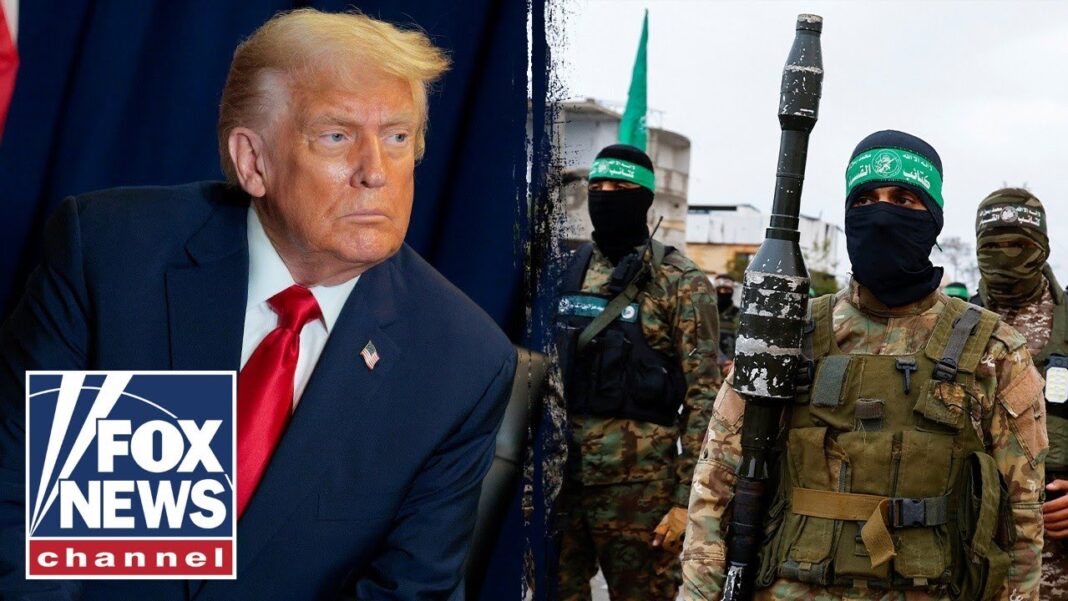
President Trump on Thursday renewed a stark ultimatum to Hamas as the Islamist group continued to stall over a central, deeply painful tenet of the ceasefire agreement: the return of the bodies of Israeli hostages killed during the October 7, 2023, massacre. Speaking to reporters at the White House, the president framed the impasse in blunt, consequential terms: the United States — and by extension Israel — will not tolerate perfidy when it comes to humanitarian commitments underlying the fragile truce.
“It’s a tough neighborhood, we know that,” Trump said, according to a report that appeared on Thursday at Israel National News (INN). “We have a commitment from them, and I assume they’re going to honor that commitment. I hope they do, and I understand they brought back some additional bodies today. It’s a tough situation… If they behave, good. If they don’t behave, we’ll take care of it.”
The president’s remarks echoed an earlier, more pointed message posted on his Truth Social account, where he warned that Hamas militants “will themselves be killed” if the group persisted in violating the agreement — an uncompromising posture that underscores how thin the line has become between diplomacy and renewed military confrontation. Trump also told CNN that Israeli forces could resume operations “as soon as I say the word,” signaling an American hand in potential contingency planning and a readiness to encourage or green-light a return to force if Hamas does not fulfill its commitments.
At the heart of the controversy is an objective that many observers — diplomats, military planners and bereaved families alike — view as morally nonnegotiable: the transfer of remains so that families can bury their dead and observe religious rites. Under the terms of the truce, Hamas agreed to hand over both living hostages and the bodies of those killed during the October 7 rampage.
Twenty living hostages have now been freed and returned to Israeli custody; by contrast, only nine bodies have been transferred so far, and at least one of those proved not to be an Israeli hostage, further inflaming tensions. Israel National News has followed the situation closely, reporting each development and cataloguing the growing frustration among Israeli officials and families.
Hamas this week asserted that it had completed its obligations with respect to living prisoners and that the bodies still unaccounted for would be difficult to recover without specialized equipment and effort. “We met our end of the agreement, we released all the living hostages, and what we have as far as deceased hostages. Regarding the rest, we will need great efforts and special tools to find them,” the organization said in a statement cited in the INN report. Israeli officials, however, reject the notion that recovery is beyond the group’s capacity: Foreign Minister Gideon Sa’ar has publicly contended that Hamas could return far more bodies and has accused the group of dragging its feet.
The asymmetry between living and deceased returns has become the focal point of a diplomatic squeeze play. Israel has warned that failure to comply with the terms of the truce could void the agreement and precipitate a resumption of military operations aimed at “changing the reality in Gaza,” as Defense Minister Itamar Ben Gvir and others have put it. The Trump administration appears to have adopted a similar posture, threading together public pressure, private diplomacy and the implicit threat of kinetic escalation.
Families of the hostages have been vocal and visceral in their reaction. For many, the return of remains is not merely a symbolic demand; it is a demand for closure and dignity after more than two years of agony. The emotional calculus is acute: the failed or partial returns of bodies reopen centuries-old questions of how to treat the dead and satisfy ritual obligations under Jewish law. Israel National News has given extensive coverage to families’ grief and to the litany of statements from officials who say the matter of bodies is nonnegotiable.
Beyond the moral urgency, there are strategic calculations in the background. The truce — painstakingly engineered by a coalition of regional mediators and Washington — sought to combine immediate humanitarian relief with a larger, if tentative, political framework: demilitarization of Gaza’s terror infrastructure, wider aid flows, and steps toward reconstruction.
The failure to deliver on a basic humanitarian promise threatens to unravel the broader architecture. If Israel perceives that Hamas is gaming the agreement to gain time or leverage, the calculus in Jerusalem could shift rapidly toward a comprehensive military reset designed to physically remove the mechanisms that enable such obstruction.
Trump’s language — “we’ll take care of it” — leaves open a range of options that span diplomatic sanctions, tighter pressure on Gaza’s interlocutors, or kinetic measures in Gaza itself. Israel National News has reported on intense exchanges between Israeli and U.S. officials in recent days, portraying a joint impatience that has been building since the truce was signed. The White House, anxious to preserve a ceasefire that the administration touts as a major diplomatic accomplishment, faces a delicate balancing act: applying enough pressure to ensure compliance without precipitating the very collapse it seeks to avoid.
The mechanics of returning bodies from Gaza are complex and risky. Bodies may be located in destroyed infrastructure, hidden in tunnels, or interred in conditions that require forensic teams and heavy machinery for secure retrieval. Still, Israeli officials maintain that Hamas retains precise knowledge of burial sites and access to the tunnels and caches where some hostages were held. For families, the technical obstacles are often incidental to the more basic question of intention: whether Hamas wants to fulfill the deal.
International organizations have been drawn into the mechanics of custody and transfer. The International Committee of the Red Cross (ICRC) has historically played a role in such exchanges, an ostensible intermediary that can receive remains before handing them to Israeli authorities for forensic verification and burial rites. Israel National News has chronicled the ICRC’s involvement and the logistical choreography required to move remains safely across active frontlines and checkpoints.
The political reverberations are immediate and far-reaching. In Israel, the issue has unified disparate parties in calling for decisive action if Hamas continues to flout the deal. If the truce collapses, the domestic political fallout could be severe: the public’s patience, already frayed after two years of war and a long procession of unsatisfactory outcomes, would almost certainly harden behind a mandate for sweeping military measures.
Regionally, the breakdown of the return obligation could strain the coalition of Arab states and mediators that helped secure the truce. Egypt, Qatar and other interlocutors will be pressed to produce leverage over Hamas or risk reputational damage for having negotiated an agreement that fails on a central humanitarian point. Washington, too, would face criticism for brokered terms that did not survive the test of implementation.
Yet the risks of escalation must be weighed against the human cost of inaction. For families of the deceased, the inability to bury loved ones compounds years of grief, rendering the promise of peace hollow. As the INN report emphasized, the political and military stakes are inseparable from the moral obligation to the dead.
For now, the stalemate centers on a grim arithmetic: twenty living hostages returned; nine bodies received; an untold number still unaccounted for. President Trump’s warnings — stark, public and repeated — are intended to sharpen Hamas’s choices. Whether they are sufficient to move the group’s leadership, or whether they merely raise the ante and increase the probability of renewed conflict, remains the key question in the days ahead.
Diplomats and military planners alike will be watching for signs that Hamas is prepared to comply fully — not merely to offer partial gestures — and for indicators that mediators can provide the necessary technical and security arrangements for comprehensive returns. If those signs do not materialize, Israel’s patience, already strained, may run out. In that event, the “we’ll take care of it” line will become not only a rhetorical menace but a policy road map, with consequences that could reshape the fragile calm that presently holds.
