



|
Getting your Trinity Audio player ready...
|
Trump’s 21-Point Gamble: Bold Gaza Blueprint Pits Ceasefire Dreams Against Israel’s Security Red Lines
By: Fern Sidman
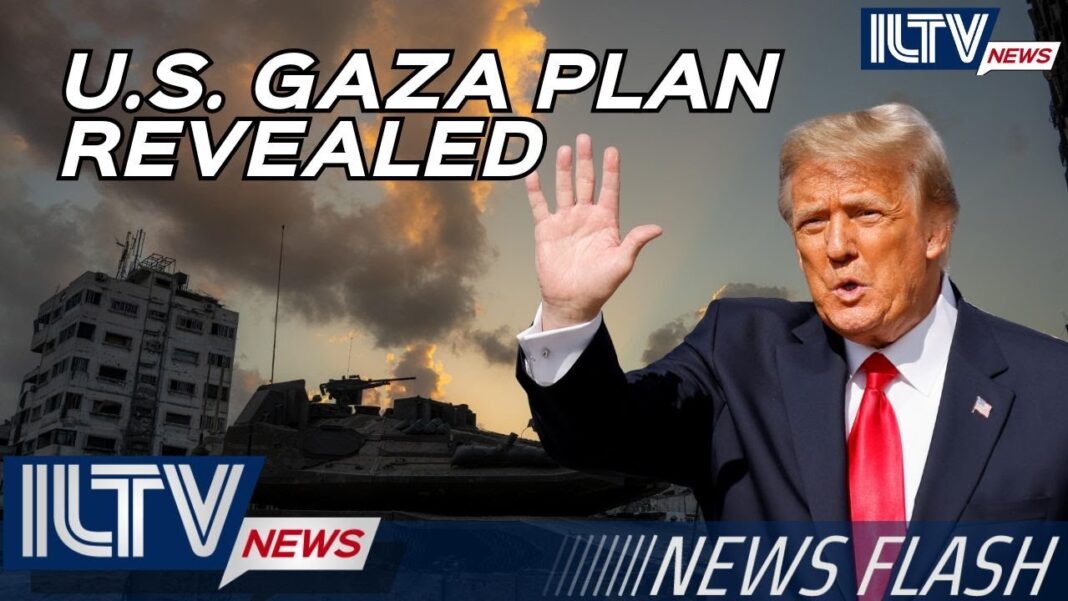
The Washington Post published new details on Saturday night about a sweeping 21-point proposal drafted by the Trump administration aimed at ending the war in Gaza. The proposal—ambitious in scope yet riddled with uncertainties—was obtained by the Washington Post and verified by officials from two governments briefed on the plan. As reported, the framework includes an immediate halt to military operations, the freezing of battle lines, and a demand that Hamas release within 48 hours all 20 surviving hostages, along with the remains of those murdered during captivity.
According to a report that appeared on Israel National News (INN), the proposal marks one of the most comprehensive American efforts to shape the post-October 7 order in Gaza, combining ceasefire demands with security restructuring, prisoner exchanges, and even an economic redevelopment vision. Yet, despite the elaborate presentation, neither Israel nor Hamas has accepted the framework, leaving its fate uncertain as it awaits Monday’s high-stakes meeting between President Donald Trump and Israeli Prime Minister Benjamin Netanyahu at the White House.
The proposal centers on four initial measures:
Immediate cessation of hostilities – both Israel and Hamas would halt offensive military operations, effectively freezing battle lines where they currently stand.
Hostage release – Hamas would be compelled to release all 20 remaining living hostages within 48 hours, along with the remains of deceased captives.
Disarmament clauses – the group’s offensive weaponry—rockets, drones, and heavy arms—would be destroyed, while members committing to “peaceful co-existence” would be granted amnesty.
Safe passage for terrorists – Hamas operatives unwilling to remain under the terms of coexistence would be given safe passage to third countries.
As the Israel National News report emphasized, these provisions represent a dramatic gamble: on one hand, they seek to neutralize Hamas’s military capacity while averting further bloodshed; on the other, they hinge on a level of trust and compliance that past ceasefire arrangements have repeatedly failed to secure.
The 21-point outline also contains extensive sections on governance and reconstruction. While light on sequencing and operational detail, the plan envisages an interim governing authority for Gaza, presumably backed by the United Nations and international donors. This entity would manage humanitarian aid, security transitions, and infrastructure rebuilding.
The document makes two notable commitments:
No Gazans will be forced to leave their homes; those who temporarily relocate under the ceasefire arrangement will retain the right to return.
A “Trump economic development plan” will be launched to “rebuild and energize” Gaza, though no timeline or funding commitments are specified.
Israel National News reported that the vagueness of these proposals has already drawn skepticism in Jerusalem. Critics argue that absent firm enforcement mechanisms, Hamas could regroup under the guise of reconstruction while international funds flow freely into Gaza.
One of the most controversial aspects of the plan, first revealed by Saudi outlet Al-Hadath, is its proposed prisoner exchange. In return for the release of hostages, Israel would reportedly free thousands of Palestinian prisoners, including between 100 and 200 serving life sentences.
As the Israel National News report noted, the Israeli public remains deeply divided on this point. While hostage families have mounted emotional campaigns demanding concessions for their loved ones’ return, many Israelis fear that releasing hardened terrorists will only embolden Hamas and lead to future massacres. The memory of prior exchanges—such as the 2011 deal that freed over 1,000 prisoners for the release of Gilad Shalit—looms heavily over current deliberations.
The Trump framework also proposes sweeping changes to humanitarian assistance in Gaza. Aid would be allowed to flow freely and without limitation through the United Nations and allied NGOs. However, the existing humanitarian fund operating in the enclave would be shut down, a measure apparently intended to prevent diversion of resources by Hamas.
The Israel National News report emphasized that this provision reflects Israel’s longstanding concerns about aid diversion. Reports in recent months have detailed how Hamas gunmen looted food and fuel convoys, depriving civilians of vital supplies. Whether Trump’s plan includes sufficient safeguards to prevent such abuses remains unclear.
On Friday evening, Trump himself took to Truth Social to confirm ongoing negotiations. His message was characteristically buoyant:
“I am pleased to report that we are having very inspired and productive discussions with the Middle Eastern Community concerning Gaza. Intense negotiations have been going on for four days and will continue for as long as necessary in order to get a Successfully Completed Agreement. All of the Countries within the Region are involved, Hamas is very much aware of these discussions, and Israel has been informed at all levels, including Prime Minister Bibi Netanyahu. There is more Goodwill and Enthusiasm for getting a Deal done, after so many decades, than I have ever seen before. Everyone is excited to put this period of Death and Darkness behind them. It is an Honor to be a part of this Negotiation. We must get the Hostages back and get a PERMANENT AND LONGLASTING PEACE!”
As the Israel National News report observed, Trump’s personal investment in the deal calls attention to his broader legacy ambitions. Having previously engineered the Abraham Accords, he now seeks to frame himself as the architect of a post-Gaza peace.
The Israeli government has remained cautious in its response. According to the information contained in the Israel National News report, Prime Minister Netanyahu views parts of the plan as deeply problematic, particularly the absence of any requirement that Hamas disarm before a ceasefire takes effect. For Netanyahu and his coalition, demilitarization of Gaza remains a non-negotiable prerequisite.
Furthermore, the plan’s reliance on the Palestinian Authority—or other external actors—to play a role in governing Gaza is a red flag for Jerusalem. Netanyahu has repeatedly vowed never to allow PA control of the Strip, citing its history of incitement and “pay-for-slay” stipends to convicted terrorists.
Opposition voices in Israel, however, argue that Trump’s proposal may represent the best available chance to end the fighting and rescue hostages before more lives are lost.
Regional leaders have shown cautious interest in Trump’s framework. As the Israel National News report highlighted, Arab governments were briefed on the plan during high-level meetings at the UN last week. Several expressed guarded optimism but stressed that any ceasefire must guarantee meaningful Palestinian participation in post-war governance.
The European Union, for its part, has echoed support for a ceasefire and humanitarian relief but has not formally endorsed the specifics of the Trump proposal. Critics in Brussels and New York argue that offering amnesty and safe passage to Hamas terrorists could inadvertently reward terrorism.
Despite the ambitious framing, major questions remain unresolved:
Enforcement: Who will monitor the destruction of Hamas’s weapons and ensure compliance with the ceasefire?
Governance: What body will take responsibility for Gaza’s administration, and will it have real legitimacy among Gazans?
Security: How will Israel’s concerns about renewed rocket fire or tunnel reconstruction be addressed?
Funding: Where will the resources for the “Trump economic development plan” originate, and how will they be safeguarded from corruption?
As the Israel National News report noted, without concrete answers to these questions, the proposal risks being seen as another in a long line of unfulfilled peace initiatives.
The decisive moment will come on Monday, when Netanyahu sits down with Trump at the White House. According to the Israel National News report, U.S. envoys are expected to press Netanyahu to accept at least the framework’s opening measures—a ceasefire, hostage release, and humanitarian access—in order to prevent Israel’s further diplomatic isolation.
Yet Netanyahu, bolstered by hawkish members of his coalition, is unlikely to yield easily. His government views continued military pressure as essential to dismantling Hamas’s infrastructure, and many Israelis believe that premature concessions could squander hard-won gains.
The Trump administration’s 21-point Gaza plan represents both a bold diplomatic gambit and a potential trap. It seeks to marry humanitarian relief with hostage recovery, reconstruction with disarmament, and amnesty with accountability. But as the Israel National News report indicated, the core contradictions remain unresolved: Hamas is unlikely to surrender its arms or ideology willingly, while Israel is unwilling to risk a ceasefire without guarantees of security.
Whether the plan marks the beginning of a historic breakthrough or simply another entry in the long catalog of failed Middle East peace initiatives will depend on the willingness of leaders—Netanyahu, Hamas chiefs, and Trump himself—to navigate a treacherous path of trust, verification, and compromise.
For now, the world watches, and waits.
