



|
Getting your Trinity Audio player ready...
|
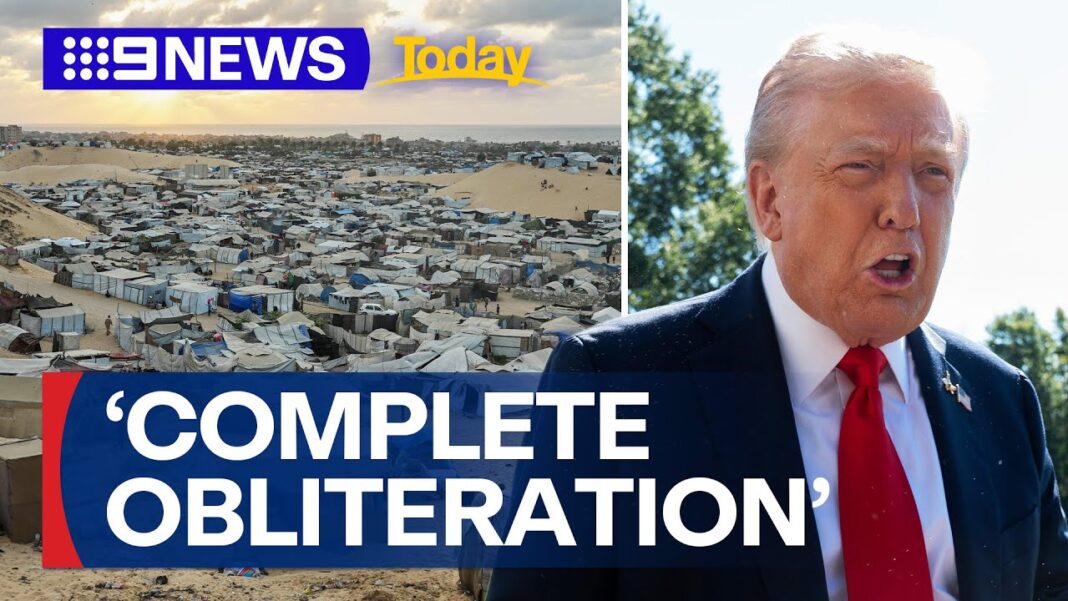
Trump Warns Hamas of “Complete Obliteration” if Ceasefire Plan Rejected, As Netanyahu Backs Proposal
By: Fern Sidman
As diplomatic maneuvers surrounding President Donald Trump’s proposed ceasefire agreement gather intensity, the American president has issued his starkest warning yet to Hamas: agree to the deal or face “complete obliteration.”
According to a report that appeared on Sunday at Israel National News, Trump delivered the phrase in a blunt text message to CNN’s Jake Tapper on Saturday evening, signaling a dramatic escalation in rhetorical pressure on the terror organization that has controlled the Gaza Strip since 2007. The terse response came after Tapper pressed Trump on comments made by Sen. Lindsey Graham, who suggested that Hamas had already rebuffed the White House plan by insisting on retaining its weapons, maintaining control of Gaza’s governance, and tying hostage releases to further negotiations.
“Complete Obliteration!” Trump wrote, his characteristic capital letters underscoring the gravity of the ultimatum. When asked if Graham’s assessment was premature or inaccurate, Trump replied cryptically: “We will find out. Only time will tell!!!”
As INN has emphasized in its coverage, a critical component of Trump’s diplomatic strategy is the support of Israeli Prime Minister Benjamin Netanyahu. When asked directly whether Netanyahu was prepared to move forward under the terms of the agreement, Trump responded with a curt but affirmative: “Yes on Bibi.”
That confirmation appears to anchor the plan in the bedrock of U.S.-Israel coordination, a factor essential to its viability. In remarks over the weekend, Trump went further, announcing that Israel had formally agreed to the initial withdrawal line set out in his peace plan, the first step in what he has repeatedly described as a “phased” ceasefire arrangement.
“After negotiations, Israel has agreed to the initial withdrawal line, which we have shown to, and shared with, Hamas,” Trump wrote on Truth Social. “When Hamas confirms, the Ceasefire will be IMMEDIATELY effective. The Hostages and Prisoner Exchange will begin, and we will create the conditions for the next phase of withdrawal, which will bring us close to the end of this 3,000 YEAR CATASTROPHE.”
The capitalized phrasing, coupled with his dramatic invocation of Jewish historical suffering, reinforced the messaging that Trump views this moment as both urgent and epochal. The INN report noted that the inclusion of the Philadelphi Corridor and other strategic areas in Israeli hands remains a sticking point in Hamas’s deliberations.
For its part, Hamas has maintained a carefully ambiguous position. On Friday, Trump insisted that the group had responded “positively” to his proposal, declaring it “a big day” and “unprecedented.” But as the Israel National News report stressed, Hamas’s response was riddled with caveats—chief among them its stated intention to retain arms, to preserve its governing influence in Gaza, and to condition hostage releases on broader negotiations.
This ambiguity is central to the unfolding drama. By neither rejecting nor fully accepting the plan, Hamas appears to be leveraging the international spotlight to extract concessions while avoiding the wrath of an American president who has threatened annihilation.
Secretary of State Marco Rubio, speaking on Saturday, reinforced the precarious balance: “Priority number one is the release of all the hostages in exchange for Israel moving back to the designated withdrawal line.” But he conceded that the “hard work” of defining Gaza’s future governance and dismantling Hamas’s armed capacity lies ahead.
As INN reported, Rubio stressed that the process remains in its infancy, noting: “All that work—that’s going to be hard, but that’s critical, because without that, you’re not going to have lasting peace.”
The ceasefire framework crafted by the Trump administration is a 20-point plan, according to officials briefed on its details. It is designed in phases:
Immediate Ceasefire – triggered once Hamas formally confirms acceptance of the initial Israeli withdrawal line.
Hostage-Prisoner Exchange – involving the release of all Israeli hostages, living and deceased, in exchange for Palestinian prisoners.
Phased IDF Withdrawal – linked to compliance by Hamas and monitored by mediators.
Long-Term Governance Structure – discussions on a technocratic Palestinian administration for Gaza, backed by regional Arab states, but with explicit commitments to preventing Hamas’s return under political cover.
As the Israel National News report highlighted, Israeli officials remain cautious, wary that Hamas may attempt to stall for time while rebuilding its networks. There is deep skepticism in Jerusalem about Hamas’s sincerity, with several cabinet ministers privately warning that any deal leaving Hamas’s infrastructure intact is untenable.
Trump’s high-stakes diplomacy reflects both his personal style and his broader Middle East strategy. Since October 7, 2023, when Hamas launched its mass terror assault killing over 1,200 Israelis and abducting more than 250 hostages, the conflict has dominated international headlines.
Now, as the second anniversary of the massacre approaches, Trump appears determined to frame himself as the architect of a potential peace breakthrough. By issuing an ultimatum—“Complete Obliteration”—he raises the cost of rejection for Hamas while simultaneously projecting resolve to Israel and its allies.
The INN report underscored that Trump’s message to Hamas is not merely rhetorical. The president has repeatedly alluded to “all hell, like no one has ever seen before” should his peace initiative collapse. That language, while vague, signals the possibility of intensified American backing for Israeli military operations, or even direct U.S. involvement.
International reactions remain muted as the parties await Hamas’s formal stance. Mediators in Qatar, Egypt, and Turkey have acknowledged receipt of Trump’s proposal but declined to comment on its prospects. European capitals, while publicly supportive of ceasefire efforts, are reportedly divided over Trump’s heavy-handed approach.
Within Israel, Israel National News reported that the government has instructed the IDF to reduce its operations to “a minimum,” focusing on defensive postures while awaiting Hamas’s response. That decision, critics argue, risks giving Hamas breathing space, though others see it as a necessary gesture of good faith in negotiations.
Meanwhile, the Hostage Families Forum has expressed cautious hope. “We want to believe this is the beginning of the end of our nightmare,” one spokesperson told INN. Yet, the families remain deeply anxious that political maneuvering will once again delay the return of their loved ones.
Even if Hamas accepts the initial framework, daunting challenges loom. The question of Gaza’s post-war governance remains unsettled. Trump’s plan envisions an “independent Palestinian technocratic body” supported by Arab and Islamic states. But as the INN report noted, Israel insists that any arrangement must ensure Hamas’s permanent dismantling—a condition Hamas has yet to acknowledge.
Further complicating matters is the question of disarmament. Hamas has consistently rejected calls to surrender its weapons, portraying them as essential to Palestinian resistance. Without demilitarization, Israeli security officials argue, no agreement can deliver real peace.
Secretary Rubio acknowledged these difficulties, telling reporters: “Shaping Gaza’s long-term governance and disarming terror groups—that’s going to be the hardest part. But it’s critical. Without that, you’re not going to have lasting peace.”
The coming days are likely to prove decisive. If Hamas confirms acceptance of the initial withdrawal line, as Trump insists it must, a ceasefire and hostage release could unfold rapidly. If it hesitates, or seeks to delay through further caveats, Trump’s threat of “complete obliteration” may become more than rhetorical flourish.
As Israel National News has consistently emphasized, Israel’s overriding goal remains the safe return of hostages and the absolute prevention of Hamas’s resurgence. For the Jewish state, any agreement that falls short of dismantling Hamas risks repeating the tragic cycles of violence that have defined Gaza for decades.
Trump’s gamble—blending brinkmanship with diplomacy—may yet yield a historic breakthrough. But as of now, the balance hangs precariously, with the lives of hostages and the future of Gaza suspended between hope and annihilation.
Everyone had clearly understood that if HAMAS accepted Trump‘s ultimatum that it would be fully surrendering and agreeing to a peaceful transition to its “complete obliteration”.
That was NEVER understood to be a mere “rhetorical flourish”! Hamas is not permitted to survive in any way, and will have NO remaining role in Gaza. The alternative remainsIsrael military proceeding with its “complete obliteration”.
It was represented to be a “take it or leave it” ultimatum, with clear deadlines. Hamas is supposed to surrender by laying down all of its weapons, disbanding, and releasing every last hostage. The only remaining detail was how to verify its full compliance.
(However, it has been clear for some time that Trump has betrayed Israel.)
Consider the fact that millions of so-called “palestinians” in Gaza have done NOTHING to help or free the TORTURED STARVED Jews, and instead are quite willing to see swaths of their cities turned to rubble. Still, they virtually ALL have more than adequate shelter and food. (Personally, I would prefer to see these Muslim monsters treated the same way as they treat their Jewish victims.)
These arabs are MORE EVIL than the Nazi Germans during the Holocaust. Any civilized person (particularly any so-called “Jew“) who feels or expresses any sympathy or compassion towards any of these Muslim monsters is equally evil.