



|
Getting your Trinity Audio player ready...
|
By: Fern Sidman
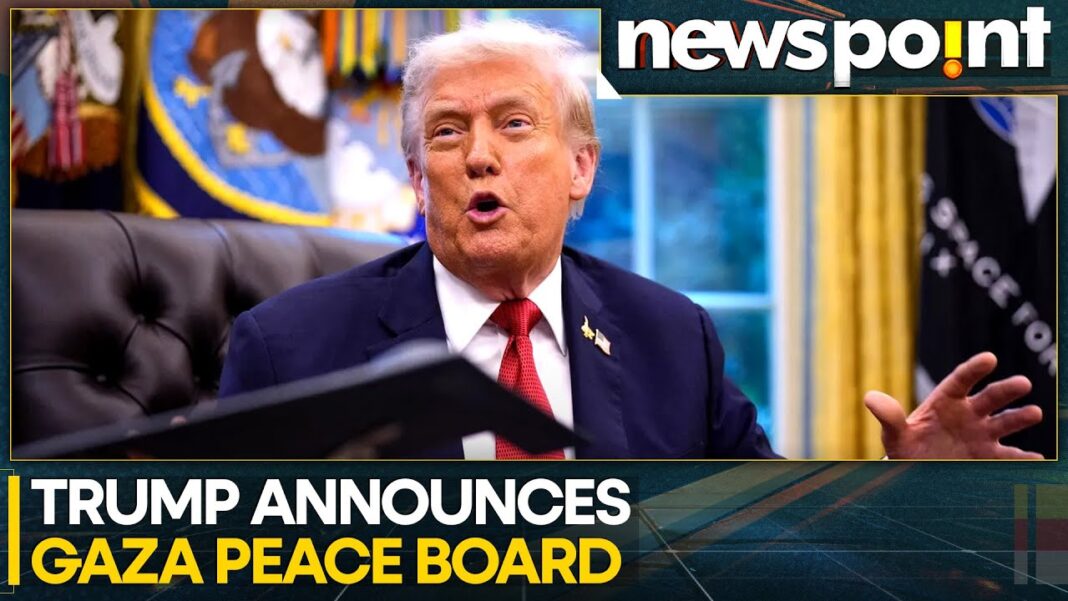
In a dramatic announcement that signals a new and potentially transformative phase in Middle Eastern diplomacy, President Trump declared on Thursday night that the long-anticipated “Board of Peace for Gaza” has officially been established. The statement, delivered via the president’s Truth Social platform, marks a pivotal milestone in the implementation of the Trump administration’s comprehensive 20-point peace plan — an initiative that helped broker the fragile October ceasefire between Israel and the Hamas terrorist organization.
On Thursday, Israel National News reported on the announcement, emphasizing that the creation of the Board represents one of the most consequential elements of the post-war framework. According to Trump, the identities of the members will be revealed in the near future, though he offered an unmistakably confident preview of what lies ahead.
“It is my Great Honor to announce that THE BOARD OF PEACE has been formed,” Trump wrote. “The Members of the Board will be announced shortly, but I can say with certainty that it is the Greatest and Most Prestigious Board ever assembled at any time, any place. Thank you for your attention to this matter!”
The formation of the Board of Peace is not merely symbolic. As Israel National News has outlined in previous reports, the body is intended to serve as an international transitional oversight mechanism tasked with guiding Gaza through what is envisioned as a complex and delicate reconstruction period. The Board is expected to supervise governance reforms, humanitarian relief, infrastructure rehabilitation, and security arrangements in the war-torn enclave.
The Board of Peace occupies a central role in Trump’s broader Gaza plan, which was crafted with the dual objectives of ending hostilities and preventing Hamas from reconstituting its military and political power. Israel National News has consistently described the initiative as one of the most ambitious diplomatic efforts undertaken in recent years, designed to address not only the immediate aftermath of the conflict but also the structural dysfunctions that have long plagued Gaza.
Under the terms of the plan, daily administrative responsibilities in Gaza are to be managed by a technocratic Palestinian Arab committee. This body will operate under the supervision of an intermediate executive committee, which in turn will be accountable to the newly formed Board of Peace. The layered structure is intended to ensure both local involvement and international accountability, preventing a vacuum that could be exploited by extremist elements.
The Board itself is slated to be chaired by President Trump and is expected to include between 10 and 15 prominent leaders from Arab states, Western allies, and other key international stakeholders. While the precise roster remains undisclosed, Israel National News has reported that the group will likely include figures with significant diplomatic and humanitarian experience, capable of navigating the political sensitivities inherent in Gaza’s reconstruction.
Serving as the senior representative on the ground will be former United Nations Middle East envoy Nickolay Mladenov, a seasoned diplomat with extensive experience in Israeli-Palestinian affairs. His appointment highlights the administration’s desire to combine political oversight with practical, hands-on management of the transition process.
Trump’s announcement came just one day after his Middle East envoy, Steve Witkoff, declared that the United States intends to press ahead with Phase Two of the Gaza peace plan. As Israel National News reported, Witkoff’s statement indicated Washington’s determination to maintain momentum, even as critical unresolved issues continue to cloud the process.
Foremost among those issues is the fate of Ran Gvili, the final Israeli hostage whose body remains in Hamas captivity. According to the original ceasefire agreement, all hostages — living and deceased — were to be returned to Israel during Phase One. Yet months later, Hamas has failed to fulfill that obligation, insisting it does not know the location of Gvili’s remains.
Israeli officials, however, have provided what they describe as credible and precise intelligence regarding the burial site. Israel National News has highlighted Jerusalem’s frustration over Hamas’s refusal to cooperate, a stance many in Israel view as a deliberate act of bad faith intended to extract further concessions.
The Israeli government has maintained a firm position: Phase Two should not commence until every commitment of Phase One has been honored, including the return of Gvili. This stance has been reiterated by senior ministers and echoed across much of the Israeli political spectrum.
Nevertheless, Witkoff’s declaration suggests that the United States is prepared to advance the process despite these unresolved matters — a move that has generated unease within Israel. As the Israel National News report observed, the divergence between Washington’s timetable and Jerusalem’s conditions has introduced a new element of tension into an already delicate situation.
At the heart of the current debate lies a fundamental question: can Gaza be rebuilt without first ensuring that Hamas has been fully neutralized and held accountable?
Proponents of the Board of Peace argue that an internationally supervised reconstruction process offers the best chance to stabilize Gaza and prevent a return to the cycle of violence. By placing governance in the hands of technocrats and external monitors, they contend, the plan can create a future in which humanitarian needs are met without empowering terrorist factions.
Critics, however, warn that moving too quickly risks legitimizing Hamas’s obstructionism. Israel National News has quoted several analysts who caution that unless the group is compelled to meet its ceasefire obligations in full, any transitional framework may rest on shaky foundations.
Israeli officials have also expressed concern that premature implementation of Phase Two could weaken their leverage over Hamas. “The return of every hostage was a core element of the agreement,” one senior source told Israel National News recently. “Allowing the process to continue without this condition being met sets a dangerous precedent.”
The creation of the Board of Peace is being closely watched across the Middle East. Arab governments that supported the ceasefire — including Egypt, Qatar, and the United Arab Emirates — are expected to play significant roles in the new structure. Their participation will be essential in securing funding for Gaza’s reconstruction and in providing political legitimacy to the transitional administration.
Western powers, too, are likely to be heavily involved. European nations have long advocated for an internationalized approach to Gaza, and many see the Board of Peace as a potential vehicle for coordinated engagement. Israel National News has reported that diplomatic channels between Washington and several European capitals have been active in recent weeks as the initiative took shape.
At the same time, Iran and its regional proxies are almost certain to view the development with suspicion, if not outright hostility. For Tehran, any framework that diminishes Hamas’s control over Gaza represents a strategic setback. Israeli defense officials have warned that attempts to sabotage the process — whether through propaganda, political interference, or renewed violence — cannot be ruled out.
Ultimately, the success of the Board of Peace will depend on its ability to navigate a labyrinth of competing interests: Israel’s security requirements, Palestinian humanitarian needs, regional rivalries, and international expectations.
Trump’s confident tone suggests he believes the moment is ripe for bold action. Yet the path ahead remains fraught with uncertainty. As the Israel National News report emphasized, the situation on the ground in Gaza remains volatile, and the political landscape on both sides of the conflict is deeply fractured.
For Israelis, the unresolved hostage issue continues to cast a long shadow over any talk of progress. For Palestinians in Gaza, daily life remains dominated by shortages, displacement, and the slow pace of recovery. Bridging those realities will be the Board’s central challenge.
In the coming days, attention will focus on the identities of the Board members and the specific mandate they will be given. Their composition will offer important clues about the balance of power within the new framework and the seriousness with which the United States intends to enforce compliance.
As the Israel National News report noted, the establishment of the Board of Peace represents a bold gamble — one that could either usher in a new era of stability or expose the deep fault lines that still divide the region.
For now, President Trump has set the machinery in motion. Whether it delivers genuine peace, or merely a temporary pause between storms, will be determined in the months ahead.
Israel should stop playing games. No one on the ‘peace board’ will protect Israel. A complete waste of time and money. Israel must do it itself. No other choice. Move the Arabs out one way or another. You would think that the Chief Rabbis of Israel would say the obvious. Think again. They also have their heads in the sand.