



|
Getting your Trinity Audio player ready...
|
Trump Threatens to Pull All US Support for Israel if Judea and Samaria Annexation Bill Moves Forward in Knesset
By: Fern Sidman
Vice President JD Vance issued a sharp rebuke Thursday to Israel’s preliminary parliamentary vote to extend Israeli civil law to parts of the West Bank, calling it a “reckless political stunt” that jeopardizes Washington’s diplomatic momentum and risks destabilizing fragile regional peace efforts.
Speaking to reporters in Jerusalem at the close of his two-day visit to Israel, Vance’s unusually blunt criticism marked one of the most candid expressions of frustration by a senior U.S. official since the Trump administration returned to office. His comments came amid what an The Algemeiner report on Thursday described as “mounting diplomatic unease” over the Knesset’s razor-thin approval of the measure, which passed 25–24 on Wednesday.
The bill, which would apply Israeli civil law to Jewish settlements in parts of Judea and Samaria was characterized by The Algemeiner report as a preliminary step toward extending Israeli sovereignty to the area — a move widely perceived abroad as “annexation.” Yet legal experts and Israeli officials have underscored that, under international law, Judea and Samaria does not belong to any recognized sovereign state, and therefore the proposed measure would not constitute annexation in the formal sense.
A separate, narrower bill applying Israeli sovereignty to the city of Maale Adumim also passed by a vote of 31–9, signaling a coordinated push by right-wing lawmakers despite opposition from Prime Minister Benjamin Netanyahu’s government.
“If it was a political stunt, it is a very stupid one, and I personally take some insult to it,” Vance said during his press briefing Thursday, according to The Algemeiner report.
“The West Bank is not going to be annexed by Israel,” the vice president continued, underscoring that President Donald Trump’s position remains clear. “That will continue to be our policy, and if people want to take symbolic votes, they can do that, but we certainly weren’t happy about it.”
Vance’s unusually frank remarks reflected both Washington’s deep irritation and the broader concern that the Knesset’s vote could derail the U.S.-brokered ceasefire between Israel and Hamas that took effect earlier this month. The vice president, who spent his visit meeting with Israeli security officials and Palestinian business leaders, emphasized that the administration’s top priority is stabilizing Gaza and advancing the Comprehensive Peace Plan laid out by President Trump earlier this year.
According to the information provided in The Algemeiner report, senior U.S. officials were blindsided by the vote and viewed it as an unnecessary provocation that threatens to inflame tensions in a region already teetering between ceasefire and renewed conflict.
Prime Minister Netanyahu’s office quickly issued a statement attempting to calm Washington’s ire. The statement described the vote as “a deliberate provocation” orchestrated by “members of the far-right opposition” and insisted that the government had not sponsored, supported, or endorsed the bill.
Netanyahu, who is walking a delicate political tightrope between his right-wing coalition partners and U.S. diplomatic expectations, sought to distance his administration from the Knesset’s rebellious factions.
“The prime minister remains committed to Israel’s security partnership with the United States and to the framework of the current ceasefire agreement,” the statement read, according to the report in The Algemeiner.
However, political analysts noted that Netanyahu’s control over his own coalition has weakened, as several Likud and Religious Zionist Party members defied the government’s wishes by voting in favor of the measure. The vote exposed widening fissures within the ruling bloc and deepened Washington’s anxiety over Israel’s ability to speak with one unified voice on matters of peace and sovereignty.
The Knesset vote arrived at a particularly sensitive moment in Middle East diplomacy. The ceasefire with Hamas — brokered through a combination of U.S., Egyptian, and Qatari mediation — remains fragile, and any suggestion of unilateral Israeli sovereignty expansion risks undermining ongoing reconstruction efforts in Gaza.
As The Algemeiner reported, American and Arab officials fear that even symbolic legislation could embolden extremist factions, invite renewed rocket attacks, and jeopardize U.S.-led efforts to rebuild Gaza under the Trump administration’s “Peace and Prosperity Framework.”
Vance echoed those concerns, warning that the bill “would only serve to embolden extremists on both sides” and “undermine the trust we’ve been trying to rebuild.”
“The United States has worked tirelessly to lay the groundwork for lasting stability,” he said. “Actions like this — taken without coordination — erode confidence and complicate our shared objectives.”
Diplomatic observers told The Algemeiner that the incident also risks complicating Washington’s parallel initiative to expand the Abraham Accords, the historic series of normalization agreements signed during Trump’s first term between Israel and Arab states such as the United Arab Emirates, Bahrain, Morocco, and Sudan.
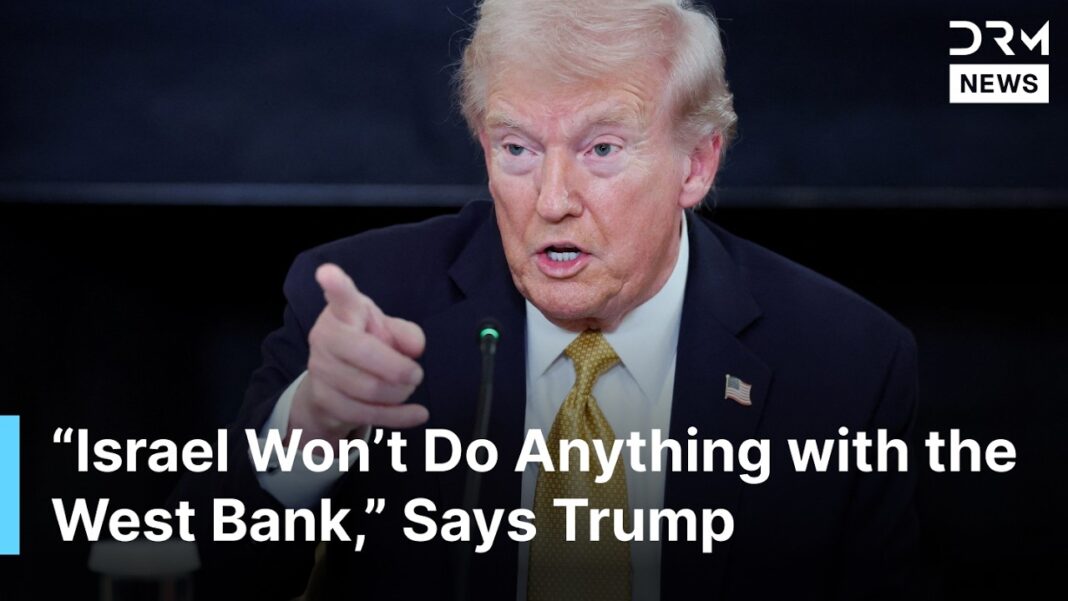
In an interview released Thursday by Time magazine and cited in The Algemeiner report, President Trump unequivocally rejected any Israeli move to extend sovereignty over Judea and Samaria, saying such an action would violate the commitments he made to Arab leaders during negotiations over the ceasefire and broader regional peace.
“It won’t happen,” Trump said. “It won’t happen because I gave my word to the Arab countries. And you can’t do that now. We’ve had great Arab support. It won’t happen because I gave my word to the Arab countries. It will not happen. Israel would lose all of its support from the United States if that happened.”
The president’s comments drew attention to how deeply intertwined Washington’s credibility in the region is with Israel’s conduct. The administration’s balancing act — maintaining unwavering support for Israel’s security while preserving the trust of Arab allies — has become increasingly delicate as regional actors monitor Jerusalem’s internal politics.
As The Algemeiner report noted, Arab diplomats from the UAE and Jordan privately warned that unilateral Israeli steps in Judea and Samaria could “undo years of painstaking diplomacy.”
The controversy has also spilled into the U.S. political arena. Senator Lindsey Graham (R-SC), a longtime ally of both Trump and Israel, took to social media to calm tensions after speaking with Israeli Ambassador Yechiel Leiter in Washington.
“He vigorously stressed no offense was meant and reinforced that no major decisions will be made by Israel without cooperation and coordination with the U.S.,” Graham posted on X. “I believe this was a misunderstanding rather than a provocation.”
Nonetheless, the episode reignited debate in Washington over how to balance U.S. support for Israeli sovereignty claims with the need to preserve diplomatic credibility among Arab states that are key partners in countering Iran.
The Algemeiner report noted that several senior administration officials privately described the timing of the Knesset vote as “infuriating,” given that Vice President Vance was in Jerusalem precisely to demonstrate America’s renewed commitment to the ceasefire and peace process.
Inside Israel, the legislation’s narrow passage highlighted growing political turbulence within the Knesset. According to the information contained in The Algemeiner report, Environmental Protection Minister Idit Silman of the Otzma Yehudit party initiated the bill, describing it as a “necessary affirmation of Israel’s biblical and historical right” to Judea and Samaria.
However, moderate lawmakers accused Silman and her allies of “political grandstanding” aimed at embarrassing Netanyahu and forcing him into a confrontation with Washington.
“This was a stunt, pure and simple,” said MK Simcha Rothman (Religious Zionism), who supported the measure but acknowledged it was largely symbolic. “There was no expectation of implementation. It was about reminding Israelis of our rights.”
Opposition figures within Israel’s center-left camp condemned the move as reckless. “Every symbolic vote chips away at our diplomatic legitimacy,” said MK Yair Lapid, warning that such gestures could isolate Israel internationally.
Throughout his visit, Vance emphasized Washington’s commitment to Israel’s security and its right to defend itself from terror, but he also stressed the importance of discipline and coordination in policy.
“I came here to reinforce the bond between our nations — a bond based on trust, shared interests, and strategic cooperation,” he told reporters, as cited in The Algemeiner report. “That trust requires predictability. We can disagree privately, but surprises in public don’t serve either of us.”
Diplomatic insiders quoted in The Algemeiner report said Vance’s forthright approach reflects the administration’s confidence in its position: unwavering support for Israel’s defense, coupled with an insistence on restraint in politically explosive moves that could derail broader peace goals.
The vice president also met with senior members of Israel’s security establishment, including officials from the IDF Planning Directorate, to assess the ceasefire’s implementation and discuss the next stages of the Trump peace initiative.
As Vance departed Israel Thursday night for Tokyo, the fallout from the Knesset’s vote continued to reverberate through both capitals. Though the measure faces little chance of becoming law, it has exposed the increasingly complex political landscape confronting both Netanyahu and the Trump administration.
For Jerusalem, it underscored the challenge of managing domestic political pressures without alienating its most important ally. For Washington, it served as a reminder that diplomacy in the Middle East often moves at the mercy of Israel’s volatile parliamentary politics.
In the words of The Algemeiner report, the controversy “revealed not only the enduring fragility of the Israeli-American alliance but also the profound importance of discipline, coordination, and timing in the pursuit of peace.”
Vice President Vance, who departed Israel visibly frustrated but resolute, left little doubt that Washington expects its allies to avoid reckless theatrics at a time when diplomacy remains Israel’s strongest weapon.
“Symbolism has its place,” Vance said, “but in the Middle East, symbolism can start wars. We need strategy, not stunts.”
US has over stepped its boundaries. It NONE of their business about on how Israel has made a move to annex ‘West Bank’ . It belongs to Israel and it’s called JUDEA SAMARIA for a reason !!! How dare the US threatened Israel with withdrawing support for them!!!The Arabs made a mess of the area and harbor their terrorist allies ! Now the Israelites are being are being terrorized everyday because of the proximity in the land.
Israel cannot make policy based on what Trump does and does not like. If Trump withdraws all support, Israel has the power to make sure America has no more interests in the Middle East. Israel has that kind of power in its hands. Israel survived the first 20 years of its existence WITHOUT much American support (1948-1968). Israel can and will survive without American support today if that becomes a reality.
Israel’s treasonous opposition parties, who don’t give a damn about the hostages, used this as a cynical political weapon against Netanyahu.