



|
Getting your Trinity Audio player ready...
|
By: Fern Sidman
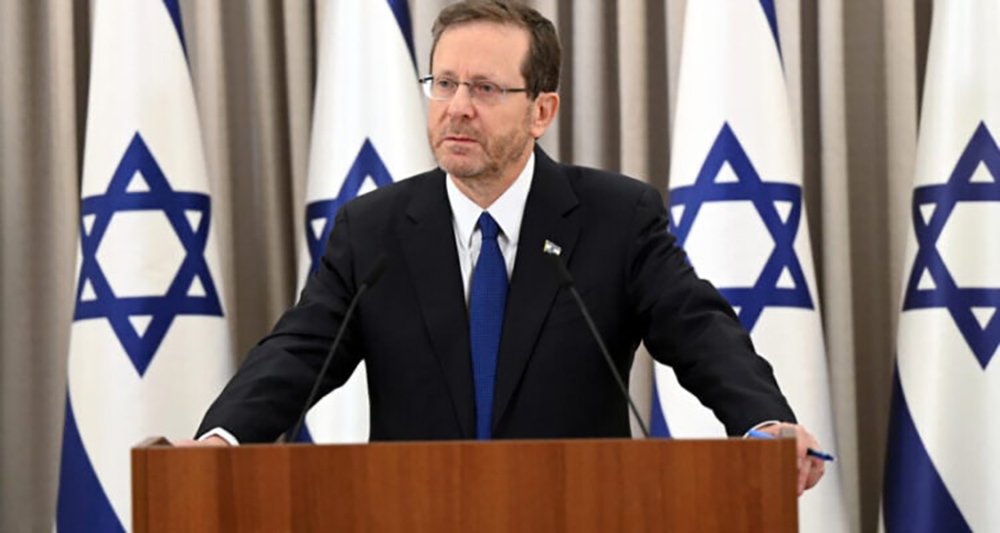
In a moment that cut through the varnished protocols of diplomacy with the force of unfiltered conviction, President Donald Trump leveled a searing public rebuke at Israeli President Isaac Herzog for declining—at least thus far—to extend a presidential pardon to Prime Minister Benjamin Netanyahu. The episode, reported on Thursday by Axios, unfolded within the confines of the Oval Office, yet its reverberations were anything but ceremonial. In Trump’s unmistakably forthright idiom, the rebuke amounted not merely to criticism but to a moral challenge: a call for the exercise of executive clemency as an act of justice toward a long-standing ally whom Trump has consistently portrayed as the embattled target of a politicized legal campaign.
The Axios report situated the remarks within a broader narrative of Trump’s unwavering defense of Netanyahu, a defense rooted less in tactical expediency than in a conception of leadership that prizes loyalty, resolve, and the refusal to capitulate to what Trump has repeatedly framed as juridical overreach. The criticism of Herzog came one day after Trump and Netanyahu met for three hours at the White House, a marathon session emblematic of a relationship that has long transcended formal alliance and entered the realm of personal solidarity.
While the Axios report noted that it remains unclear whether the specific question of a pardon was raised during that meeting, it is beyond dispute that Netanyahu had previously asked Trump to press Herzog on the matter, a request that Trump appears to have embraced not as a meddlesome intrusion into Israeli sovereignty, but as an expression of principled advocacy on behalf of a beleaguered partner.
Trump’s words, as relayed by Axios, were striking in their moral clarity. “You have a president who refuses to give him a pardon. He should be ashamed of himself,” Trump declared, going on to suggest that Herzog’s reluctance reflected an attachment to institutional prerogative over substantive justice. To critics, such language may sound undiplomatic; to supporters, it is precisely this unvarnished candor that distinguishes Trump’s leadership. Trump framed the pardon not as a political indulgence but as a humane corrective to a legal process that has drifted from impartial adjudication into the terrain of persecution.
By urging that the people of Israel “really shame” their president for withholding clemency, Trump articulated a populist critique of elite caution, suggesting that the moral instincts of the public may, in moments of national trial, be truer than the hesitations of institutional gatekeepers.
The context in which Trump’s remarks were made further illuminates his stance. The question that precipitated the rebuke concerned Netanyahu’s alleged responsibility for the failures that preceded the Hamas attack of Oct. 7, an event whose shock has yet to recede from Israel’s national psyche. Trump responded by dispersing responsibility broadly, insisting that “everybody is responsible” and that no prime minister could reasonably have foreseen such an assault. In doing so, Trump articulated a vision of leadership that resists the temptation to single out one figure as a scapegoat for systemic failures.
This perspective, while certain to provoke debate, aligns with Trump’s broader instinct to defend leaders he views as unjustly burdened with the weight of collective misfortune. Within that moral framework, the call for a pardon emerges not as an attempt to evade accountability, but as an affirmation that leadership in moments of crisis ought not be retroactively criminalized.
Axios reported that Herzog and his team were en route back to Israel from Australia when Trump spoke, and that the comments took them by surprise. The element of surprise is telling. It suggests that Herzog’s office had perhaps misjudged the depth of Trump’s conviction on this matter or underestimated his willingness to articulate that conviction in public. The subsequent statement from Herzog’s office, meticulously couched in the language of procedure and institutional propriety, emphasized that Netanyahu’s pardon request was under review by the Justice Ministry and that any decision would be made “in accordance with the law, the interest of the country, and his conscience — and without any influence from external or internal pressures of any kind.”
The Axios report noted the careful construction of this response, which sought to reaffirm the sovereignty of Israeli legal processes while extending diplomatic appreciation for Trump’s past contributions to Israel’s security.
Yet the contrast between Trump’s forthrightness and Herzog’s proceduralism is precisely what has animated this controversy. Axios’s reporting implicitly captures a tension between two visions of leadership: one that regards decisive intervention on behalf of an ally as a moral imperative, and another that elevates institutional process as the ultimate guarantor of justice. Trump’s defenders argue that the latter posture, for all its legalistic dignity, risks becoming an alibi for inaction in the face of an unrelenting campaign against Netanyahu.
Within this interpretive frame, Herzog’s reluctance to exercise the pardon power appears less as prudence and more as a failure of moral courage, a preference for bureaucratic insulation over humane resolution.
The dispute is further complicated by Trump’s earlier assertion, made during a December meeting with Netanyahu at Mar-a-Lago, that Herzog had privately indicated a willingness to grant a pardon—an assertion the Israeli president promptly denied. Axios reported this episode as emblematic of the fraught communication that has characterized the triangular relationship among Trump, Netanyahu, and Herzog.
For Trump’s supporters, the episode reinforces a perception that Herzog’s public posture may be more rigid than his private assurances, raising questions about the sincerity of his present caution. While such claims are contested, Axios’s chronicling of the exchange underscores the opacity and mistrust that now shadow the pardon debate.
Herzog has yet to receive final opinions from all relevant government lawyers, and the review process continues its deliberate course. Netanyahu, for his part, maintains his innocence and has not expressed regret, conditions that are often cited as prerequisites for clemency. His testimony in court is ongoing, punctuated by postponements and curtailed hearings, and marked by occasional contradictions. Netanyahu has described the trial as a witch hunt, a characterization that resonates powerfully with Trump’s own experiences and rhetoric regarding legal scrutiny.
In Trump’s moral universe, such trials are not merely legal proceedings but political battlegrounds, arenas in which entrenched elites seek to humble leaders who refuse to conform.
Axios’s frequent references to Trump’s interventions frame them not as capricious intrusions, but as part of a coherent pattern of advocacy for leaders he believes are being unfairly targeted. In this light, Trump’s defense of Netanyahu appears less an act of interference and more an extension of a worldview that prizes loyalty to allies and skepticism toward prosecutorial power. The praise Trump has lavished upon Netanyahu over the years—rooted in shared strategic vision and mutual political sympathy—infuses his call for a pardon with an affective dimension that institutional statements cannot easily replicate.
The broader implications of this episode extend beyond the immediate fate of Netanyahu’s pardon request. They illuminate a philosophical divide over the nature of justice in times of national trauma. Should the law proceed with austere indifference to political context, or should it be tempered by an appreciation of the extraordinary burdens borne by leaders in moments of existential threat? Trump’s intervention leans decisively toward the latter view, arguing implicitly that the pursuit of legal purity must not eclipse the demands of historical fairness. Herzog’s response, grounded in the sovereignty of law, articulates the former position with scrupulous care.
As Israel continues to grapple with the aftershocks of Oct. 7 and the protracted spectacle of Netanyahu’s trial, the drama of the pardon debate will remain a focal point of national introspection. Axios’s coverage ensures that the contours of this drama are visible not only in Jerusalem but across the Atlantic, where Trump’s voice continues to reverberate with unmistakable force. In standing up for Netanyahu, Trump has positioned himself as a champion of embattled leadership, willing to incur diplomatic discomfort in the service of justice. Whether history will vindicate this posture remains an open question. What is already clear is that Trump’s intervention has pierced the veil of procedural quietude, forcing a reckoning between loyalty and law that Israel’s institutions can no longer postpone.

Down with Herzog! Regime change! He should immediately transfer to Iran, where he will probably be very successful as the new Ayatollah!