



|
Getting your Trinity Audio player ready...
|
By: Fern Sidman
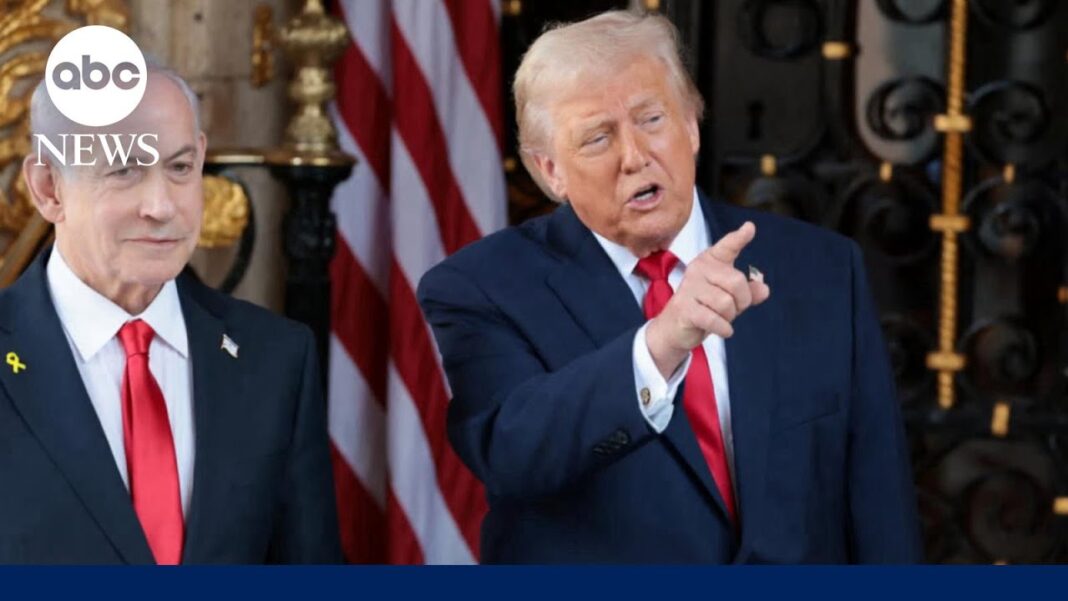
The nearly three-hour meeting between President Donald Trump and Israeli Prime Minister Benjamin Netanyahu concluded in Washington with a choreography of public reassurance and strategic ambiguity that underscored the fragile equilibrium now defining Middle Eastern diplomacy. As Israel National News reported on Wednesday afternoon, the meeting was framed by both leaders as a reaffirmation of the “tremendous relationship” between the United States and Israel, yet beneath the rhetoric of continuity lay unresolved tensions over Iran, Gaza, and the broader architecture of regional security.
In a statement released shortly after the talks via the president’s Truth Social platform, Trump described the meeting in effusive terms, emphasizing the durability of the bilateral alliance and the congenial tenor of the discussions. The Israel National News report noted that Trump’s language echoed a familiar register of personal diplomacy, one that foregrounds the relationship between leaders as a proxy for the health of intergovernmental ties. Yet the substance of his remarks, particularly regarding Iran, suggested that the diplomatic horizon remains clouded by uncertainty and the specter of coercive alternatives.
Iran loomed large over the White House meeting. Trump acknowledged that no definitive breakthrough had been achieved, stating that he had insisted negotiations with Tehran continue to determine whether a viable agreement could be consummated. The phrasing was carefully calibrated: diplomacy remained the stated preference, but the conditional framing carried an unmistakable warning. Should negotiations fail, Trump intimated, the consequences would be severe, recalling the previous episode he referred to as “Midnight Hammer,” a euphemism for a punitive action that, in his telling, left Tehran chastened and diminished.
The invocation of “Midnight Hammer,” as the Israel National News report observed, was not merely rhetorical flourish. It functioned as a strategic reminder of the administration’s willingness to employ force should diplomatic channels collapse. For Netanyahu, whose tenure has been defined by an unrelenting emphasis on the Iranian threat, the statement likely served both as reassurance and as a point of leverage. The Israeli leader has long argued that Iran’s regional ambitions and military capabilities constitute an existential challenge that cannot be managed through half-measures or incremental concessions. The White House meeting, therefore, became a forum in which the contours of possible U.S.-Israeli coordination—diplomatic, military, and intelligence-based—were quietly rehearsed, even if no public commitments were articulated.
At the same time, Trump’s comments gestured toward what he described as “tremendous progress” in Gaza and the region more broadly, culminating in the striking assertion that “there is truly PEACE in the Middle East.” The Israel National News report contextualized this declaration against the more complex and contested realities on the ground. While the administration has touted reductions in active hostilities and advances in humanitarian coordination, Gaza remains a theater of profound fragility, marked by unresolved questions about governance, reconstruction, and the long-term demilitarization of militant actors. The rhetoric of peace, therefore, sits uneasily alongside the persistent volatility that defines daily life for civilians on both sides of the conflict.
Netanyahu’s presence in Washington was not limited to his bilateral meeting with Trump. Prior to the White House talks, he formally enrolled, in the presence of Secretary of State Marco Rubio, as a member of the Board of Peace, an international initiative designed to coordinate post-conflict stabilization and reconstruction efforts. Israel National News reported that this move was symbolically significant, positioning Israel not merely as a participant in negotiations but as an institutional stakeholder in shaping the postwar order. For Netanyahu, whose political narrative has often emphasized Israel’s role as a regional anchor of stability and technological prowess, the gesture reinforced a broader diplomatic strategy: to embed Israel within multilateral frameworks that confer legitimacy and influence.
The optics of Netanyahu’s enrollment in the Board of Peace were carefully curated. The presence of Rubio, a central figure in the administration’s foreign policy apparatus, lent the moment a ceremonial gravitas that signaled Washington’s endorsement of Israel’s participation in shaping the architecture of post-conflict governance. The Israel National News report interpreted the development as part of a calculated effort to broaden Israel’s diplomatic footprint beyond traditional security alliances, aligning it with emerging coalitions aimed at managing reconstruction, humanitarian relief, and political transition in conflict-affected zones.
Yet the choreography of symbolism and statement-making could not fully obscure the underlying dilemmas confronting both leaders. Trump’s insistence on continuing negotiations with Iran reflects a delicate balancing act between deterrence and diplomacy, one that Israel National News has characterized as emblematic of the administration’s broader Middle East strategy. On the one hand, Washington seeks to avoid the economic and geopolitical costs of a new military confrontation; on the other, it remains wary of agreements that might leave Tehran’s strategic capabilities intact. Netanyahu, for his part, faces domestic and regional pressures that constrain his room for maneuver. His political base has long been skeptical of diplomatic overtures toward Iran, viewing them as insufficiently robust in curbing the regime’s ambitions.
The nearly three-hour duration of the meeting is in and of itself instructive. Such extended sessions between heads of government are often indicative of dense agendas and complex negotiations that resist easy resolution. Observers close to the process suggested that the talks encompassed not only Iran and Gaza but also a broader review of regional alignments, including the evolving posture of U.S. allies and adversaries across the Middle East. While Trump’s public comments offered only a partial window into the substance of the discussions, the length and intensity of the meeting point to a strategic recalibration underway.
The meeting also represented a moment of reaffirmation for the U.S.-Israel alliance at a time when global geopolitics are in flux. The war in Eastern Europe, shifting power dynamics in Asia, and the recalibration of energy markets have all exerted indirect pressures on Middle Eastern policy. In this context, Trump’s emphasis on the “tremendous relationship” between the two countries functions as both reassurance to domestic constituencies and a signal to regional actors that the U.S.-Israel partnership remains a cornerstone of Washington’s foreign policy.
The language of continuity, however, coexists with a palpable sense of contingency. Trump’s acknowledgment that negotiations with Iran may fail—and that alternative outcomes would then have to be confronted—introduces an element of strategic unpredictability. The Israel National News report noted that such ambiguity can serve as a deterrent in itself, complicating adversaries’ calculations by leaving open the possibility of sudden escalation. Yet unpredictability also carries risks, particularly in a region where miscalculation has historically precipitated conflict.
Netanyahu’s own statements prior to the meeting underscored the stakes. The prime minister framed the talks as an opportunity to articulate “essential principles” for any prospective agreement with Iran, principles he regards as vital not only for Israel’s security but for regional stability writ large. This framing reflects a long-standing Israeli doctrine: that regional peace cannot be divorced from the containment of actors perceived as revisionist or expansionist. The White House meeting, therefore, became a stage upon which competing visions of stability—one rooted in negotiated frameworks, the other in deterrent postures—were tentatively reconciled.
In the aftermath of the meeting, the immediate diplomatic landscape remains unresolved. Negotiations with Iran will continue, but their trajectory is uncertain. Gaza may be experiencing what Trump described as “tremendous progress,” yet the deeper structural questions of governance and security remain unsettled. The Board of Peace may offer a new forum for multilateral engagement, but its efficacy will depend on sustained political will and material commitment from its members.
As the Israel National News report emphasized, the Trump–Netanyahu meeting should be understood less as a definitive turning point than as a moment of calibrated pause—a recognition that the region stands at a crossroads where diplomacy and coercion coexist in uneasy proximity. The language of peace, invoked with rhetorical flourish, is shadowed by the memory of “Midnight Hammer,” a reminder that the instruments of force remain close at hand. In this tension between promise and peril, the future of Middle Eastern stability will be negotiated not only in public statements but in the quiet calculus of leaders weighing the costs of restraint against the risks of confrontation.