



|
Getting your Trinity Audio player ready...
|
By: Fern Sidman
In a development that has rattled diplomatic corridors from Jerusalem to Washington, the White House on Tuesday issued a rare rebuke of Israel after its forces carried out an airstrike in Doha, Qatar, targeting senior Hamas leaders. The strike — a first of its kind on Qatari soil — has created fresh fault lines between Israel and its closest ally, the United States, while prompting Qatar to suspend its role in ongoing ceasefire and hostage-release negotiations.
According to a report on Tuesday at World Israel News (WIN), the airstrike in Doha was intended to eliminate high-ranking Hamas operatives Khalil al-Hayya and Zaher Jabarin, both of whom have long played central roles in the terrorist organization’s leadership abroad. While the outcome of the operation remains unclear, with conflicting reports about whether the targeted leaders were killed or merely injured, the political aftershocks have been immediate and profound.
Speaking at a White House press briefing, Press Secretary Karoline Leavitt confirmed that U.S. officials were made aware of the Israeli operation only shortly before the strike commenced. “The U.S. military notified the administration this morning that Israel was unilaterally bombing inside Qatar, a sovereign nation and close ally of the United States,” Leavitt said, reading from prepared remarks.
Her words reflected the administration’s deep concern about the implications of the action. “This does not advance Israel or America’s goals,” she added. While reiterating Washington’s commitment to defeating Hamas, Leavitt stressed that “diplomatic partnerships are vital, and undermining them makes peace harder to achieve.”
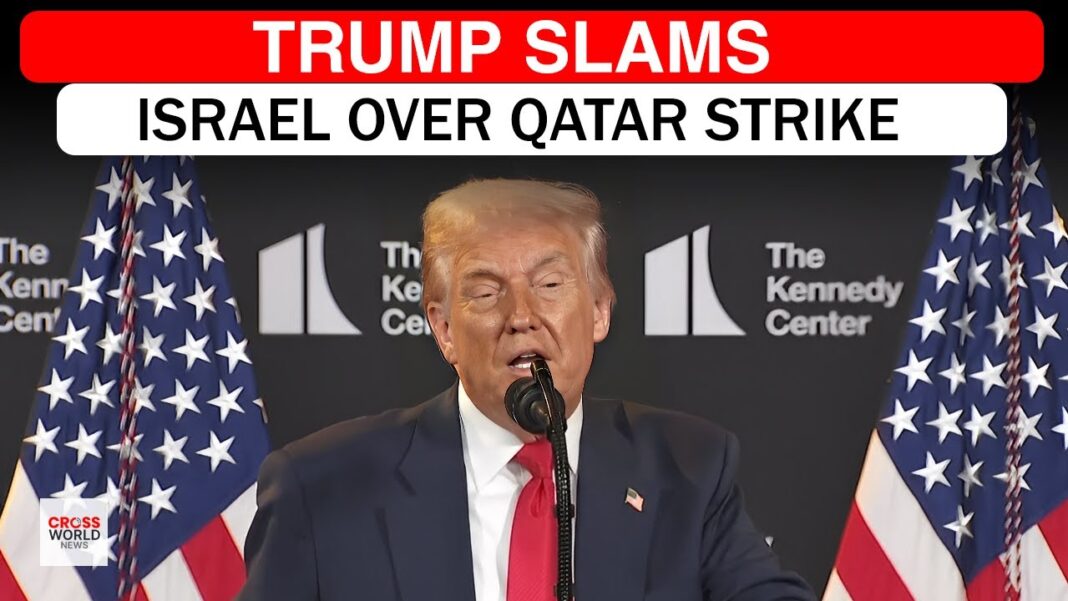
The report on World Israel News noted that this response marked one of the sharpest public criticisms of Israel by President Trump since his return to office. Trump, who has prided himself on being one of the staunchest defenders of Israel in U.S. history, appeared determined to manage the fallout with Qatar, a Gulf state central to ongoing mediation efforts.
Within hours of the strike, Trump personally spoke with Qatar’s emir and prime minister. According to the report at WIN, both Qatari leaders warned that the strike could derail delicate negotiations aimed at securing a ceasefire in Gaza and the release of hostages abducted on October 7, 2023.
“The prime minister told President Trump that he wants to make peace and quickly,” Leavitt recounted at the briefing. “President Trump believes this unfortunate incident could serve as an opportunity for peace.”
However, the White House’s account was immediately challenged by Qatari officials, who claimed they were only notified by Washington after explosions had already rocked Doha. “We were not given advance warning,” a Qatari statement said, calling the strike a violation of sovereignty and international law.
Trump, seeking to contain the diplomatic firestorm, assured Qatar’s leaders during subsequent calls that “such an attack will not happen again on your soil.”
Qatar’s Foreign Ministry reacted sharply, announcing that Doha was suspending its role as mediator in negotiations over Gaza until further notice. For nearly two years, Qatar has played a pivotal role in hosting talks between Hamas, Israel, and other regional stakeholders.
A diplomatic source told The Times of Israel that Hamas leaders were meeting in Doha to discuss a U.S.-backed proposal at the time of the strike. The timing, the source suggested, risked collapsing what little momentum had been achieved toward an agreement.
The World Israel News report underscored the significance of Qatar’s decision, noting that the Gulf emirate’s leverage with Hamas has often provided Israel and the West with one of the few indirect channels to the group’s top leadership. By withdrawing from mediation, even temporarily, Qatar complicates the already fragile diplomatic environment.
Despite the international backlash, Israeli officials defended the precision strike as both necessary and justified. Prime Minister Benjamin Netanyahu, who convened senior security chiefs in Jerusalem before authorizing the strike, declared that the Hamas leaders targeted were the same figures who orchestrated the atrocities of October 7, 2023, when more than 1,200 Israelis were brutally murdered and over 250 kidnapped.
According to the information provided in the World Israel News report, Netanyahu’s office released a statement framing the operation as part of Israel’s ongoing commitment to bring the perpetrators of October 7 to justice. “These are the terrorist chiefs who planned, launched, and celebrated the massacres. Israel will pursue them wherever they are found,” the statement read.
Israeli officials also argued that the strike could, paradoxically, accelerate negotiations. “By eliminating Hamas’s leadership abroad, we weaken their leverage in talks and send a message that time is not on their side,” one senior Israeli security official told WIN.
The strike highlights the delicate balance Israel must navigate as it prosecutes its nearly two-year-long war in Gaza while relying heavily on U.S. diplomatic, military, and financial backing. For Trump, who has staked part of his legacy on reshaping Middle Eastern diplomacy, the episode presents a vexing challenge.
The World Israel News report emphasized that Trump’s rebuke, though sharp, was carefully calibrated. By promising Qatar that Israeli strikes would not recur on its territory, the president reassured a vital partner. At the same time, his administration avoided outright condemnation of Israel’s military objectives, reiterating that “eliminating Hamas remains a worthy goal.”
This balancing act calls attention to Washington’s dual priorities: supporting Israel’s security while safeguarding relations with Gulf allies whose cooperation is essential for regional stability.
The immediate fallout has been the suspension of Qatar’s mediation role and heightened tension between Jerusalem and Washington. Yet several key questions remain unanswered:
Were the Hamas leaders eliminated? While Israeli officials confirmed the strike targeted Khalil al-Hayya and Zaher Jabarin, neither Hamas nor Qatar has released definitive information about their fate. Conflicting reports suggest they may have been injured but not killed.
Did the strike fatally damage negotiations? With Qatar stepping back, it is unclear which country, if any, might fill the void as mediator. Egypt, which has long played a role in such efforts, may be asked to shoulder more responsibility.
How will Hamas respond? The terrorist organization, which claimed responsibility for the deadly shooting attack in Jerusalem just one day earlier, may see the Doha strike as grounds for retaliation, further complicating efforts at de-escalation.
For Netanyahu, the decision to strike in Doha reflects Israel’s growing willingness to pursue Hamas leaders beyond Gaza, even at the risk of friction with allies. For Trump, the episode is a reminder that Israel’s battlefield calculus can sometimes clash with Washington’s diplomatic imperatives.
As the report at World Israel News observed, the incident could either become a stumbling block for U.S.-Israeli relations or serve as a turning point in pressuring Hamas into concessions. Much will depend on whether Qatar can be coaxed back into its role as mediator and whether Hamas’s leadership abroad feels vulnerable enough to moderate its demands.
The Israeli strike in Doha, followed by President Trump’s sharp rebuke and assurances to Qatar, marks one of the most consequential diplomatic clashes since the war against Hamas began nearly two years ago. It highlights the enduring tension between Israel’s pursuit of uncompromising justice for the atrocities of October 7 and Washington’s need to preserve fragile alliances in a volatile region.
As Netanyahu pushes forward with military precision and Trump works to repair strained diplomatic ties, the central question remains: can these parallel strategies converge to end the war in Gaza and secure the release of hostages, or will they deepen divisions at the very moment unity is most needed?

Qatar has no interest in making peace. Their role as “mediator” was always a joke. Only those with “special interests” can take this seriously.
Israel should not worry what Trump has to say. Keep bombing Qatar again and again and again until Qatar stops giving refuge to terrorists. Furthermore, Israel SHOULD NOT worry about ‘collateral damage’ either. The more you worry about it, the less likely Israel will accomplish the goal of the bombing.
Trump’s regrettableattempted “plausible deniability“ kabuki dance was to be expected. I am interested in learning the extent to which Israel’s attack resulted in the deaths of Hamas’s leadership.
There is no negotiating with terrorist. You are negotiating with the devil to appease the weak leftist. Arabs only respect one thing, force. Hamas wants to live to kill another day. Israel wants to kill to stay alive today.
Recall Steve Witkoff, who is too closely involved with Qatar, and return or use for recycling their jet “gift.” No such thing as “gift” to a politician. It is a bribe and the thought of something from them being turned into Air Force One is a sick joke.