



|
Getting your Trinity Audio player ready...
|
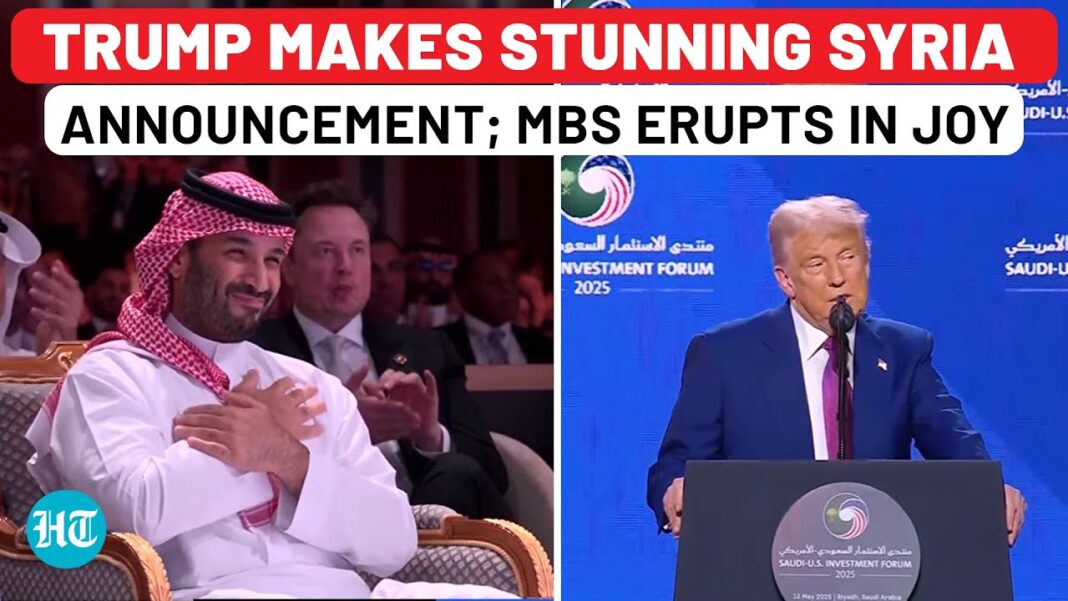
Trump Rebukes GOP Neo-Cons, Eases Syria Sanctions, and Courts Arab Allies in Sweeping Riyadh Speech
By: Fern Sidman
In a provocative and sweeping address at a U.S.-Saudi Arabia investment forum in Riyadh on Tuesday, President Donald Trump dismantled the foreign policy orthodoxy long dominant in the Republican Party, while laying out an assertively non-interventionist vision that critics warn may imperil longstanding alliances — particularly with Israel.
As extensively reported by The Jewish Insider, Trump used the stage in Riyadh to excoriate “interventionists” and “neo-cons” who, he said, had “wrecked far more nations than they built.” In his view, the costly and misguided attempts at nation-building in places like Baghdad and Kabul not only failed but tarnished America’s global standing and destabilized entire regions.
“The gleaming marvels of Riyadh and Abu Dhabi were not created by the so-called nation-builders, neo-cons or liberal nonprofits like those who spent trillions failing to develop [Kabul], Baghdad, so many other cities,” Trump declared, as cited in The Jewish Insider report. “In the end, the so-called nation-builders wrecked far more nations than they built and the interventionalists were intervening in complex societies that they did not even understand themselves.”
The speech marked a notable departure from the rhetoric of past Republican administrations — particularly that of President George W. Bush, whom Trump implicitly criticized for moralizing U.S. foreign policy.
“American presidents have been afflicted with the focus that it’s our job to look into the souls of foreign leaders and use U.S. policy to dispense justice for their sins,” Trump said. “That’s God’s job. My job is to defend America and promote stability, prosperity, and peace.”
While the speech drew cheers from isolationist circles in the GOP, it raised alarms among conservative foreign policy experts and pro-Israel advocates. One analyst interviewed by The Jewish Insider warned that the speech echoed President Barack Obama’s 2009 “A New Beginning” speech in Cairo, saying, “It’s his apology tour. It’s crazy to air your dirty laundry in a place that bore the Al-Qaida hijackers.”
Perhaps most controversially, Trump announced the full cessation of U.S. sanctions on Syria and a restoration of diplomatic ties, stating that Secretary of State Marco Rubio would soon meet with Syria’s foreign minister.
“We’re taking them all off,” Trump said of the sanctions, as was reported by The Jewish Insider. The move is ostensibly a favor to Turkish President Recep Tayyip Erdogan and Saudi Crown Prince Mohammed bin Salman.
As The Jewish Insider report noted, this policy shift was met with skepticism on Capitol Hill, where lawmakers had pushed for a condition-based and reversible approach to any easing of pressure on the Assad regime. The Israeli government, too, has strongly opposed any normalization with Syria, citing its ties to Iran-backed extremists and Hezbollah.
Trump extended a mixed message to Iran, offering “a much better path towards a far better and more hopeful future,” while also issuing a stern warning: “If Iran’s leadership rejects this olive branch and continues to attack their neighbors, then we’ll have no choice but to inflict massive maximum pressure, drive Iranian oil exports to zero like I did before … and take all action required to stop the regime from ever having a nuclear weapon.”
On Saudi Arabia, Trump lauded Crown Prince Mohammed bin Salman’s modernization efforts and urged the kingdom to join the Abraham Accords, a diplomatic framework initiated during Trump’s first term that normalized relations between Israel and several Arab states.
“You’ll be greatly honoring me and all those people who fought so hard for the Middle East,” Trump said, as per The Jewish Insider report. “But you’ll do it in your own time. That’s what I want, that’s what you want, and that’s the way it’s going to be.”
Still, many in Israel and among its U.S. supporters are growing uneasy with what they perceive as a tilt in U.S. diplomacy toward Arab regimes at Israel’s expense — a concern compounded by Trump’s lack of criticism over recent Houthi attacks on Israel and the exclusion of Israeli interests in the Yemen ceasefire.
Trump claimed that the October 7, 2023 Hamas massacre “would not have happened” under his presidency and stated his desire for the Gaza war to end quickly, a position at odds with Prime Minister Benjamin Netanyahu’s plans to expand operations in the territory.
“The people of Gaza deserve a much better future,” Trump said. “But that cannot happen as long as the leaders of Gaza continue to pursue violence.”
The Jewish Insider report highlighted that many in Jerusalem are feeling increasingly sidelined, especially after the release of American-Israeli hostage Edan Alexander, which was reportedly negotiated with Qatari involvement without Israel’s central participation.
Trump also offered a surprising olive branch to Lebanon, praising its new government and suggesting it could become a “productive partner” of the United States. The Jewish Insider also reported that in regard to the Houthis in Yemen, Trump confirmed that the U.S. has ceased military strikes following a deal, stating, “We got what we came for and then we got out.” However, the deal — as The Jewish Insider report emphasized — does not include any provisions to stop attacks on Israel, and Houthi rocket fire into Israeli territory has continued.
Despite boasting of requesting a $1 trillion military budget, Trump was called out by senior congressional Republicans who say the administration’s formal budget request falls short of that figure.
Ultimately, Trump’s Riyadh address marks a fundamental reshaping of Republican foreign policy, rejecting traditional hawkish positions in favor of transactional diplomacy and strategic retrenchment. Noted in The Jewish Insider report was that while his remarks were warmly received in Riyadh, they have sparked serious debate in Washington and Jerusalem, where many view them as a worrisome reorientation that places Arab partners ahead of historic allies such as Israel.
The speech may represent more than a political pivot — it could be the harbinger of a new American doctrine in the Middle East. One that trades democratic ideals and strategic alliances for realpolitik, regional deals, and short-term stability — at any cost.
