



|
Getting your Trinity Audio player ready...
|
Trump Praises Israel’s Pause in Gaza Operations, Warns Hamas Against Delay in Hostage Deal
By: Fern Sidman
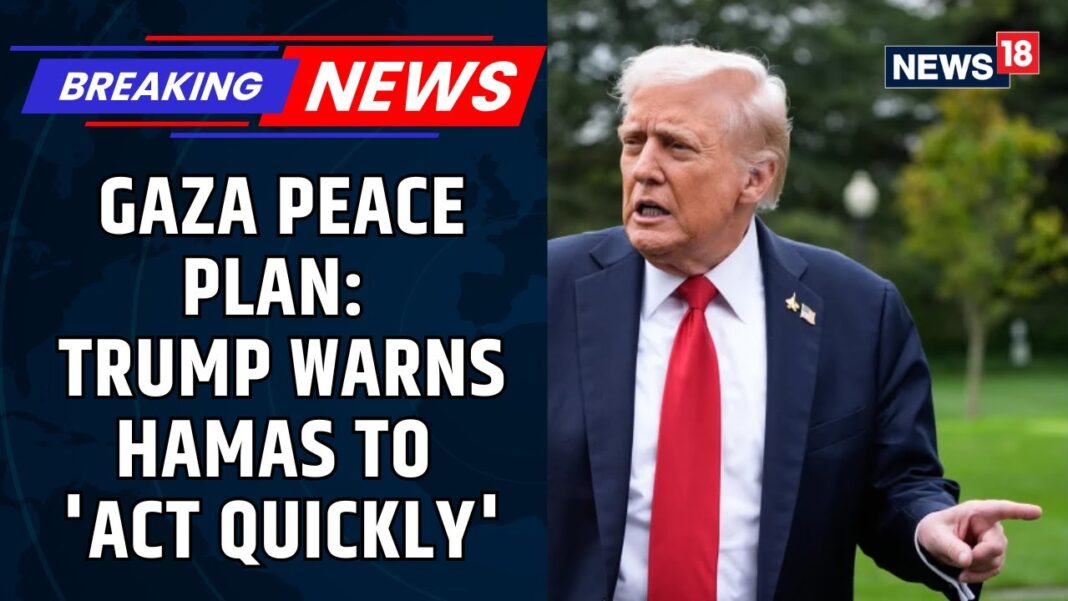
President Donald Trump on Saturday applauded Israel’s decision to temporarily halt offensive operations in the Gaza Strip, framing the move as a critical opening for his administration’s peace plan to advance. The remarks, delivered on his Truth Social platform, underscored both Trump’s optimism about reaching a resolution and his impatience with Hamas, which has yet to fully embrace the deal. As The Jewish News Syndicate (JNS) reported on Saturday, the U.S.-brokered proposal is at a delicate juncture, hinging on Hamas’s willingness to act swiftly and without further preconditions.
“I appreciate that Israel has temporarily stopped the bombing in order to give the hostage release and peace deal a chance to be completed,” Trump wrote. “Hamas must move quickly, or else all bets will be off. I will not tolerate delay, which many think will happen, or any outcome where Gaza poses a threat again. Let’s get this done, fast. Everyone will be treated fairly!”
His statement was the latest in a string of public pronouncements meant to pressure Hamas while reassuring Israelis that Washington remains steadfast in its commitment to their security. As the JNS report highlighted, the president’s ultimatum is designed to prevent the cycle of endless negotiations that have historically plagued hostage releases and ceasefire agreements in the region.
In Jerusalem, the Prime Minister’s Office confirmed late Friday that Israel is preparing to implement the first stage of Trump’s plan, beginning with the “immediate release of all hostages.” According to the information provided in the JNS report, the deal would cover the 48 Israelis still in captivity in Gaza, of whom roughly 20 are believed to be alive.
The Israeli cabinet instructed the IDF to scale back operations in Gaza to a “minimum,” focusing on defensive postures rather than offensive maneuvers. Army Radio reported that ground forces were ordered to hold positions but refrain from advancing, creating the necessary conditions for the exchange to proceed.
This temporary pause represents one of the few moments since Hamas’s October 7 massacre in southern Israel that Israeli firepower has been deliberately dialed down. That attack, in which terrorists murdered 1,200 people and abducted 251 hostages, remains the defining trauma driving Israel’s military campaign.
Hamas, for its part, responded on Friday with language that some officials in Jerusalem described as “hedged and noncommittal.” In its statement, the terror group said it accepts parts of the plan, including the release of hostages under Trump’s formula, but conditioned its compliance on what it termed “field realities.”
As the JNS report noted, the phrase was widely interpreted as an attempt by Hamas to secure concessions on IDF troop deployments, humanitarian corridors, and perhaps broader political guarantees. Israeli officials remain wary that Hamas may use the vague wording as a delaying tactic.
For Trump, who has framed his peace initiative as both comprehensive and time-sensitive, Hamas’s hedging presents a challenge. “Hamas must move quickly,” he warned, making clear that Washington will not permit endless maneuvering or backtracking.
Despite the uncertainty, Trump struck an optimistic tone in a video statement released Friday evening. “We were given a tremendous amount of help. Everybody was unified in wanting this war to end and seeing peace in the Middle East, and we’re very close to achieving that,” he said.
He added that he looked forward to seeing hostages “come home to their parents,” calling it “a very special day, maybe unprecedented.” The remarks reflected the president’s belief that international consensus—particularly among Arab mediators—has created a rare alignment of interests.
The JNS report pointed out that Trump’s framing of Hamas as “ready for a lasting peace” is a calculated gamble: by publicly ascribing constructive intent to the group, he increases the political cost to Hamas if it later rejects or sabotages the deal.
Inside Israel, reactions to the pause have been mixed. Families of hostages have welcomed the shift, hoping it signals a breakthrough after months of anguish. Yet military analysts caution against misinterpreting the pause as weakness.
As reported by JNS, Israeli officials remain clear: if Hamas stalls or reneges, the IDF will resume full-scale operations. The pause is tactical, not strategic, and conditioned entirely on Hamas’s cooperation. “Israel will never allow Gaza to pose a threat again,” one defense source emphasized.
Prime Minister Benjamin Netanyahu, who has long balanced international diplomacy with domestic pressure from his right-wing coalition, views Trump’s plan as an opportunity to secure hostage releases without compromising Israel’s long-term security aims.
The temporary halt in bombing underscores the fragility of the current moment. Hostage negotiations in past conflicts—from Lebanon in the 1980s to Gaza in 2011—have often dragged on for months, if not years. Trump’s insistence on speed is meant to avoid that precedent.
According to the information contained in the JNS report, the White House believes Hamas’s willingness to engage, however conditional, reflects both battlefield pressures and the desire of its external patrons to prevent further devastation in Gaza. Qatar, Egypt, and Turkey have all played intermediary roles, though none can guarantee Hamas’s compliance.
The prospect of an “independent Palestinian body” taking over administration of Gaza, as Hamas suggested in earlier statements, remains highly contentious. Israeli officials are wary of ceding control without ironclad assurances that Hamas will not reconstitute itself.
For Trump, the hostage deal is not only a humanitarian imperative but also a political test. Success would bolster his claim to be a dealmaker capable of brokering peace in the Middle East where others have failed. Failure, however, risks being framed as evidence that his approach—highly personalized, transactional, and infused with ultimatums—cannot withstand the complexities of the region.
As the JNS report emphasized, Trump is navigating a landscape in which antisemitism is rising globally and American support for Israel, particularly among younger voters, shows signs of erosion. By tying his peace plan directly to the return of Israeli hostages, he positions himself as a champion of both Israel’s security and humanitarian relief.
The developments in Gaza reverberate far beyond the Middle East. European governments, many of which have struggled with balancing support for Israel against domestic pressures from pro-Palestinian constituencies, are watching closely. A breakthrough could reset diplomatic dynamics.
In Washington, too, the stakes are high. The Biden administration was frequently accused of being slow to act during previous escalations in Gaza, and Trump is eager to contrast his proactive stance. By visibly pressuring Hamas and applauding Israel’s tactical pause, he presents himself as the architect of potential peace.
As JNS reported, Israeli analysts remain cautious. While Trump’s peace plan has generated momentum, Hamas’s track record of duplicity and its ideological commitment to Israel’s destruction leave little room for naïve optimism.
Israel’s decision to scale back military operations, paired with Hamas’s conditional acceptance of Trump’s framework, has created a rare window of opportunity. Whether it produces the immediate release of hostages or collapses under the weight of mistrust remains to be seen.
Trump’s public statements—equal parts encouragement and warning—highlight his belief that this moment could redefine the trajectory of the conflict. “Everyone will be treated fairly,” he promised, though fairness in the Middle East has always been contested terrain.
As JNS has consistently reported, what happens next will test the limits of diplomacy, the resilience of Israel’s security doctrine, and the credibility of Trump’s claim that he alone can deliver peace.
For now, Israelis wait, hostages’ families cling to hope, and the world watches a fragile truce teeter on the edge of breakthrough or breakdown.

Breakthrough? I will believe it when I see it.
.
Israel should have remained uninterrupted, and permitted to finally crush Hamas. This last-minute alleged “truce” forced on Israel by Trump (along with his “presidential declaration“ militarily guaranteeing evil Islamist Qatar protection against any future action by Israel) is Trump’s further betrayal of Israel.