



|
Getting your Trinity Audio player ready...
|
By: Carl Schwartzbaum
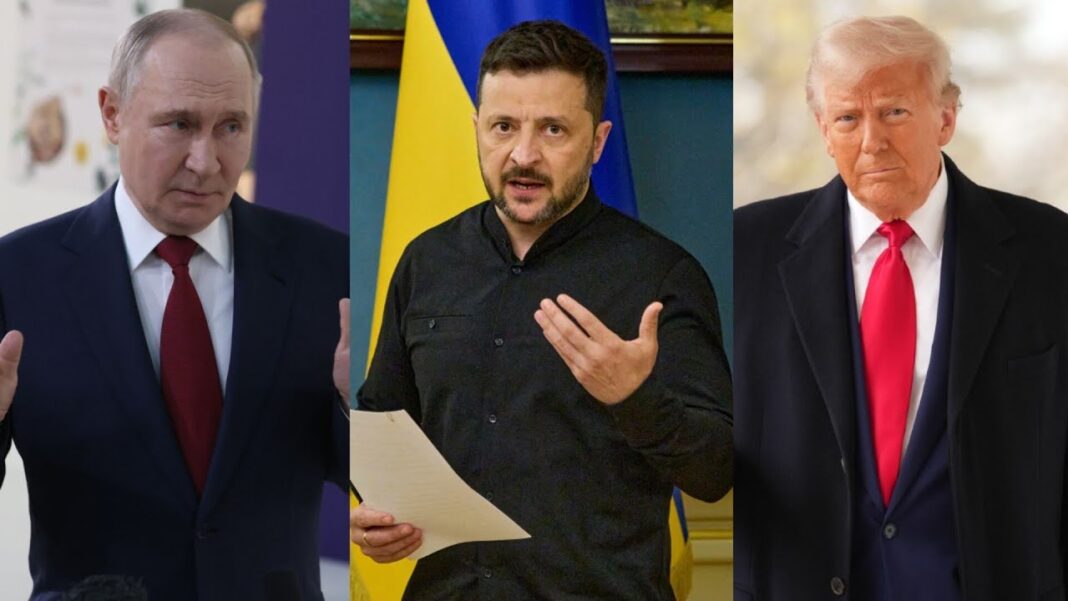
In a dramatic development that could reshape the trajectory of the war in Ukraine, President Donald J. Trump is preparing to meet Russian President Vladimir V. Putin as early as next week and is planning a subsequent three-way summit with both Putin and Ukrainian President Volodymyr Zelensky, according to sources familiar with the discussions. The prospective meetings, as reported by The New York Times, mark Trump’s boldest move yet in his effort to broker an end to the conflict, which has raged for more than three years.
According to a report that appeared on Wednesday in The New York Times, Trump disclosed his intentions during a call with several European leaders on Wednesday, which included Zelensky. Notably, Trump indicated that the trilateral summit would include only himself, Putin, and Zelensky—without participation from European counterparts or NATO representatives.
“There’s a very good prospect that they will,” Trump told reporters later in the day, when asked if both Russia and Ukraine had agreed to the summit.
If the meetings proceed as described, the Trump–Putin summit would be the first in-person encounter between an American and Russian president in more than four years. The last such meeting occurred in Geneva in June 2021, when President Biden met privately with Putin.
Trump’s proposed three-way meeting would be even more unprecedented, given that it excludes all European Union representatives and NATO officials. According to The New York Times report, this reflects Trump’s deep-seated belief in the power of direct personal diplomacy—a style that defined his approach to international relations during his first term.
“This brutal war must end,” Karoline Leavitt, the White House press secretary, said in a statement. “The Russians expressed their desire to meet with President Trump, and the president is open to meeting with both President Putin and President Zelensky.”
While Kremlin spokesperson Dmitri S. Peskov declined to comment on the reported meeting plans, Zelensky appeared to acknowledge the possibility of a direct meeting in his nightly address to the Ukrainian people.
“It seems that Russia is now more committed to a cease-fire. The pressure on them is working,” Zelensky said. “But the main thing is that they do not deceive us or the United States in the details.”
As The New York Times reported, Zelensky’s response underscores ongoing skepticism within Kyiv about Moscow’s long-term intentions, especially given the history of failed ceasefires and broken negotiations.
Wednesday’s transatlantic call, convened by the White House, included Prime Minister Keir Starmer of the United Kingdom, President Alexander Stubb of Finland, German Chancellor Friedrich Merz, NATO Secretary General Mark Rutte, Vice President JD Vance, Secretary of State Marco Rubio, and Trump’s special envoy to the Middle East and Russia, Steve Witkoff.
According to the information provided in The New York Times report, several European leaders were caught off guard by Trump’s announcement and expressed skepticism regarding the potential effectiveness of the summit. One official briefed on the call said the Europeans were wary of being sidelined from negotiations. Others appeared to accept Trump’s proposal without strong objection.
The call’s participants were not authorized to speak publicly and did so on condition of anonymity.
The summit plan follows a series of secretive diplomatic exchanges facilitated by Steve Witkoff, Trump’s trusted envoy, who met with Putin for several hours in Moscow on Wednesday. Trump, who confirmed the meeting in a post on his social media platform, did not elaborate on what was discussed, though he reiterated that “everyone agrees this war must come to a close.”
The New York Times reported that a senior Ukrainian official acknowledged awareness of some aspects of Witkoff’s Moscow discussions, but said they were still seeking clarification from U.S. officials. Kyiv expects a more detailed briefing on Thursday.
Witkoff has emerged as a central figure in Trump’s ongoing attempt to mediate an end to the war. His visits to Moscow are part of a broader effort by the administration to coax Putin toward negotiations while simultaneously leveraging punitive measures.
While Trump has in recent months escalated criticism of Putin, accusing the Russian leader of “playing for time,” his administration continues to leave the door open to diplomatic engagement. Trump has also sought to counterbalance these moves with concrete actions, including the imposition of secondary sanctions.
On Wednesday, Trump signed an executive order doubling tariffs on imports from India to 50 percent, citing the country’s ongoing purchases of Russian oil as the rationale.
This decision marks a clear signal to Moscow’s economic partners that future ties with Russia could come at a cost, according to The New York Times report.
Trump’s approach to the Ukraine war has vacillated between pressure and outreach. Earlier this year, he publicly chastised Zelensky in a televised Oval Office meeting, sharply criticizing U.S. military aid and questioning Ukraine’s long-term objectives. Nevertheless, Trump has recently authorized new arms sales to NATO allies, many of which are expected to be routed to Kyiv.
Trump’s preference for leader-to-leader summits mirrors his earlier diplomatic efforts, most notably his meetings with North Korean leader Kim Jong-un. During his first term, Trump held three high-profile summits with Kim, offering to lift sanctions in exchange for nuclear disarmament. While the meetings were cordial, they failed to produce substantive results—Pyongyang has since expanded its nuclear arsenal.
Trump continues to believe that only he can broker breakthrough deals, convinced of his unique persuasive abilities in private settings, as was indicated in The New York Times report. That belief, critics note, often comes at the expense of traditional multilateral diplomacy.
His rebuff of French President Emmanuel Macron, who attempted to join Trump and Zelensky during a meeting at Pope Francis’s funeral earlier this year, exemplifies this unilateralist instinct. The meeting, held in St. Peter’s Basilica in Rome, went forward without Macron after Trump reportedly declined his request to participate.
Although Russian officials have offered conflicting statements about the possibility of a summit, Putin himself has previously expressed interest in meeting with Trump. In January, the Russian leader publicly stated that the two presidents should “talk calmly about all areas that are of interest to both the U.S. and Russia.”
However, as The New York Times report pointed out, Peskov has more recently denied that any summit is imminent, perhaps reflecting internal debates within the Kremlin about the wisdom of engaging at a time when Russia’s strategic position remains uncertain.
Despite its battlefield advances in Ukraine’s east, Russia continues to face economic strain and growing international isolation. A meeting with a U.S. president could help Putin rehabilitate his standing on the world stage—though such a move carries risks if it yields little progress.
The proposed trilateral summit, if realized, could prove to be one of the most consequential moments in Trump’s presidency. A successful meeting could lay the groundwork for a ceasefire or even a longer-term framework for peace.
Yet many observers remain skeptical. Both Putin and Zelensky have hardened their positions in recent months, and the trust deficit between the two sides remains vast.
For now, the world waits to see whether Trump’s gamble on personal diplomacy can achieve what years of war and conventional diplomacy have failed to produce.