



|
Getting your Trinity Audio player ready...
|
By: Fern Sidman
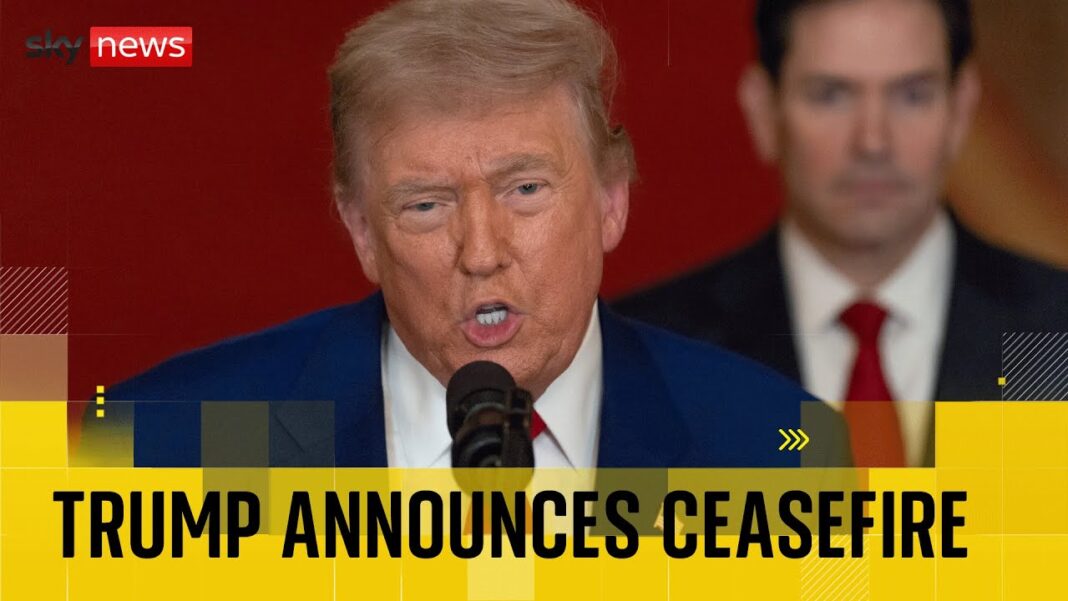
In a dramatic announcement late Monday evening, President Donald Trump proclaimed that Israel and Iran have agreed “in principle” to a ceasefire, signaling what could be the closing chapter of the most direct and perilous confrontation between the two nations in modern history. The declaration, made via Trump’s Truth Social platform, outlines a phased cessation of hostilities that, if implemented, would bring an official end to what he termed the “12-Day War.”
According to a report in The New York Post, which has closely tracked the conflict’s rapid escalation and political ramifications, Trump’s message was characteristically emphatic: “CONGRATULATIONS TO EVERYONE! It has been fully agreed by and between Israel and Iran that there will be a Complete and Total CEASEFIRE (in approximately 6 hours from now…!),” he wrote. The post described a carefully timed framework meant to allow both sides to “complete their in progress, final missions” before hostilities cease in full.
The terms laid out by the former president propose a dual-stage truce:
12:00 a.m. ET Tuesday: Iran begins its ceasefire
12:00 p.m. ET Tuesday: Israel reciprocates
12:00 a.m. ET Wednesday: An official end to hostilities is declared, closing the book on the 12-day conflict
Notably, The New York Post report pointed out that no formal confirmation of these terms has yet been issued by the governments of Israel or Iran. There has also been no corroboration from the Israeli Defense Forces (IDF), Iran’s Islamic Revolutionary Guard Corps, or intermediaries such as Qatar and Oman—nations believed to have played quiet behind-the-scenes roles in brokering temporary de-escalation during the worst days of missile fire.
In a dramatic escalation of tensions in the Gulf, Iran launched a barrage of missiles targeting Al Udeid Air Base in Qatar late Sunday night, prompting swift condemnation from Qatari officials and setting the stage for an intensified regional confrontation. As The Jewish Insider reported, the Qatari Ministry of Foreign Affairs confirmed Monday morning that the country’s air defense systems successfully intercepted the incoming Iranian missiles, averting what could have been a deadly assault on the critical U.S. military installation that serves as the nerve center for American operations in the Middle East.
Majed Al Ansari, the spokesperson for Qatar’s Foreign Ministry, issued a strongly worded statement, describing the missile strike as “a flagrant violation of the sovereignty of the State of Qatar, its airspace, international law, and the United Nations Charter.” Al Ansari added that Qatar “reserves the right to respond directly in a manner equivalent with the nature and scale of this brazen aggression, in line with international law.”
The Jewish Insider report noted that Al Udeid Air Base is not only home to more than 10,000 U.S. troops but also functions as the forward headquarters of U.S. Central Command (CENTCOM). The base had already been on heightened alert, with American aircraft evacuated in the days leading up to the strike following intelligence that a retaliatory Iranian response to recent U.S. strikes on Iran’s nuclear infrastructure was imminent.
According to the information provided in The Jewish Insider report, three Iranian officials familiar with the operation told The New York Times that Tehran had provided advance warning to Qatar ahead of the attack, raising difficult questions for Qatari officials about the nature of that communication and whether Iran sought to avoid civilian casualties or limit the political fallout of striking a U.S. base on allied territory.
In addition to the attempted strike in Qatar, the Ain al-Assad base in Iraq—another facility housing U.S. personnel—was also targeted by Iranian missiles, according to an Iraqi security official speaking to the Associated Press. This dual-pronged strike appears to reflect Iran’s determination to project military strength while testing American resolve in the aftermath of significant blows to its nuclear program.
As The Jewish Insider report detailed, the Qatari government acted swiftly to protect its population, grounding all air traffic and issuing emergency shelter-in-place advisories through the U.S. Embassy in Doha. A written statement from the Ministry of Foreign Affairs clarified: “This is part of a set of precautionary measures taken based on developments in the region,” highlighting the sense of urgency and calculated anticipation that surrounded the days leading up to the Iranian assault.
The White House, meanwhile, remained on high alert. A senior official confirmed to The Jewish Insider that Chairman of the Joint Chiefs of Staff Gen. Dan Caine and Secretary of Defense Pete Hegseth monitored the situation from the Situation Room overnight. President Donald Trump was briefed at 1:00 p.m. ET on the unfolding developments, according to administration sources.
U.S. intelligence officials had reportedly assessed that Iran would attempt some form of retaliatory action within 48 hours of the American strikes on its nuclear facilities in Fordo, Isfahan, and Natanz. A senior administration source told Reuters on Sunday that “a counterstrike was almost inevitable,” and preparations were made to reposition assets and reinforce American diplomatic facilities across the region.
While no casualties were reported due to the effective missile interception by Qatari defenses, the attempted strike has injected a new level of volatility into the already fragile geopolitical calculus of the Middle East. As The Jewish Insider report observed, the attack has forced Qatar—often seen as a diplomatic intermediary between Iran and the West—into a more confrontational posture, one that may have lasting implications for its traditionally cautious regional diplomacy.
The diplomatic repercussions of the strike are still unfolding, but the message from Doha was unmistakably clear: Qatar, while home to one of America’s most strategic military installations, will not tolerate direct assaults on its sovereignty—especially when they risk igniting broader conflict on its soil. “This was not just an attack on a military base,” Al Ansari said in remarks carried by The Jewish Insider. “It was an attack on our national dignity and our international standing.”
In Washington, the attack has galvanized calls for a more assertive stance against Iran’s military provocations. Congressional Republicans swiftly condemned the missile strike and urged the administration to “reestablish deterrence through immediate and proportionate response,” while Democratic lawmakers largely urged caution, emphasizing the need for de-escalation in coordination with Gulf allies.
Published reports said that early signs indicate that the attempted strike may have backfired diplomatically for Tehran, pushing even neutral parties such as Qatar closer to Washington’s strategic orbit.
With both capitals now weighing their next steps, the Gulf remains on edge—and the international community is watching closely to see whether deterrence or escalation will define the next phase of this unfolding conflict.
In related developments, Israel was thrust into another harrowing morning on Monday as air-raid sirens wailed across the country for more than 30 minutes, signaling the launch of a multi-pronged Iranian missile attack that rattled civilians from the northern border with Lebanon to the southern edges of the Negev Desert. According to a report in the Jewish News Syndicate (JNS), the Islamic Republic of Iran launched at least four volleys of ballistic missiles—totaling approximately 15 projectiles—targeting both civilian and strategic sites in Israel.
The Israel Defense Forces (IDF) confirmed the detection of four distinct barrages, each composed of several missiles launched in rapid succession. While the bulk of the projectiles were intercepted by Israel’s advanced air defense systems, five impact sites were confirmed by midday, sparking fires and temporary infrastructure disruptions but—miraculously—resulting in no immediate loss of life.
As JNS reported, one missile struck open terrain near the northern city of Safed in the Upper Galilee, where firefighting units battled a blaze triggered by the explosion. Another projectile impacted an open area near the coastal city of Ashdod, narrowly avoiding densely populated neighborhoods. The Israel Electric Corporation reported that a “strategic facility” in the south sustained damage, leaving around 8,000 residents temporarily without power. Energy and Infrastructure Minister Eli Cohen assured the public that electricity would be restored swiftly, a promise fulfilled by late morning as JNS confirmed that power had returned to all affected households.
In an alarming sign of the attack’s reach, sirens echoed from the borders of Gaza to Lebanon and throughout central Israel, including the greater Tel Aviv area. “Millions of Israelis were jolted from sleep around 3 a.m. as sirens pierced the quiet night,” JNS reported, detailing the psychological strain of sustained alerts and the stampede-like rush to fortified shelters.
A single Iranian missile targeting central Israel was successfully intercepted by Israeli air defenses. Though no physical injuries were reported, Magen David Adom (MDA) stated that numerous individuals required treatment for anxiety, with some sustaining minor injuries while racing to secure shelter. “There were no direct impacts or casualties, except for cases of anxiety and people who were injured on their way to a protected area,” said MDA spokesperson Zaki Heller.
Just hours after the barrages, the Israeli Air Force responded with a decisive counteroffensive, launching a series of strikes on regime targets deep within Tehran. The retaliatory air raids emphasize the growing intensity of “Operation Rising Lion,” Israel’s ongoing military campaign aimed at degrading Iran’s missile infrastructure and its ability to support proxy militias in Lebanon, Syria, and beyond.
As the report at JNS highlighted, Monday’s attacks were just the latest episode in a broader pattern of aggression that has taken a severe toll on Israeli civilians. Since the onset of “Operation Rising Lion” on June 13, Iran has launched more than 950 missiles and drones at Israel. According to IDF statistics obtained by JNS, these attacks have resulted in 24 Israeli deaths, 1,217 injuries, and the evacuation of 8,190 civilians from conflict zones. The material toll is equally staggering, with 25,040 incidents of building damage and 5,629 cases of destruction to vehicles and other personal property reported thus far.
The psychological impact on the Israeli population cannot be overstated. As the JNS report noted in interviews with emergency responders and local officials, “The continued missile salvos, while largely thwarted by the Iron Dome and David’s Sling systems, are inducing widespread trauma, particularly among children and the elderly, many of whom have endured sleepless nights and relentless anxiety.”
Compounding the complexity of the situation was a drone incident reported roughly two and a half hours after the morning missile attacks. According to the IDF, an unmanned aerial vehicle was intercepted before crossing into Israeli territory near Eilat. As per military protocol, no sirens were activated, but the attempted infiltration underscores the persistent aerial threat posed by Iranian forces and their regional proxies.
The timing of this latest attack appears calculated. As JNS has noted in previous reporting, Iranian leadership has sought to escalate hostilities incrementally in response to the significant damage inflicted by Israel on its nuclear and military infrastructure in recent weeks. Monday’s strikes mark an escalation in both intensity and symbolism, suggesting a shift from proxy warfare to more direct, state-on-state confrontation.
Diplomatic ramifications are expected to follow swiftly. Prime Minister Benjamin Netanyahu convened his security cabinet in the aftermath of the attacks, with sources telling JNS that Israel “reserves the right to expand its operations and strike decisively at the heart of Iranian missile development facilities.”
Meanwhile, calls for international condemnation of Iran’s actions have intensified. “The Iranian regime has crossed a red line,” said a senior Israeli official quoted by JNS. “No nation can remain silent when ballistic missiles rain down on civilian populations.”
As the world watches, Israel braces for the next wave—whether in the form of missiles, drones, or cyber warfare. With regional tension at a boiling point and thousands of Israeli families living under constant threat, the defense establishment remains in a heightened state of alert.
In one of the most audacious operations in recent Middle East history, Israeli fighter jets launched a series of surgical airstrikes deep inside Tehran early Monday, targeting the most sensitive assets of the Islamic Republic of Iran. As The Times of Israel reported, the strikes delivered a multifaceted blow not only to Iran’s military infrastructure but also to its ideological and political symbols, escalating what many now describe as a direct war between Israel and Iran.
According to the IDF, over 50 Israeli Air Force (IAF) jets participated in the operation, dropping more than 100 munitions within a two-hour window. The military described the air campaign as “extensive,” with a strategic aim of undermining the Iranian regime’s ability to wage war, suppress internal dissent, and maintain regional influence.
The Times of Israel report detailed that among the primary targets were the headquarters of the Islamic Revolutionary Guard Corps (IRGC), Iran’s all-powerful security and military force, and its internal security apparatus. The IDF confirmed it had struck the Thar-Allah and Sayyid al-Shuhada Corps — elite units tasked with defending Tehran from both external threats and internal uprisings. The Thar-Allah Headquarters, in particular, is known for orchestrating crackdowns on anti-regime protests and coordinating surveillance across the capital.
The Basij militia’s headquarters, also targeted in the strikes, represents a central pillar of the IRGC’s domestic control strategy. Known for its role in enforcing Iran’s Islamic code and informing on citizens, the Basij has been pivotal in stifling political dissent since the 2009 Green Movement and more recently during the 2022–2023 anti-hijab demonstrations.
In addition, The Times of Israel report confirmed strikes on the Alborz Corps — a regional command responsible for guarding key cities in Tehran Province — and on Iran’s internal security forces’ intelligence and general security branches. The IDF emphasized that these institutions were not only vital to Iran’s military operations but also deeply embedded in preserving regime control.
One of the most symbolically potent strikes was against the infamous Evin Prison, a site long condemned by human rights organizations for systemic torture, arbitrary detention, and the incarceration of political prisoners, journalists, and foreign nationals. Defense Minister Israel Katz stated that the gate of Evin was deliberately targeted in an apparent attempt to enable political prisoners to escape — though the IDF has not formally confirmed this detail.
Iranian state media released surveillance footage showing a direct hit near the entrance, while the judiciary acknowledged that parts of the facility had sustained damage. The Times of Israel reported that there were no immediate injuries to detainees, but the strike sowed confusion and fear among families of those imprisoned, particularly foreign nationals held on dubious charges.
One such case involves Cecile Kohler and Jacques Paris, two French citizens detained since May 2022 on accusations of espionage. Noemie Kohler, Cecile’s sister, told French media the strike was “irresponsible” and feared for the pair’s safety. “We have no news… we’re panicking,” she said, underscoring the delicate intersection of military action and international diplomacy.
In a striking act of ideological defiance, the Israeli Air Force also targeted and destroyed the so-called “Destruction of Israel” countdown clock, located in Tehran’s Palestine Square. Unveiled in 2017, the massive digital installation counted down to the year 2040 — the date Supreme Leader Ayatollah Ali Khamenei predicted Israel would cease to exist. The Times of Israel report called the strike “highly symbolic,” erasing what many Israelis view as a monument to genocidal intent.
In tandem with the attacks on regime symbols and security forces, Israeli jets also bombed roads leading to Iran’s underground Fordo nuclear facility. The IDF explained that these strikes were meant to “disrupt” access following U.S. bombings of the same facility over the weekend. The operation suggests close coordination between Israel and the United States, particularly as both nations escalate efforts to neutralize Iran’s nuclear capabilities.
 -->>Though Israel has insisted its campaign is defensive in nature — aimed at protecting its civilian population from Iranian aggression — The Times of Israel report noted a widening scope in the list of targets. What began as a military campaign focused on nuclear scientists, missile arsenals, and IRGC infrastructure has now expanded to include state-run media, ideological monuments, and domestic surveillance hubs. This has fueled growing speculation that Israel may now be pursuing regime destabilization or, at the very least, seeking to fracture Khamenei’s hold on power.
Defense Minister Katz made no effort to mask the strategic clarity of Israel’s intent: “For every rocket fired at the Israeli home front, the Iranian dictator will be severely punished,” he said. “The strikes will continue with full intensity. We will continue to act to defend the home front and defeat the enemy until all war objectives are achieved.”
While Iran has vowed to retaliate, the depth and precision of the Israeli air campaign — reported by The Times of Israel — suggest a level of operational dominance that may give Tehran pause. Still, the danger of miscalculation and the risk of a broader regional conflict remain high, with Hezbollah, the Houthis, and Iran-backed militias in Iraq all potential flashpoints for secondary escalation.
President Trump on Sunday raised the prospect of regime change in Iran in the wake of what he described as a “monumental” U.S. military operation against the Islamic Republic’s nuclear infrastructure, suggesting that Tehran’s leadership may soon face a critical reckoning. As Fox News reported on Monday, the comments came less than 24 hours after B-2 stealth bombers executed precision strikes on key Iranian nuclear facilities, in what military officials and administration insiders have described as a major strategic success.
In a series of posts to his Truth Social platform, the president hailed the return of the elite bomber crews, praised the accuracy of the mission, and implied that if the current regime in Tehran cannot restore the nation’s status, a leadership change may be warranted. “It’s not politically correct to use the term, ‘Regime Change,’ but if the current Iranian Regime is unable to MAKE IRAN GREAT AGAIN, why wouldn’t there be a Regime change???” Trump posted. He punctuated the remark with a slogan that quickly began trending among his supporters: “MIGA!!!”
As Fox News has reported, Saturday’s strikes targeted Iran’s critical nuclear enrichment infrastructure, including key facilities near Natanz and Fordo. Intelligence analysts told Fox News the operation was designed to both degrade Iran’s ability to enrich uranium and to send a message of deterrence to the regime following weeks of escalating missile attacks on U.S. and Israeli interests.
The mission, which involved the deployment of multiple B-2 Spirit bombers from Whiteman Air Force Base in Missouri, was carried out with pinpoint accuracy, according to senior defense officials cited by Fox News. Trump confirmed the aircraft had safely returned to U.S. soil, writing: “The GREAT B-2 pilots have just landed, safely, in Missouri. Thank you for a job well done!!! DONALD J. TRUMP, PRESIDENT OF THE UNITED STATES!”
In a follow-up post, the president dismissed skepticism about the efficacy of the strikes. “The damage to the nuclear sites in Iran is said to be ‘monumental,’” Trump declared. “The hits were hard and accurate. Great skill was shown by our military. Thank you!”
Military sources who spoke to Fox News on background corroborated the president’s assessment, noting that the strikes had significantly set back Iran’s centrifuge operations and resulted in “crippling” delays to its uranium enrichment timeline. Pentagon officials emphasized that no U.S. personnel were injured in the operation, and no aircraft were lost.
The political implications of Trump’s statements are already reverberating through Washington and Tehran alike. As the Fox News analysis indicated, Trump’s open flirtation with the notion of regime change is likely to provoke fierce reactions not only from Iran’s leadership, but also from global powers that have long warned against U.S.-led efforts to destabilize sovereign governments.
Still, for many within the administration and among Trump’s national security allies, the calculus is changing. One senior White House official told Fox News that “Iran’s escalating aggression, paired with its pursuit of nuclear weapons, has made containment strategies obsolete. The president is right to raise fundamental questions about the regime’s future.”
Iran’s response thus far has been predictably defiant. State-run media downplayed the damage, even as foreign satellite imagery confirmed significant destruction at key facilities. Tehran vowed retaliation, though its military capacity—already diminished by sanctions and internal unrest—has shown signs of strain. Fox News defense analysts noted that Iranian air defenses failed to prevent the U.S. strike, a fact likely to fuel domestic criticism of the regime’s military readiness.
Meanwhile, Trump’s remarks are galvanizing his political base at home. The “MIGA” slogan—Make Iran Great Again—has been adopted by conservative influencers online, echoing the administration’s message that Iran’s suffering stems not from foreign pressure but from a regime that has squandered its national potential.

Trump has been crowing about a breakthrough, which has not occurred.