



|
Getting your Trinity Audio player ready...
|
By: Fern Sidman
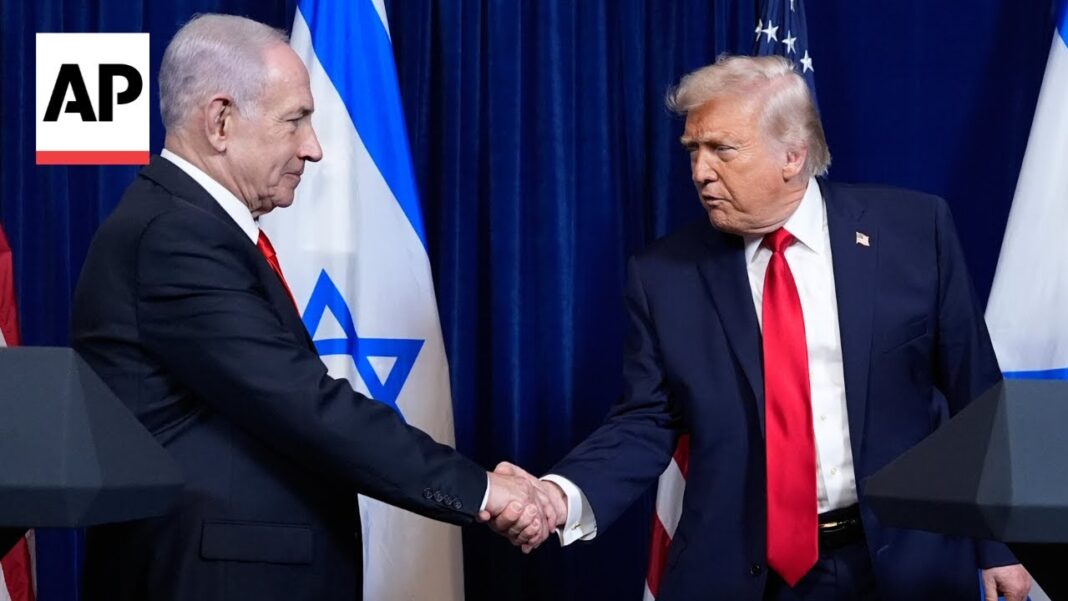
In a gesture freighted with symbolism and certain to reverberate far beyond the ceremonial halls of Jerusalem, Israel’s minister of education, Yoav Kisch, has formally extended an invitation to President Donald Trump to attend the Israel Prize Award Ceremony on April 22, where he is slated to receive the nation’s highest civic honor for what Israeli leaders have termed a lifetime of “unique contribution to the State of Israel and the Jewish people.” The development marks a historic departure from the traditions that have governed the Israel Prize since its inception, inaugurating, for the first time, the conferral of the award upon a foreign head of state.
According to a report that appeared on Thursday at The Jewish News Syndicate (JNS), Minister Kisch confirmed on Tuesday evening that he had transmitted a formal letter of invitation to the American president, a missive whose language sought to elevate the moment beyond protocol into the realm of moral and historical theater. In a public post accompanying the letter, Kisch described the invitation as an expression of national gratitude and an emblem of the deep and enduring bond between Jerusalem and Washington. JNS reported that Kisch characterized the decision to bestow the Israel Prize upon Trump as “historic,” emphasizing that it was intended to recognize an “extraordinary contribution and its lasting impact on the Jewish people in Israel and around the world.”
The Israel Prize, administered under the aegis of the Ministry of Education, is traditionally awarded annually on Israel’s Independence Day, itself a ritualized commemoration of statehood that intertwines civic pride with the solemn memory of national sacrifice. The ceremony this year will coincide with the celebrations marking Israel’s 78th Independence Day, drawing together President Isaac Herzog, Prime Minister Benjamin Netanyahu, senior government officials, leaders from across Israeli society, and what organizers have described as distinguished guests from abroad. Within this carefully choreographed tableau of national affirmation, the anticipated presence of a sitting American president introduces an element of geopolitical theater that is both unprecedented and laden with interpretive complexity.
The formal announcement of Trump’s selection for the prize had been made weeks earlier, on Dec. 29, when Prime Minister Netanyahu publicly declared that the U.S. leader would receive the Israel Prize in the category of “Unique Contribution to the Jewish People.” The JNS report underscored the novelty of the decision, pointing out that no foreign leader has previously been honored in this manner. The designation of a special category for Trump, one that explicitly frames the award as recognition of his relationship to the Jewish people rather than solely to the Israeli state, signals a deliberate broadening of the prize’s symbolic horizon.
In his letter Kisch adopted a tone at once formal and effusive. He wrote that Trump’s presence in Jerusalem to personally receive the prize would constitute “a moment of profound significance for the people of Israel and a powerful expression of the deep and enduring friendship between our two nations.” The phrasing, as reported by JNS, situates the ceremony not merely as a domestic honorific event but as a diplomatic spectacle, one that seeks to dramatize the intimacy of the bilateral relationship through the performative act of public recognition.
The decision to extend the Israel Prize to a foreign leader inevitably invites reflection upon the evolving meaning of national honors in an era of hyper-mediated politics. The JNS report framed the move as a conscious recalibration of the prize’s scope, transforming it from a primarily inward-looking celebration of Israeli intellectual, cultural, and civic achievement into a platform for articulating Israel’s global alliances. For decades, the Israel Prize has functioned as a mirror held up to Israeli society, reflecting back its most esteemed contributions in science, literature, education, and public service. The inclusion of Trump, a figure whose political career unfolded primarily on the global stage, refracts that mirror outward, projecting Israel’s narrative of gratitude and affinity into the international arena.
Supporters of the decision have emphasized the language of recognition and historical continuity. By honoring Trump for what Israeli leaders describe as his extraordinary and lasting impact upon the Jewish people, the government situates the award within a broader story of diasporic interconnectedness. The prize, in this telling, becomes not merely an instrument of domestic accolade but a bridge between Israel and Jewish communities worldwide, mediated through the actions of a foreign statesman whose policies were perceived in Jerusalem as aligning with Israeli interests and Jewish concerns.
At the same time, the move carries with it an undeniable element of political theater. The JNS report noted that the invitation to Trump, extended publicly and with considerable rhetorical flourish, operates on multiple registers. It is, on one level, a ceremonial courtesy extended by one sovereign state to the leader of another. On another, it is a statement of values, an attempt to inscribe a particular interpretation of recent history into the symbolic canon of the Israeli state. The Israel Prize, long regarded as an apolitical recognition of excellence, is here mobilized as a vehicle for diplomatic messaging, its gravitas harnessed to articulate a narrative of alliance and mutual regard.
The context of the ceremony itself further amplifies the significance of the invitation. Israel’s Independence Day, with its dense layering of patriotic ritual, collective memory, and forward-looking aspiration, provides a potent backdrop for such a gesture. The JNS report has described the annual celebrations as moments when the state seeks to narrate itself to its citizens and to the world, weaving together past struggle and present sovereignty into a coherent national story. To introduce into that narrative the figure of a foreign president, elevated to the status of Israel Prize laureate, is to embed an external actor within the internal dramaturgy of Israeli statehood.
President Isaac Herzog’s attendance, alongside Prime Minister Netanyahu and other senior officials, further situates the ceremony at the intersection of Israel’s constitutional symbolism and its executive authority. JNS has reported that the presence of leaders from across Israeli society, as well as distinguished guests from abroad, will transform the event into a kind of civic convocation, a gathering in which the boundaries between domestic celebration and international diplomacy blur. In such a setting, the act of awarding the Israel Prize to Trump assumes a performative dimension, staging a tableau of friendship that is meant to be witnessed, interpreted, and, perhaps, internalized by diverse audiences.
The rhetoric employed by Minister Kisch in his public statements is telling in its emphasis on profundity and honor. By framing Trump’s potential attendance as a moment of “profound significance,” Kisch elevates the ceremony beyond the routine rhythms of state protocol, casting it as a symbolic apex in the narrative of U.S.-Israel relations. The letter’s closing appeal, in which Kisch writes that he would be “deeply honored” were Trump to accept the invitation on behalf of the government and the citizens of Israel, seeks to fuse personal sentiment with national voice, a rhetorical maneuver that transforms an individual act of diplomacy into a collective gesture of gratitude.
Yet the conferral of such a singular honor upon a foreign leader also raises questions about the future orientation of the Israel Prize itself. The JNS report has alluded to the precedent-setting nature of the decision, suggesting that it may recalibrate expectations around who can be deemed a worthy recipient of the state’s highest accolade. If the prize is no longer exclusively reserved for Israeli citizens or for figures whose contributions are rooted in domestic spheres of endeavor, its symbolic function may evolve, becoming a more explicitly diplomatic instrument. Such a transformation would not necessarily diminish the prize’s prestige, but it would alter the grammar of honor through which the state articulates its values and allegiances.
In the weeks leading up to the April 22 ceremony, Jerusalem is poised to become the stage for a moment that intertwines ritual, recognition, and realpolitik. The JNS report underscored the layered meanings embedded in the invitation extended by Minister Kisch. It is at once a gesture of gratitude, a declaration of friendship, and a reimagining of a venerable national institution’s role in the choreography of international relations. Whether President Trump ultimately accepts the invitation to stand in Jerusalem and receive the Israel Prize in person, the act of extending the honor has already inscribed itself into the annals of Israeli ceremonial life, marking a moment when the laurel of national esteem was deliberately cast across continents, seeking to bind history, politics, and symbolism into a single, resonant tableau.