



|
Getting your Trinity Audio player ready...
|
By: Abe Wertenheim
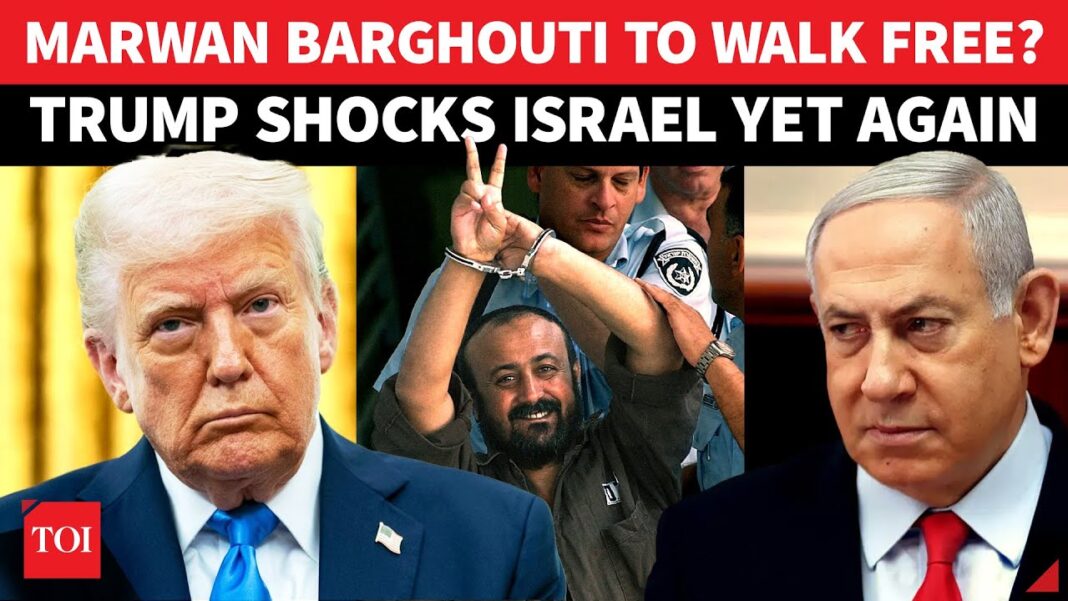
In a move that could reshape Palestinian politics and test the boundaries of U.S.-Israel diplomacy, President Donald Trump has suggested he may call on Israel to release Marwan Barghouti, the imprisoned Fatah leader widely regarded as the most popular and potentially unifying figure among Palestinians.
As VIN News reported on Thursday, Trump’s remarks came during an interview with Time magazine published Thursday, in which he confirmed that the White House is actively discussing Barghouti’s future. “I was literally being confronted with that question about 15 minutes before you called,” Trump said when asked about Barghouti’s possible release. “So I’ll be making a decision.”
While the White House declined to comment further on Trump’s deliberations, the president’s acknowledgment marks the first time an American administration has publicly weighed the idea of freeing Barghouti — a move that could signal Washington’s growing desire to fill the leadership vacuum in postwar Gaza and to position a credible Palestinian authority to govern once Hamas is removed from power.
Barghouti, now 66, has been imprisoned in Israel since 2002. Once a rising star in the Fatah movement, he led its operations in Judea and Samaria, during the Second Intifada, the Palestinian uprising that erupted in 2000. In 2004, he was convicted of involvement in attacks that killed five Israelis and sentenced to five life terms. Israel has consistently branded him a terrorist, while many Palestinians see him as a freedom fighter and the symbolic embodiment of resistance under occupation.
According to the information provided in the VIN News report, Barghouti’s name carries deep resonance across Palestinian society. He remains the only Palestinian leader with cross-factional appeal, commanding loyalty from both Fatah and, to some degree, Hamas sympathizers. His political stature — untainted by the corruption scandals that have plagued Palestinian Authority (PA) President Mahmoud Abbas — has made him the most popular Palestinian leader in every major opinion poll for more than a decade.
To his supporters, Barghouti represents both steadfastness and pragmatism: a man who, despite endorsing “armed resistance” during the Intifada, has repeatedly expressed support for a two-state solution. “He is both the man of the gun and the man of peace,” one Palestinian political analyst told VIN News, calling Barghouti “the only figure who can bridge the divide between resistance and diplomacy.”
Barghouti’s supporters often draw parallels between his imprisonment and that of Nelson Mandela, the South African anti-apartheid leader who spent 27 years in prison before leading his country to democracy. Like Mandela, Barghouti has refused to recognize the authority of the court that sentenced him, arguing that Israel’s occupation invalidated its jurisdiction.
His refusal to mount a defense was a political act in itself — one that elevated his standing among Palestinians and abroad. “Barghouti’s cell has become his podium,” a Middle East expert told VIN News. “He has managed to turn imprisonment into political immortality.”
That comparison, however, strikes a nerve in Israel. Many Israelis — including families of terror victims — reject any moral equivalence between Mandela’s fight against apartheid and Barghouti’s role in a violent uprising that killed hundreds. To them, his release would not symbolize reconciliation but the rehabilitation of a convicted murderer.
As the VIN News report noted, Barghouti’s name did not appear on the list of prisoners Israel agreed to release this month as part of the U.S.-brokered Gaza ceasefire and hostage exchange deal. That omission was deliberate.
Israeli officials see Barghouti as uniquely dangerous — not because of his violence, but because of his legitimacy. “Israel fears Barghouti not as a fighter, but as a politician,” an Israeli security analyst told VIN News. “He has the credibility to unify the Palestinian street. If he returns, he could eclipse Abbas, and perhaps even resurrect Fatah in a way that would challenge Israel diplomatically.”
Within Washington, however, Trump’s team appears to view Barghouti differently. As the administration explores frameworks for Gaza’s postwar governance, the president and his advisers are said to be weighing how to empower “credible Palestinian actors” capable of rebuilding civil institutions while rejecting Hamas’s rule.
“Trump is a dealmaker,” said one senior aide quoted by VIN News. “He believes in using leverage — even controversial leverage — to build stability. If Barghouti could be part of that solution, it’s something that has to be considered.”
Still, the idea faces formidable opposition. Israel’s Prime Minister Benjamin Netanyahu has made clear that Jerusalem will not release “convicted terrorists,” and Israeli officials privately warn that Barghouti’s return to political life could ignite unrest among victims’ families and right-wing factions.
The Palestinian Authority (PA), led by the 88-year-old Mahmoud Abbas, is in a state of decline. Widely viewed as corrupt, ineffective, and out of touch, Abbas’s administration has lost much of its legitimacy — especially among younger Palestinians who see it as a subcontractor of Israel’s occupation rather than a path to independence.
According to polling cited in the VIN News report, Barghouti remains the only Fatah figure capable of winning an election against Hamas. His popularity stems from his credibility as a man who has suffered for the cause but remains committed to coexistence. “If Abbas is seen as the politician of Oslo,” one observer told VIN News, “Barghouti is seen as the politician of the people.”
That distinction matters greatly in Gaza, where reconstruction and political legitimacy must go hand in hand. Washington’s current challenge is to identify leadership that is both trusted by Palestinians and acceptable to Israel — a balance few can strike.
For Trump, the potential call for Barghouti’s release could serve multiple strategic aims. It might appeal to Arab states invested in Gaza’s reconstruction, such as Egypt and Qatar, who have long sought a unifying Palestinian leadership. It could also showcase Trump’s diplomatic audacity, reinforcing his image as the president capable of doing what his predecessors would not.
As the VIN News report pointed out, Trump has previously defied conventional boundaries in Middle East diplomacy — most notably with the Abraham Accords, which normalized Israel’s relations with several Arab states. His willingness to take political risks could extend to testing whether Barghouti, despite his past, can become part of a new regional equation.
But the move carries immense risks. Any U.S. push to release Barghouti would ignite backlash in Israel and among victims’ groups. It could also fracture Trump’s domestic coalition, alienating pro-Israel voters who view Barghouti as complicit in terrorism.
“Barghouti’s release would be the boldest gamble in Trump’s Middle East strategy yet,” VIN News commented in its analysis. “It would test Israel’s trust, the Palestinian street’s patience, and the world’s readiness to accept a convicted killer as a future statesman.”
While Trump weighs his decision, Vice President JD Vance is already sketching the outlines of Gaza’s postwar recovery. Speaking from Tel Aviv at the end of a three-day visit, Vance told reporters that reconstruction in areas cleared of Hamas could begin soon.
“We could start reconstruction of the areas that are free of Hamas very quickly,” Vance said, as reported by VIN News. “We think that we could potentially get hundreds of thousands of Gazans living in that area very quickly. But again, this is all still pretty early.”
That vision — rebuilding Gaza while keeping Hamas out — hinges on a credible local leadership. U.S. officials understand that reconstruction without political legitimacy will be unsustainable. Barghouti’s supporters argue that only he can fill that vacuum. His detractors counter that reviving a figure convicted of killing Israelis would make peace impossible.
Barghouti’s story remains deeply polarizing: to some, he is the imprisoned patriot capable of healing a fractured nation; to others, he is a remorseless architect of terror. His dual legacy — of armed struggle and peacemaking rhetoric — reflects the contradictions at the heart of the Palestinian cause.
As the VIN News report observed, the question of Barghouti’s release is not merely about one man but about the future architecture of Palestinian politics. Whether Gaza’s postwar order can balance justice with reconciliation will determine not just the fate of the territory but the broader prospects for peace in the region.
For now, Trump’s deliberations add a new layer of unpredictability to an already complex equation. A single decision — to advocate Barghouti’s freedom or not — could reverberate from Jerusalem to Washington, from the rubble of Gaza to the corridors of the Knesset.
The president is no stranger to bold, headline-grabbing moves. But as VIN News cautioned, this one may be the most consequential of his Middle East presidency.
In the end, the calculus may not rest solely on diplomacy, but on history — on whether the man once seen as a symbol of Palestinian defiance can be reimagined as the architect of a future peace.

If Barghouti killed Trump’s family he would feel very differently. No murderer should knowingly be promoted to leader, especially of a murderous population. Does Trump think the decades in prison improved him? What a joke.
Screw Trump. He is turning out to be an enemy of Israel.