



|
Getting your Trinity Audio player ready...
|
By: Fern Sidman
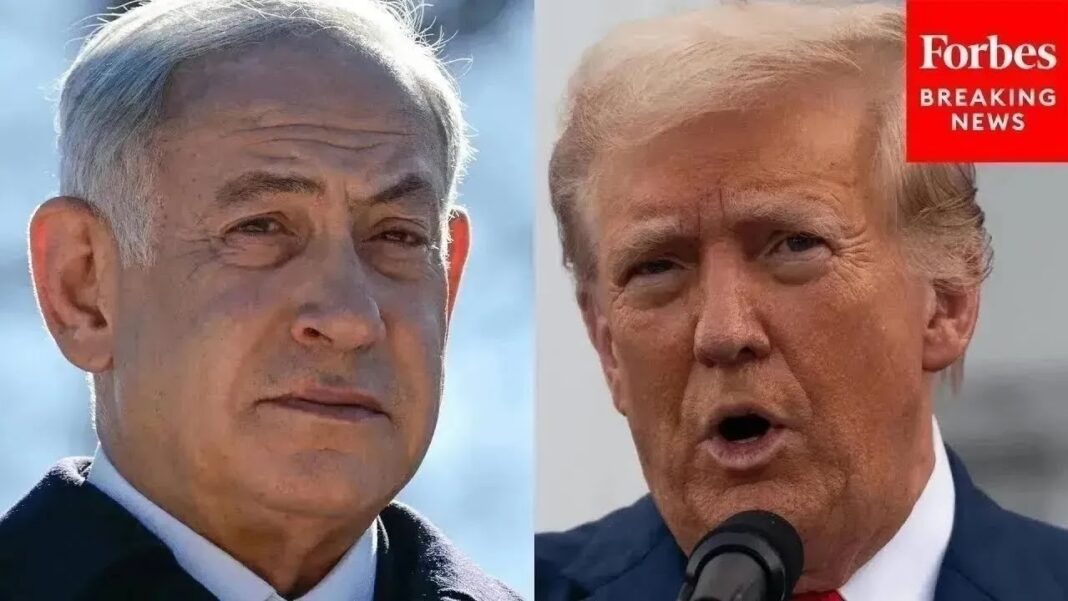
President Donald Trump on Monday sought to dispel growing speculation that he had been personally notified by Israeli Prime Minister Benjamin Netanyahu of Israel’s recent airstrike in Doha, Qatar, which targeted a gathering of senior Hamas figures. The clarification came amid conflicting reports from American and Israeli media outlets that had suggested the U.S. president may have been aware of the strike in advance.
Speaking to reporters in the Oval Office, Trump issued an unequivocal denial. “No, no he didn’t,” the president said when asked if Netanyahu had personally informed him of the operation. “I learned about the attacks through the news reports, the same way you did.” His statement directly contradicted a claim published by Axios last week, which cited anonymous officials who alleged Netanyahu had tipped off Trump approximately 50 minutes before Israeli warplanes unleashed ballistic missiles on a Hamas politburo meeting in Doha.
According to a report that appeared on Tuesday on World Israel News (WIN), the dispute underscores the sensitive diplomatic terrain between Israel, the United States, and Qatar — a country that simultaneously hosts U.S. military bases and serves as a key financial and political backer of Hamas.
Axios initially reported that Netanyahu had briefed Trump shortly before the missiles were fired, prompting the U.S. president to instruct his special Middle East envoy, Steve Witkoff, to caution Doha about the impending strike. Yet, according to the information provided in the World Israel News report, Qatari officials maintain they received no warning until nearly 10 minutes after the missiles had already struck.
The Wall Street Journal offered another version, reporting that while Israel did inform the United States of the attack, the notice came only after the strike was underway. The report stressed there was no evidence Netanyahu personally communicated the information to Trump. Instead, U.S. space-based infrared sensors tracked the missile launches, allowing the Pentagon to determine the trajectory and conclude the target was in Doha.
The tangled accounts reflect both the secrecy and urgency surrounding Israel’s strike, as well as the political stakes for Washington. By denying early knowledge, Trump distances himself from potential diplomatic fallout with Qatar, a nation whose cooperation remains critical for U.S. operations in the Gulf.
From Jerusalem’s perspective, the Doha strike marked a bold expansion of the war against Hamas. Long believed to be directing operations from the relative safety of Qatar, Hamas’s politburo leadership had until now evaded direct Israeli strikes. According to the information contained in the World Israel News report, the decision to hit a target in Doha was rooted in the conviction that Hamas cannot be dismantled militarily unless its overseas leadership is also placed under existential threat.
Six people were killed in the strike, including the son of a senior Hamas official, his office manager, and three bodyguards. Hamas quickly condemned the attack, labeling it a violation of Qatari sovereignty, while Doha lodged formal complaints with Washington and other Western capitals.
Two senior Israeli officials, speaking to Axios, claimed the U.S. had indeed been consulted on the matter, though Trump never moved to block the plan. “If Trump had wanted to stop it, he could have,” one official said. “In practice, he didn’t.”
For his part, Trump has sought to portray the incident as a singular occurrence. He assured reporters that Israel’s strike on Qatar was a “one-off” and insisted that Netanyahu “won’t be hitting Qatar again.” The remarks, carried by World Israel News, appeared designed to soothe tensions with Doha while reaffirming American support for Israel’s broader campaign against Hamas.
For Netanyahu, the strike was not only a military gamble but also a political one. According to the information in the WIN report, Israel’s leader has been under mounting pressure to deliver decisive blows against Hamas leadership after months of grinding conflict in Gaza. By expanding the battlefield to Doha, Netanyahu signaled that no safe haven would remain for the group’s senior commanders.
Yet the operation also risked alienating Qatar, one of the few countries still serving as a mediator in hostage negotiations and ceasefire discussions. Critics argue that hitting a Hamas target in Doha could complicate those diplomatic channels, potentially reducing the already narrow chances of securing the release of Israeli captives held in Gaza.
For Washington, the timing of the strike could not have been more delicate. Qatar hosts Al-Udeid Air Base, the largest U.S. military installation in the Middle East, and is regarded as a key logistical hub for American operations across the region. At the same time, it has long been accused of bankrolling Hamas and providing the group’s leadership with political cover. Qatar also invests billions of dollars each year to fund a significant segment of US universities with the goal of indoctrinating youth against Israel and American support of The Jewish State.
By insisting he learned of the strike only after the fact, Trump sought to preserve this fragile balance, emphasizing that the United States had not been complicit in an Israeli attack on Qatari soil. The report at World Israel News noted that Trump’s denial reflects an effort to manage competing imperatives: unwavering support for Israel’s campaign against Hamas, while maintaining functional ties with Doha.
While Trump’s denial may alleviate some diplomatic pressure, the episode has highlighted the growing complexities of Israel’s regional war against Hamas. If Jerusalem continues to target Hamas leadership outside of Gaza, further international complications are inevitable. Qatar, Turkey, and even some European governments have hosted Hamas officials over the years, raising the possibility of additional Israeli operations beyond traditional theaters of war.
For Netanyahu, the question is whether the Doha strike will meaningfully weaken Hamas or simply harden its resolve. According to the report at World Israel News, Israel views the removal of external leadership as a necessary precondition for dismantling Hamas’s command-and-control structure. Without targeting those abroad, Israeli officials argue, the group will continue to orchestrate attacks and resist ceasefire terms.
For Trump, the challenge lies in navigating the political optics. With midterm elections looming, he faces scrutiny over his handling of foreign policy, especially in the volatile Middle East. Aligning too closely with Netanyahu risks antagonizing Qatar, while distancing himself risks alienating pro-Israel constituencies.
The Doha strike, and the swirling narratives about who knew what and when, illustrates the high-stakes diplomacy at play in the Middle East. By denying early knowledge of the attack, Trump has positioned himself as both a steadfast ally of Israel and a pragmatic guardian of U.S.-Qatari relations. For Netanyahu, the gamble reflects an unwavering determination to dismantle Hamas, even if it means expanding the battlefield beyond Gaza.
As the World Israel News report has highlighted, the strike signals that Israel’s war against Hamas has entered a new phase — one that could reverberate far beyond the borders of Gaza. Whether it succeeds in weakening Hamas or inflames regional tensions further, one fact is clear: both Washington and Jerusalem are walking a delicate line, where every decision carries the potential to reshape the conflict’s trajectory.
