



|
Getting your Trinity Audio player ready...
|
By: Fern Sidman – Jewish Voice News
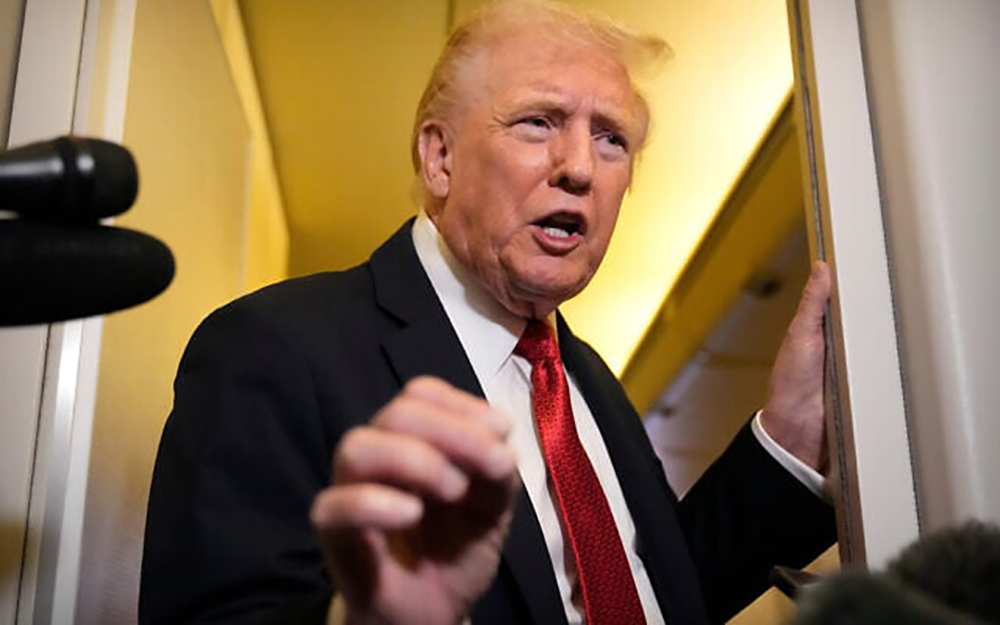
President Donald Trump confirmed Thursday that an international stability force would be deployed to the Gaza Strip “very soon,” calling the developing plan a milestone in his broader vision for a lasting peace in the Middle East. His remarks, which were reported by Israel National News, signal that the United States and its partners are preparing to implement one of the most consequential postwar arrangements since the October 7, 2023 Hamas atrocities that plunged the region into chaos.
Responding to a reporter’s question about when the multinational mission would begin operations, Trump said, “Very soon. It’s going to be very soon. Gaza is working out very well.” His confident tone reflected what the Israel National News report described as the culmination of months of complex diplomatic maneuvering involving Arab, European, and Asian partners, all coordinated through Washington to stabilize the war-torn enclave and prevent the resurgence of Hamas.
Trump went on to elaborate on the scope of the new arrangement, suggesting that several countries had already “volunteered” to contribute troops and logistical support to the force. “If there’s a problem with Hamas, as an example, or a problem with anything, they volunteer to, on a single basis, go in and take care of it,” he said.
“This is a very strong peace,” the president continued. “This is peace in the Middle East.” He then issued a pointed warning to Hamas: “Hamas is a very small part of it. And if they don’t do as they said, if they don’t behave, then they’ve got themselves a big problem — a really big problem like they’ve never had.”
According to the information provided in the Israel National News report, Trump’s statement drew attention to his administration’s insistence that the new Gaza framework must combine humanitarian reconstruction with robust deterrence. The international stability force — envisioned as a hybrid peacekeeping and administrative coalition — will be tasked not only with securing Gaza but also with reestablishing governance, rebuilding essential infrastructure, and preventing Iranian-backed militias from filling the vacuum left by Hamas’s defeat.
Earlier this week, the United States circulated a draft resolution to key members of the United Nations Security Council proposing the creation of the Gaza stabilization mission for a minimum of two years. The text, first reported by Axios and later corroborated by Israel National News, lays out a broad mandate for participating nations — led by the United States — to provide both security and civilian administration through the end of 2027, with the possibility of extensions if conditions on the ground require.
Diplomatic sources cited in the Israel National News report described the draft as a “U.S.-brokered framework for responsible governance” aimed at preventing Gaza from reverting to militant control. The mission’s initial participants are expected to include regional states aligned with the Abraham Accords, as well as European nations with existing peacekeeping experience in Lebanon and the Sinai Peninsula.
The proposal’s contours reflect what observers have called “the Trump Doctrine 2.0” — a pragmatic but muscular approach to Middle Eastern diplomacy built on regional partnerships rather than unilateral U.S. occupation. Trump’s team has reportedly emphasized that the Gaza plan is not an open-ended commitment but a transitional security and reconstruction initiative, designed to empower local civil authorities under international supervision while ensuring Israel’s security needs remain paramount.
Under the U.S.-brokered ceasefire agreement, Hamas was obligated to release all hostages within 72 hours in exchange for a phased cessation of hostilities and humanitarian aid corridors. As Israel National News has detailed, the terrorist organization met only part of its obligations — releasing the 20 remaining living hostages but stalling on the transfer of the bodies of those who were murdered in captivity.
On Wednesday night, Hamas returned the body of Joshua Loitu Mollel, a Tanzanian agricultural student who was abducted during the October 7 attack on Kibbutz Nahal Oz. According to the report at Israel National News, Mollel’s repatriation brought a somber mix of relief and grief to both Israeli and African officials. However, Hamas continues to withhold the remains of six deceased hostages, a violation of both the ceasefire agreement and international humanitarian law.
The partial compliance has angered both the Israeli government and the U.S.-led coalition shaping the postwar Gaza order. Trump, in his Thursday remarks, alluded to these continuing infractions, warning that “if Hamas doesn’t do as they said, if they don’t behave,” the consequences would be severe.
As the Israel National News report noted, his statement was widely interpreted as a green light for the new international force to engage directly if Hamas attempts to reconstitute its terror infrastructure or obstruct the ceasefire’s humanitarian terms.
The deployment of an international force marks a historic pivot in the Gaza crisis — one that Israel National News described as “a blend of deterrence and diplomacy unseen since the Camp David Accords.” Unlike past multinational peacekeeping efforts that often excluded Israel from decision-making, the current plan was reportedly drafted with full Israeli coordination and approval.
Israel’s military achievements against Hamas — including the decimation of its tunnel network, the elimination of senior commanders, and the destruction of rocket arsenals — have created what the Israel National News report termed “a strategic window” for regional stabilization.
Several Arab states, particularly those that normalized ties with Israel under the Abraham Accords, are said to view participation in the Gaza stabilization mission as an opportunity to demonstrate regional responsibility and counter Iranian influence. Reports indicate that the United Arab Emirates, Bahrain, Egypt, and Morocco are in advanced discussions about contributing to reconstruction and security components of the mission.
Meanwhile, Qatar, long accused of financing Hamas, remains under diplomatic scrutiny. Its role in any future arrangement remains uncertain, given its prior mediation efforts and deep financial entanglements in Gaza.
Despite Trump’s confident assurances, analysts cited by Israel National News caution that implementing the plan will not be without significant challenges. The fragmented political landscape in Gaza, ongoing security risks, and the humanitarian crisis left in Hamas’s wake create a volatile environment.
Moreover, integrating international troops into a densely populated and politically charged territory poses logistical and ethical complexities. As the Israel National News report noted, questions remain over the precise rules of engagement, coordination mechanisms with Israel, and the future governance structure that will eventually replace the international presence.
Yet the underlying logic of the initiative, as articulated by Trump and supported by Israel’s leadership, rests on a fundamental premise: that the cycle of war and reconstruction in Gaza must be broken. By introducing an international buffer and a credible governance framework, Washington hopes to end the era of Hamas’s dominance and restore a semblance of order to a region long trapped in turmoil.
Trump’s remark that “Gaza is working out very well” may strike some observers as overly optimistic, but as Israel National News reported, it reflects the president’s conviction that military victory must now yield political structure. The international stability force — unprecedented in both composition and mandate — is being framed as the linchpin of that transformation.
For Israel, whose northern and southern borders remain tense amid Iranian provocations and Hezbollah’s threats, the emergence of a U.S.-led security architecture in Gaza represents both strategic relief and moral vindication. It affirms Israel’s right to security while signaling to the world that, under Trump’s stewardship, peace in the Middle East is not an abstraction but a policy built on deterrence, partnership, and accountability.
As the dust settles from one of the most traumatic periods in modern Israeli history, the coming weeks will test whether this vision — ambitious, fragile, and undeniably historic — can translate from diplomatic blueprint to reality on the ground.