



|
Getting your Trinity Audio player ready...
|
By: Fern Sidman- Jewish Voice News
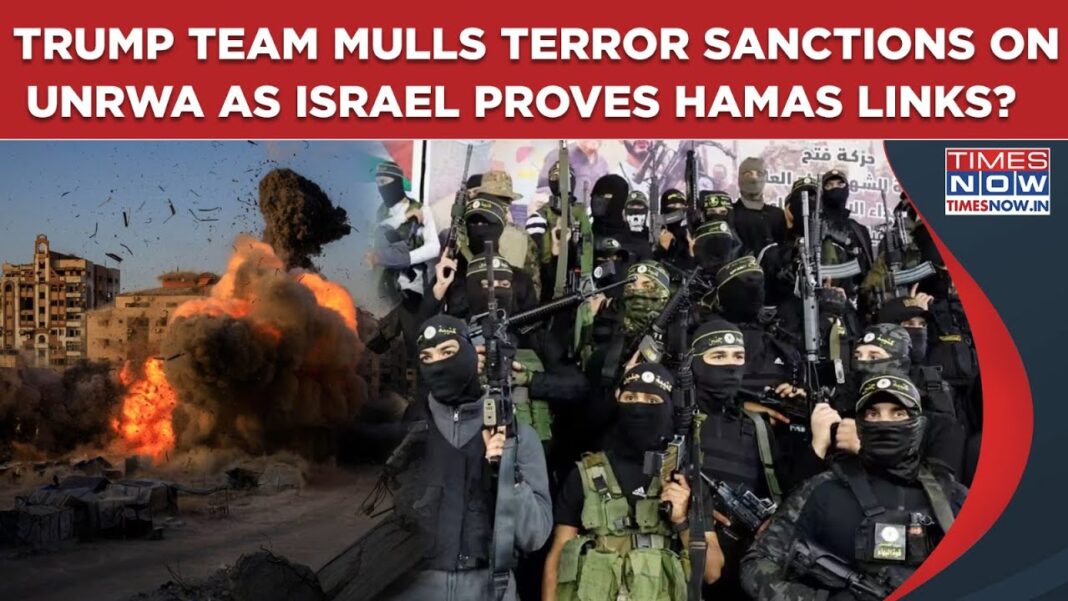
The Trump administration is engaged in advanced and highly sensitive deliberations over the possibility of imposing terrorism-related sanctions on the United Nations Relief and Works Agency (UNRWA), the principal UN body responsible for Palestinian refugees. As i24News reported on Wednesday, the move—still under internal review—reflects the administration’s growing unease with UNRWA’s alleged institutional entanglements with Hamas, allegations the UN agency vehemently denies.
Reuters first disclosed that U.S. officials have debated a spectrum of punitive steps, including the far-reaching option of designating UNRWA a foreign terrorist organization—a label normally reserved for armed terrorist groups. While it remains unclear how seriously that option is being weighed, the i24News report emphasized that merely raising the possibility has triggered alarm across diplomatic and humanitarian circles, given the enormity of its legal and operational implications.
The proposal arises at a moment when the humanitarian landscape in Gaza has rarely been more fragile. UN officials have described UNRWA as nothing less than “the backbone of the humanitarian response in Gaza,” responsible for food distribution, medical care, schools, and the basic survival of millions of Palestinians. A terrorism designation would instantly disrupt its financial lifelines, shutter operations overnight, and threaten the viability of Gaza’s largest civilian service network.
Yet within the Trump administration, advocates for the hard-line approach argue that the agency is structurally compromised and cannot be reformed through incremental oversight alone. According to the Reuters report, officials have presented evidence—supplied partly by Israeli intelligence—suggesting that UNRWA has become integrated into Hamas’s civilian and political infrastructure inside Gaza. Israel has long contended that Hamas uses UNRWA facilities as shields or staging grounds, and the allegations took on renewed urgency after Israel claimed in January 2024 that approximately ten UNRWA employees participated in, facilitated, or aided the October 7 attacks.
As i24News reported at the time, the United States—formerly UNRWA’s single largest donor—suspended all financial contributions to the agency in January 2024 pending a full investigative review. That freeze, now entering its second year, has already strained humanitarian operations in Gaza and forced UNRWA into emergency budgeting.
However, the current deliberations represent a much sharper escalation. Ending funding is one matter; designating an entire UN agency as a terrorist entity is another. Such a step, analysts told i24News, would be unprecedented in the history of U.S. relations with the United Nations. It would also place American allies—many of whom continue to channel hundreds of millions of dollars into UNRWA—in a direct political collision with Washington.
The State Department, according to the information provided in the Reuters report, has expressed deep concern over the legality of such a move. Several career officials have warned internally that designating UNRWA as a terrorist organization could violate U.S. treaty obligations, undermine counterterrorism frameworks, and create severe diplomatic blowback in the Security Council. As the i24News report noted, legal advisors have emphasized the difficulty of applying terrorism statutes to an international institution composed of thousands of civilian employees, the majority of whom are local hires.
Yet proponents of sanctions counter that the scale of alleged Hamas infiltration is too grave to ignore.
The issue reached a diplomatic crescendo during a recent UN Security Council meeting, where Israeli Ambassador Danny Danon confronted the Council with newly publicized evidence. As highlighted in the i24News report, Danon displayed photographs of Yonatan Samrano, an Israeli kidnapped on October 7, allegedly by a UNRWA employee. The ambassador asserted that Samrano’s abduction was “irrefutable proof” that UNRWA personnel have been directly complicit in Hamas’s terrorist operations.
“Reforming UNRWA is no longer possible,” Danon told the chamber, reiterating remarks he delivered to i24News afterward. “This is an organization whose infrastructure, personnel, and ideological environment have become indistinguishable from Hamas.”
UNRWA officials rejected Danon’s claim, insisting that the agency has no operational ties to Hamas and that any individual misconduct must be investigated case by case. In comments carried by i24News, UNRWA leadership stressed that they maintain strict neutrality protocols, and that Israel’s accusations rely heavily on intelligence summaries that have not been independently verified.
Still, privately, several UN diplomats acknowledged to i24News that the October 7 allegations have placed the agency in the most serious crisis of legitimacy in its 75-year history.
Inside Washington, debate centers on a fundamental tension: how to balance the necessity of countering Hamas with the reality that UNRWA’s collapse would devastate Gaza’s civilian population.
State Department officials, according to the Reuters report, warned that a terrorism designation would not merely isolate UNRWA—it could criminalize financial transactions with the agency, expose international donors to sanctions, and unravel the broader humanitarian architecture across the region. The i24News report noted that this includes clinics, sanitation programs, and refugee schools across Lebanon, Jordan, and the Judea and Samaria region, all of which rely on the agency’s continuity.
Humanitarian organizations echoed these concerns. A senior relief coordinator told i24News that such a designation would “pull the plug on the last functioning lifeline for two million civilians,” adding that replacing UNRWA with alternative structures “would take years, not months.”
Yet supporters of the stronger measures insist that the humanitarian argument cannot obscure security realities. “You cannot allow Hamas to hide behind a humanitarian agency,” one U.S. official told Reuters, which noted that the Trump administration views UNRWA as inherently flawed because it defines refugee status in perpetuity, incentivizing political exploitation.
The internal discussions are ongoing, and U.S. officials stressed to Reuters that the administration has made no final decision. Still, the fact that top policymakers are contemplating such a sweeping move is a signal of the administration’s intent to reorient American policy toward Gaza’s humanitarian institutions.
As the i24News report emphasized, the implications extend far beyond UNRWA itself. The debate touches on the future of U.S.-UN relations, the architecture of humanitarian governance, and the administration’s broader strategy for Gaza’s post-war reconstruction. If Washington ultimately sanctions UNRWA, it would fundamentally redefine American engagement with international refugee agencies.
For now, both supporters and opponents of the measure are bracing for a protracted internal battle. Diplomats told i24News that the coming months will determine whether Washington opts to reform UNRWA, replace it, or dismantle it outright through financial pressure.
What remains clear is that the agency now sits at the crossroads of geopolitics, counterterrorism, and humanitarian necessity. And the final decision—whatever it may be—will reverberate from Washington to Gaza to the chambers of the United Nations